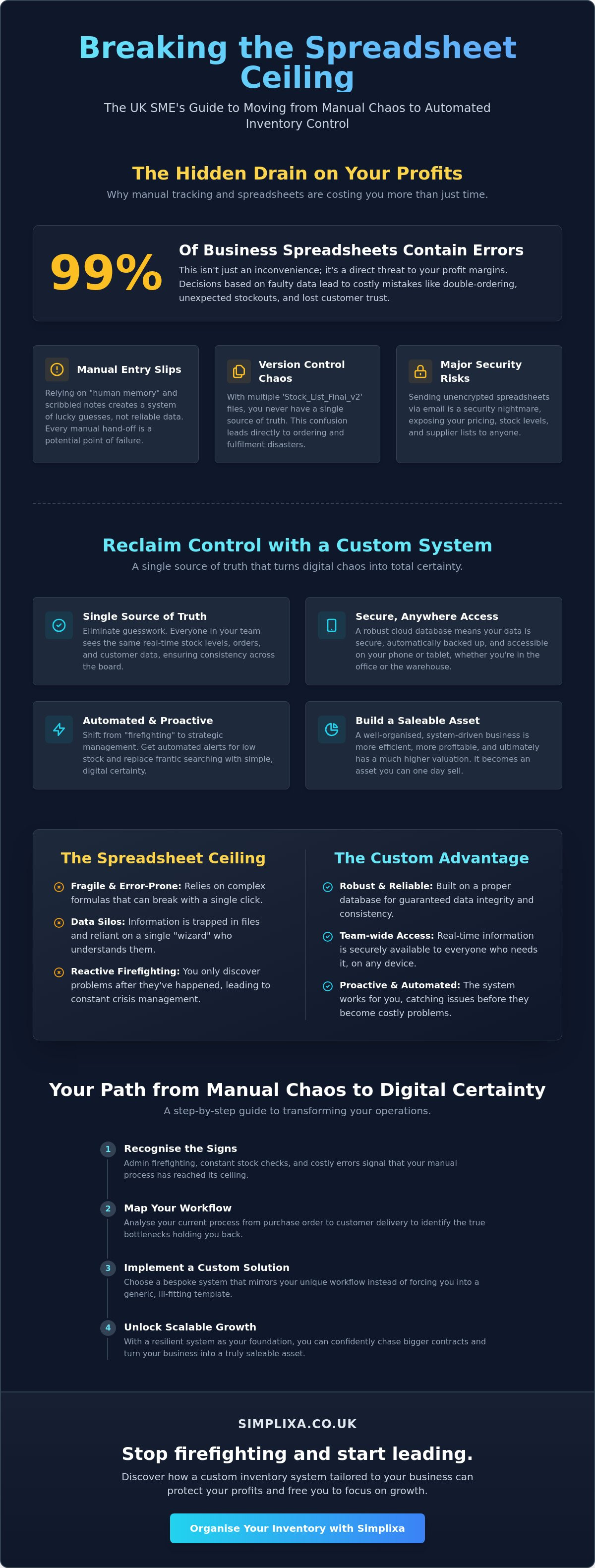

What if your most reliable "employee" was actually the one leaking your profits every single day? For many UK operators, that employee is the humble spreadsheet. It’s a familiar bit of kit, but research shows that roughly 99% of business spreadsheets contain errors. When you’re constantly battling manual data entry slips or second-guessing what’s actually left in the warehouse, you aren't just losing time; you're losing money. Understanding the benefits of a custom inventory management system is the first step toward reclaiming your week from endless admin firefighting.
We get it. You're likely fed up with the faff of "making do" with systems that don't quite fit. You need a single source of truth that tells you exactly where you stand at any given moment. This article explores how bespoke tools replace digital chaos with total certainty, using automated alerts to keep you ahead of the game. We’ll look at how a system tailored to your specific workflow can protect your profit margins and give you the headspace to actually lead your business again.
Key Takeaways
- Stop relying on "human memory" and learn why manual tracking is the hidden drain on your daily profit margins.
- Discover the real-world benefits of a custom inventory management system that mirrors your unique workflow instead of forcing you into a generic template.
- Break through the "spreadsheet ceiling" by replacing clunky Excel files with a single source of truth that helps you organise stock with total certainty.
- Follow a practical guide to identifying admin bottlenecks and mapping a more efficient journey from purchase order to customer delivery.
- See how shifting from "firefighting" to automated systems increases your company’s valuation and turns your business into a truly saleable asset.
The Inventory Headache: Why Manual Tracking Kills SME Growth
Every growing UK business eventually hits a invisible wall. It usually starts with a scribble on a Post-it note or a shouted update across the warehouse floor. This is the "chaos point." It’s that moment when your stock levels only exist in one person's head, and suddenly, you aren't running a business; you're managing a series of lucky guesses. Relying on human memory is a heavy physical and mental burden that slows every operation to a crawl. It’s exhausting. It’s also incredibly risky.
Scaling up becomes a pipe dream when your data is trapped. If you can't step away for a weekend without the warehouse grinding to a halt, you're stuck in the "Founder Trap." You’ve become the bottleneck. A professional inventory management software setup is designed to take that mental weight off your shoulders. Without it, the psychological toll of "not quite knowing" if you can actually fulfil a new order starts to eat away at your confidence. You stop chasing big contracts because you’re secretly terrified you can’t deliver them.
Recognising the Signs of Operational Burnout
You’ll know you’ve reached the limit when "admin firefighting" takes up more of your Tuesday than actual sales calls. Growth should feel like a win, not a punishment. If you're spending hours every week cross-referencing paper lists just to find one missing pallet, your manual process has reached its ceiling. This is exactly where the benefits of a custom inventory management system start to shine. It turns that frantic, paper-shuffling search into a simple, digital certainty. It moves you from a state of constant panic to a state of complete organisation.
The Real Cost of Inventory Errors
Mistakes in the storeroom aren't just annoying; they are a direct drain on your bank balance. Think about the last time you double-ordered expensive stock because the spreadsheet wasn't updated. Or the hundreds of pounds lost when a loyal customer cancelled because you didn't actually have the item you promised on the phone. These "stockouts" happen because of manual hand-offs between staff. Information gets lost in translation. Sticking with "the way we've always done it" is often the most expensive choice a small business can make. It’s time to stop paying for errors that a smart system could catch in seconds.
The Spreadsheet Ceiling: Risks of Running a National Business on Excel
Excel is a brilliant bit of kit for a quick sum. But it was never meant to be the engine room of a national operation. When you treat a spreadsheet like a database, you’re asking for trouble. It’s a calculator, not a robust storage system. The Benefits of strong inventory management go far beyond just adding up rows; they involve data integrity that Excel simply can't guarantee.
The biggest headache? Version control. One staff member saves "Stock_List_Final", another opens "Stock_List_V2", and suddenly you have three different versions of the truth. It’s a recipe for disaster. Then there's the issue of spreadsheets becoming too complex. One stray click can break a formula that’s been there for years, wiping out your data without you even noticing. Plus, sending unencrypted files via email is a security nightmare. If that file lands in the wrong hands, your entire pricing structure and supplier list are out in the open.
When Spreadsheets Become a Liability
Every complex spreadsheet has a "wizard". That’s the one person who actually understands how the master sheet works. If they’re off sick or leave the company, you’re in a right mess. This single point of failure is a massive risk for any UK SME. Hidden errors in cells often lead to thousands of pounds in lost profit because you’re making decisions based on dodgy numbers. Spreadsheets just can't give you the real-time view you need to stay competitive in a fast-moving market. One of the main benefits of a custom inventory management system is that it removes this fragility. It replaces a clunky file with a resilient tool that actually works for you, even when the "wizard" isn't in the building.
The Move to a Secure Cloud Database
A spreadsheet is what we call a "flat file". A proper system uses a relational database. This means all your data, your customers, your stock, and your orders, is intelligently connected. It’s secure, automatically backed up, and accessible from your phone or tablet whilst you're actually in the warehouse. No more guessing. No more "admin firefighting". You finally get a "Single Source of Truth" that the whole team can trust. If you're tired of the Excel faff, it might be time to look at a custom inventory management system that scales with you. It’s about moving from a state of being overwhelmed to a state of complete organisation.
Defining the Benefits of a Custom Inventory Management System
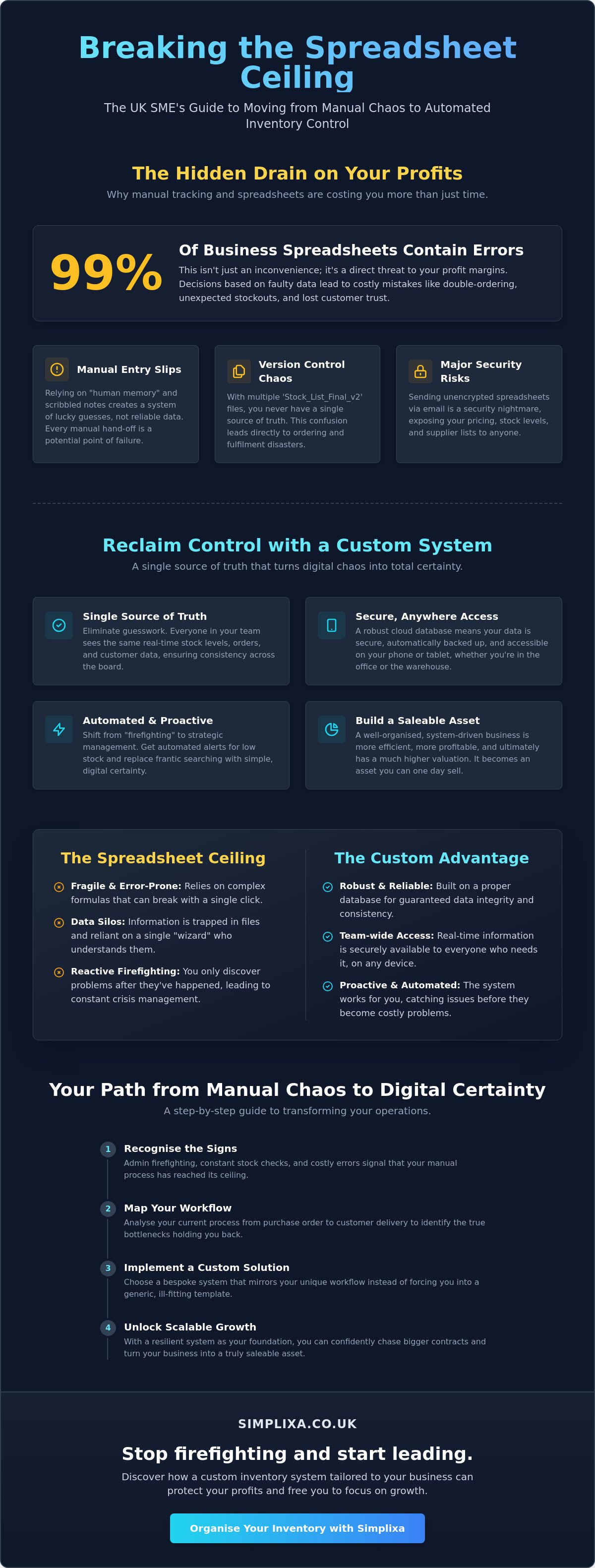
You’ve felt the frustration of the "spreadsheet ceiling." Now, let’s look at the relief on the other side. Most software developers try to tell you how to run your warehouse. They build generic tools with a thousand buttons you’ll never press. One of the main benefits of a custom inventory management system is that it actually matches your favourite way of working. It doesn't force you to change your successful habits just to satisfy a piece of code. It’s your process, just faster and more reliable.
Real-time visibility is the game changer here. It’s the difference between saying "I think we have some in the back" and knowing exactly what you have, where it’s tucked away, and who moved it last. No more "admin firefighting." Plus, you can set up automated triggers that do the heavy lifting for you:
- Low-stock alerts: Get a notification on your phone before you actually run out.
- Automated ordering: Draft supplier emails the moment stock hits a pre-set level.
- Location tracking: Know which van or shelf an item is on without leaving your desk.
It’s about providing software that makes my employees lives easier, reducing the mental load on your team so they can focus on the job at hand. When the system handles the boring bits, your staff can get back to what they do best.
Bespoke vs Off-the-Shelf: Why Fit Matters
Off-the-shelf SaaS software often feels like a square peg in a round hole. You pay for "feature bloat" you don't need and end up with a system so complex your staff just ignore it. Building a custom tool means you only have the features you actually use. No bloat. No confusion. Just utility. Better yet, custom tools grow with you. You won't get hit with those sneaky extra per-user license fees every time you hire a new apprentice or warehouse assistant. It’s a fair, no-nonsense way to do business.
Data-Driven Decision Making
Stop relying on "gut feeling" to manage your stock. By using a field service KPI dashboard uk, you can see stock trends instantly. You’ll quickly spot "dead stock" that’s been gathering dust for six months, tying up your cash flow. When you can see your real history, forecasting demand becomes a breeze. You’ll know exactly when to stock up for the busy season without over-ordering and cluttering up the storeroom. It’s about moving from guesswork to digital certainty.
Step-by-Step: Moving from Manual Chaos to Digital Certainty
Moving from a paper-based mess to a slick digital tool sounds like a massive job. It isn't. You don't need a three-year plan or a room full of consultants to get this right. You just need to solve one real-world problem at a time. The benefits of a custom inventory management system are best realised when you start small and focus on the bits that actually hurt your daily operations. It’s about replacing that nagging feeling of uncertainty with a process that actually works for your specific team.
First, audit your "admin bottlenecks." These are the moments when a staff member has to stop what they're doing to ask, "Where's that part?" or "Did we order more of these?" Map the journey of an item from the moment you raise a purchase order to the second it lands on the customer's doorstep. You’ll quickly find repetitive tasks that are perfect for automated business processes. Instead of building a massive, complex programme on day one, start with a Minimum Viable Product (MVP). Solve your biggest inventory headache first, like basic stock levels, then add the bells and whistles as you grow.
Mapping Your Inventory Workflow
Document how stock actually moves through your warehouse right now. Don't worry about how it is supposed to work; look at how it does work. Identify every spot where a "paper trail" exists. These are your weak points. By replacing a physical clipboard with a digital scan or a quick click, you stop information from vanishing into thin air. This is where you find the gaps where project profitability is currently leaking out of your business. A digital map ensures nothing gets left behind or forgotten in a dusty corner of the storeroom.
Ensuring Team Adoption
A system is only as good as the people using it. If it’s too complicated, your team will just go back to their old, messy habits. We focus on designing interfaces that even the least "tech-savvy" staff member can use without needing a thick manual. When they see it saves them twenty minutes of paperwork every afternoon, they’ll jump at it. You can even track project profitability to prove to everyone that the new way is better for the bottom line. Keep a tight feedback loop in the early days. If something feels clunky, fix it. That's the beauty of bespoke tools.
Ready to stop the firefighting and start organising? Let's talk about building your Inventory Management System today.
Building a Saleable Asset: Systems as Your Greatest Strength
If your business stops working the moment you head off for a week's holiday, you don't really own a company. You own a job. That is a tough pill to swallow for many independent operators, but it is the reality of being the "human database." One of the most significant long-term benefits of a custom inventory management system is that it transforms your daily hustle into a saleable asset. It moves the value of the business away from your personal memory and into a structured, digital environment that someone else can eventually buy and run.
Professionalised systems aren't just about saving time today; they are about increasing your company valuation for tomorrow. A potential buyer looks for certainty. They want to see that your warehouse runs like clockwork without you there to supervise every delivery. By systemising, you create a business that can grow without you. It’s the ultimate relief. You finally get the freedom to step back, knowing that the logic of your operation is safely handled by your software.
Institutional Memory in the Cloud
Buyers pay a premium for "turnkey" operations. They are looking for businesses that don't fall apart when the founder leaves the room. Storing your unique business "know-how" in a custom tool ensures that your institutional memory is protected. Whether you are preparing for an eventual sale or just want to hand over the reins to a manager, systemisation is the only way forward. It’s about building a legacy that survives your presence, turning years of hard work into a tangible, transferable strength.
Your Roadmap to Digital Relief
Waiting for the "perfect time" to start is a common mistake. In reality, every day you spend wrestling with a broken spreadsheet is a day of lost growth. At SIMPLIXA, we are committed to making this transition as painless as possible. We offer fixed-price, bespoke tools with absolutely zero "tech jargon" or hidden costs. We focus on utility over aesthetics and results over complexity. Learning how to scale business operations without more staff is much simpler when you have a system that does the heavy lifting for you. Reclaim your weekends and start building your custom system today. It’s time to move from being overwhelmed to being in complete control.
Reclaim Your Time and Protect Your Profit
You've seen how staying stuck in "Excel Hell" creates a glass ceiling for your growth. It’s a heavy physical and mental burden that drains your energy and puts your data at risk of corruption. By choosing a tool built specifically for your workflow, you aren't just buying software; you're investing in digital certainty. One of the greatest benefits of a custom inventory management system is the total relief of knowing your stock levels are spot on, without the constant faff of admin firefighting.
We've explored how bespoke tools replace unreliable human memory, turn your business into a saleable asset, and help you scale without the need for a room full of extra staff. It’s about utility over aesthetics and results over complexity. With fixed-price certainty and tools designed specifically for UK independent operators, you can finally move from being overwhelmed to being in complete control of your warehouse.
Ready to ditch the spreadsheet? See how Simplixa builds inventory systems that run themselves.
Don't let another week vanish into a sea of manual data entry and lost paperwork. You've built a great business; now give it the engine it deserves to reach the next level. Let's get started today.
Frequently Asked Questions
What is the main benefit of a custom inventory management system?
The primary benefit of a custom inventory management system is that it fits your business like a glove. Most off-the-shelf software forces you to change your successful habits to suit the tool. A bespoke system does the opposite; it automates the specific steps you already take, which removes the friction of learning a complex new process and ensures your team actually uses it.
Is bespoke inventory software more expensive than off-the-shelf SaaS?
Bespoke software requires an initial investment, but it eliminates the "per-user" monthly fees that make SaaS expensive as you grow. You aren't paying for hundreds of bloated features you'll never use. It’s a one-off cost for a tool you own entirely, which often works out as a much fairer deal for your bottom line over several years.
How do I know if my business has outgrown its current spreadsheets?
You've outgrown spreadsheets when manual data entry errors start costing you real money or customer trust. If only one person understands how the "master sheet" works, or if you're constantly second-guessing your stock levels, you've hit the spreadsheet ceiling. It’s a sign that your current process is a burden rather than a help.
Can a custom system integrate with my existing accounting software?
Yes, integration with UK accounting tools like Xero or Sage is a standard part of a custom build. Connecting your inventory directly to your accounts stops you from having to enter the same data twice. It keeps your books accurate and saves your team hours of "admin firefighting" every single week.
Will my staff find it difficult to switch to a new digital system?
Staff usually find custom systems much easier to use than generic ones because the interface only shows what they need. We strip away the confusing buttons and technical jargon. When a tool actually makes their day shorter and less stressful, they tend to embrace it quickly. It’s about making their lives easier, not harder.
How long does it take to build and deploy a custom inventory app?
A core version of your system can often be up and running in a few weeks. We don't believe in long, drawn-out development cycles that disrupt your business. By focusing on your biggest admin bottleneck first, we can deliver relief quickly and then add more features as your business scales.
Do I need to be tech-savvy to manage a bespoke inventory system?
You don't need any technical skills to manage a system we've built for you. We handle all the complex "under the hood" bits. Your job is simply to use the tool to see your stock, manage orders, and protect your margins. It’s designed to be as simple as using a basic smartphone app.
How does an inventory system help with business exit planning?
It increases your company valuation by proving the business can run without your constant presence. Buyers look for "institutional memory" that is stored in software rather than just in the founder's head. A systemised business is a saleable asset that offers a new owner immediate, digital certainty from day one.