
You’re staring at a file named "MASTER_FINANCES_FINAL_v4_DO_NOT_DELETE_JUNE_2026.xlsx" and your heart sinks because the bottom line doesn't match the bank. It’s a familiar dread. If you feel a surge of panic every time you open a workbook, it’s a clear sign of your spreadsheet becoming too complex for its own good. You didn't start your business to become a full-time data entry clerk or a part-time detective hunting for broken formulas.
We get it. You need things organised, but right now, your tools are working against you. You’re losing hours to manual updates and praying the software doesn't crash before you hit save. It’s exhausting. The good news? There is a way out that doesn't involve a degree in computer programming or a massive corporate budget.
This guide will help you identify the breaking point where a sheet turns from an asset into a liability. You’ll learn how to escape the cycle of version control nightmares and discover a cost-effective path to a system that just works. It’s time to stop tinkering and start growing again.
Key Takeaways
- Spot the warning signs of your spreadsheet becoming too complex before a broken formula or a "File is locked" error halts your operations.
- Uncover the hidden costs of manual data entry and see how "version control" nightmares are stealing hours from your working week.
- Learn how to audit your current data mess and map out a practical workflow that moves information seamlessly from enquiry to invoice.
- Discover why a bespoke, fixed-price business app is now a realistic and affordable alternative to the constant tinkering of "Excel Hell".
Recognising the Signs: Is Your Spreadsheet Becoming Too Complex?
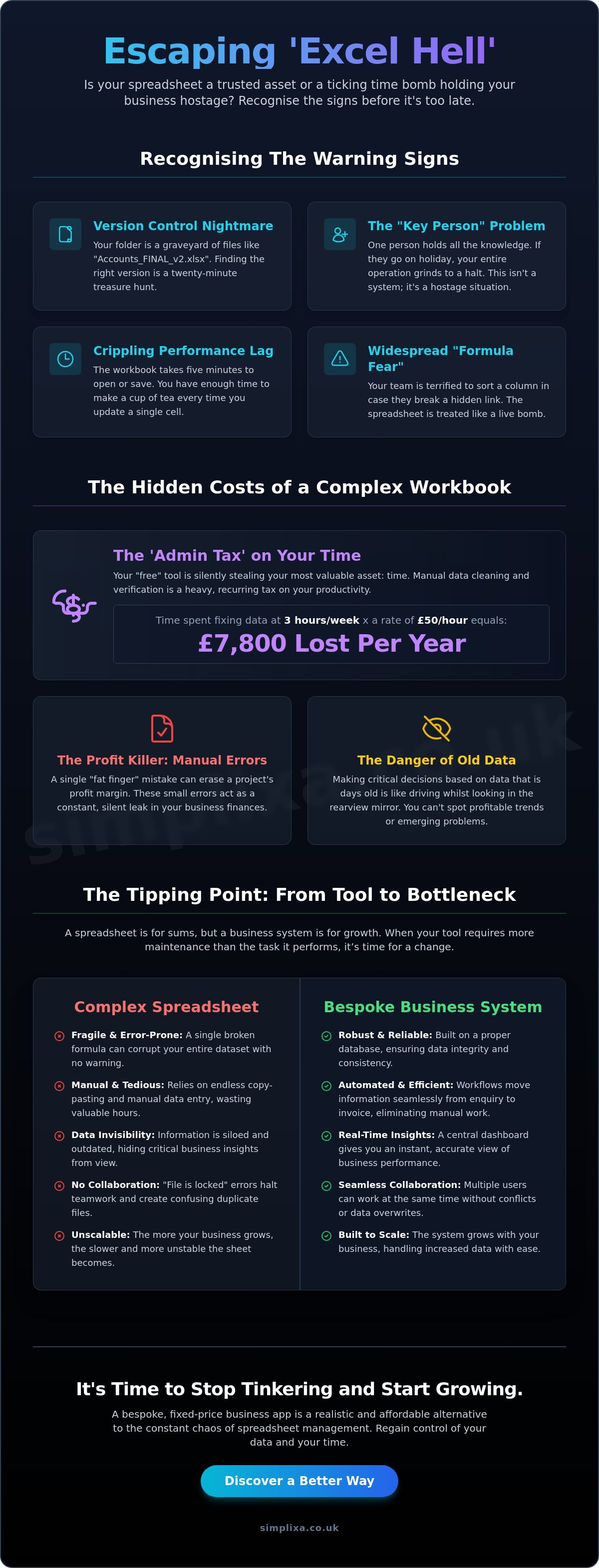
You’ve seen it. That folder full of files like "Accounts_FINAL" and "Accounts_FINAL_v2_USE_THIS_ONE". It's a mess. When you spend twenty minutes just trying to figure out which workbook is the most recent, you're looking at a spreadsheet becoming too complex. It isn't just a bit of clutter. It's a genuine business risk. One wrong copy-paste and your entire month of data is gone.
Given the nature of spreadsheets, they were originally designed for simple calculations and static tables. They weren't meant to hold the entire weight of a growing business. When you try to force them to do too much, they start to buckle. The signs are usually obvious if you know where to look.
Then there’s the "Dave" problem. We all know a Dave. He’s the only person who knows how the "Magic Macro" works or why cell B42 is linked to a file from 2022. If Dave goes on holiday or leaves the company, your business stops. That isn't a system. It’s a hostage situation. Relying on one person's memory to keep your data alive is a recipe for disaster.
Does your screen freeze whilst you’re trying to save a simple update? If your workbook takes five minutes to open, it's screaming for help. Performance lag is more than just an annoyance. It’s a sign that the underlying structure is failing. You shouldn't have time to make a cup of tea every time you hit "Save".
Staff are often terrified of sorting a column or applying a filter because they might break a hidden link. This fear is a major symptom of a spreadsheet becoming too complex to manage safely. When your team treats a file like a live bomb, you've lost control of your operations. Work should be about getting things done, not tip-toeing around fragile formulas.
The Mental Burden of "Excel Hell"
A messy spreadsheet creates a constant background hum of anxiety. You find yourself double-checking every total because you no longer trust the output. That lack of trust is exhausting. "Making do" with a broken system is actually a choice to stay small. It keeps you stuck in the weeds, frantically checking cells, instead of looking at the big picture. It’s hard to be a leader when you're acting as a full-time debugger.
When a Tool Becomes a Bottleneck
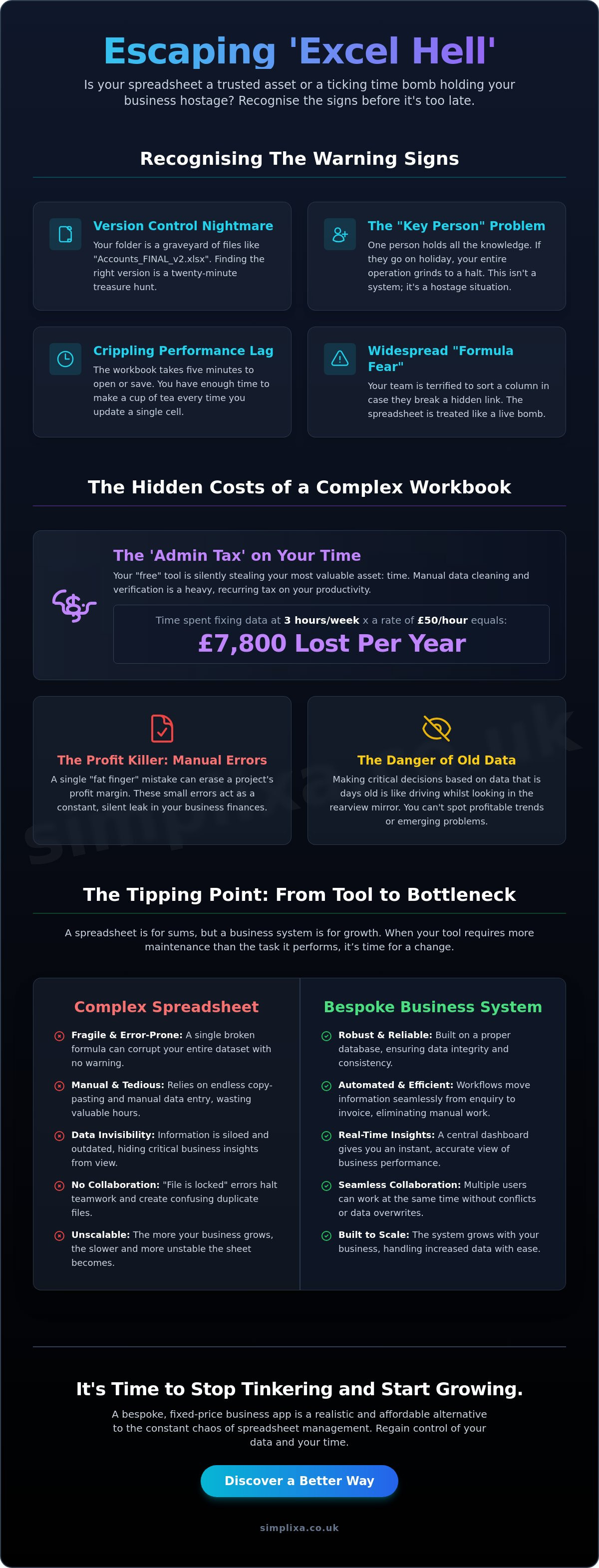
There's always a tipping point. One day the sheet helps you; the next it hinders you. A calculator is for sums, but a business operating system is for growth. You need to know the difference. Spreadsheet complexity is the exact point where the tool requires more maintenance than the task it performs. You shouldn't be working for your software. It should be working for you. Once you hit that wall, it’s time to find a better way forward.
The Hidden Costs of Managing a Business on Complex Workbooks
Excel is free. Your time isn't. Most independent operators stick with workbooks because they don't see a monthly subscription fee. But the reality is that a spreadsheet becoming too complex is a silent thief. It steals your weekends. It robs your staff of their focus. Worst of all, it hides the truth about your bank balance. When you spend three hours "cleaning" data just to see if you made a profit last month, you're paying an "admin tax".
If you value your time at £50 an hour, that single task just cost you £150. Do that every week, and your "free" tool is costing you thousands every year. It’s a heavy price to pay for a system that still feels broken. Beyond the money, there is the human cost. Talented employees don't stay at companies where their primary job is "copy-pasting" between tabs. They want to do high-value work, not act as a human bridge for a failing workbook.
Manual Data Entry: The Profit Killer
We’ve all done it. A "fat finger" mistake. You type 10.0 instead of 1.0 in a quote and suddenly your profit margin vanishes. These manual data entry errors act as a constant leak in your business. You try to fix it by "checking it twice," but that’s just more time wasted. Checking twice is a symptom of failure, not a solution. Research into the technical limitations of Excel shows that even in high-stakes environments, spreadsheets are prone to these structural failures. In a busy workshop or on a job site, you need a system that prevents errors before they happen.
Invisibility and Lack of Real-Time Insight
How do you know which client is your most profitable? If that answer takes you four hours of filtering and pivoting, you don't actually know. You're guessing. Making decisions based on data that is three days old is dangerous. Trends stay hidden. You might be losing money on a specific service right now, but you won't realise it until the end of the quarter. Complex workbooks act like a fog, obscuring the path ahead. Your team ends up doing drudgery instead of work that brings in revenue. If you're tired of the admin grind, it might be time to look at an automated quoting tool or a system that handles the heavy lifting for you. You hired talented people to help you grow, not to manage a spreadsheet that’s bursting at the seams.
Why Excel Hits a Wall (And Why a Database Wins)
"File is locked for editing by Admin." We've all seen that little box. It’s infuriating. You need to update a job status right now, but someone else has the workbook open. So you wait. Or worse, you save a "Copy 2" and promise to merge the data later. This is exactly how a spreadsheet becoming too complex starts to paralyse your team. Excel was never built for a team to work in at the same time. It’s a solo tool being forced into a group role.
Then there is the issue of data integrity. In a spreadsheet, a date can accidentally become a currency. A price can be deleted by a stray keystroke. There are no guardrails. A database is different. It ensures a date is always a date and a price is always a price. You can also control exactly who sees what. Your site team doesn't need to see your profit margins, and your junior staff shouldn't be able to delete your entire client list. This lack of control is one of The Hidden Costs of Managing a Business on Complex Workbooks that many owners overlook until something goes wrong.
The Problem with Shared Files
The habit of sending spreadsheets via email amongst staff is a recipe for disaster. Before you know it, there are five different versions of the "truth" floating around. "Shared workbooks" in Excel are notoriously flaky. They crash. They corrupt. They lose work. Moving to a system that lives in the cloud gives you a single source of truth. Everyone sees the same data, at the same time, without the risk of overwriting each other's hard work. It’s a massive relief for everyone involved.
Excel vs. Custom Apps: A Comparison
Think of a database as a smart filing cabinet that organises your information automatically, whilst Excel is just a giant sheet of paper where anything can be written anywhere. A database doesn't care if you have ten rows or ten thousand. It stays fast. It stays reliable. The user experience is the real game changer. Instead of squinting at a wall of tiny cells, your team uses a clean interface designed for their specific job. Whether it’s a mobile app for the field or a dashboard for the office, it feels natural. If you're feeling the strain, moving from Excel to a database is the most significant step you can take to future-proof your operations. You stop fighting the software and start using it.
Planning Your Escape: How to Move from Spreadsheet to System
Escaping a spreadsheet becoming too complex isn't about throwing everything away and starting from scratch on a Monday morning. It’s a planned exit. First, you need to audit the mess. Look at your columns. Which ones actually get used? Half of that data is probably "just in case" clutter that you haven't looked at since 2024. Strip it back to the essentials. You need the gold, not the grit. If it doesn't help you finish a job or get paid, it doesn't belong in your new system.
Next, map your workflow. Forget the software for a second. How does a job actually move through your business? From that first phone call to the final invoice, where does the info go? If your current process is clunky, digitising it will just give you a clunky app. Simplify the steps first. You want a streamlined path, not a digital version of your existing headache. When a spreadsheet becoming too complex starts to dictate how you work, it’s time to rewrite the rules from the ground up.
The Discovery Phase: Mapping Success
The most important work happens before anyone writes a single line of code. You need to identify the "day-one wins". What is the one thing that, if automated, would give you the most relief? Maybe it's generating a quote in two clicks instead of twenty. Focus on that. Avoid "feature creep" at all costs. You don't need a system that makes coffee; you need a system that makes your life easier. By keeping it simple, you ensure the new tool is actually used by your team instead of being ignored.
Organising Your Data for the Move
Don't import your old mistakes. Clean your data whilst it’s still in the spreadsheet. Fix the typos. Standardise the addresses. Ensure the formatting is consistent across every row. This is the perfect time for a proper spring clean. We always recommend a "Minimum Viable Product" or MVP approach. Start with the core features you need to survive, then grow the system as your team gets comfortable. You can keep your business running on the old sheet whilst the new one is built in the background. No downtime. No drama. Just a steady transition to a better way of working.
Finding a partner who understands your daily grind is vital. You need someone who speaks business, not just code. You want a problem solver who values utility over aesthetics. If you're ready to stop the spreadsheet struggle, let’s talk about a custom CRM software that fits your workflow perfectly.
Bespoke Business Apps: The Simple, Fixed-Price Alternative
Custom software used to be the playground of the "big boys". You’d need a massive IT department and a budget with too many zeros. Not anymore. In 2026, the technology has caught up with your needs. If you're tired of your spreadsheet becoming too complex, a bespoke app is the logical next step. It’s about taking the processes that already live in your head and turning them into a tool that actually works. We strip away the intimidation factor. You don't need a degree in data science to have an organised business.
At SIMPLIXA, we don't believe in open-ended hourly rates or technical jargon. We provide fixed-price certainty. You know exactly what you're paying before we start. This removes the fear of being overcharged for bloated features you'll never use. We move fast, too. You can go from spreadsheet chaos to app-based order in weeks, not months. Think about that for a second. Imagine reclaiming five hours of your week. What would you do with that time? You could focus on high-value sales, spend more time on site with the team, or actually get home for dinner on time. It's about getting your life back from the admin grind.
Simple. Practical. Built for You.
A custom staff tracking app or inventory system removes the mental load. The beauty of tools that do exactly what you need and absolutely nothing you don't. It’s about utility over aesthetics. For a growing SME, budget certainty is everything. That’s why our fixed fees are essential. You get the relief of a finished system without the stress of a ballooning bill. It’s a clean break from the constant tinkering of the past. No more worrying about broken formulas or lost data. Just a system that works as hard as you do.
The Path to a Scalable Business
A business built on a spreadsheet becoming too complex is hard to scale. It’s also incredibly hard to sell. If you ever decide to move on, a potential buyer wants to see professional systems, not a folder full of "FINAL_v3" workbooks. They want to see a machine that works. Moving from an independent operator to a true business owner means building a company that can run itself. A custom system is the foundation for that growth. It turns your daily drudgery into a valuable, transferable asset. You've fought with your data for long enough. It’s time for a solution that just works. Ready to kill your complex spreadsheet? Let’s talk.
Take Control of Your Operations Today
You’ve seen the risks. A spreadsheet becoming too complex isn't just a technical glitch. It’s a physical weight on your shoulders that slows down your growth and burns out your team. Between the "version control" nightmares and the constant fear of a broken formula, you’re likely spending more time managing your tools than serving your clients. You deserve a system that works as hard as you do.
We specialise in helping UK SMEs move from Excel chaos to streamlined order. With fixed-price certainty and fast delivery, you get a tool built for your specific workflow without any hidden hourly costs. We keep things simple and jargon-free because we know you have a business to run. It is about moving from a state of being overwhelmed to a state of complete organisation.
Stop fighting with cells and start focusing on your results. Get a fixed-price quote for your custom business tool and leave the admin grind behind you. It’s time to stop tinkering and start growing your business with a system that just works.
Frequently Asked Questions
How do I know if my Excel spreadsheet is too big or complex?
Your workbook is screaming for help if it freezes whilst saving or takes minutes to open. You’ll also notice a spreadsheet becoming too complex when only one person in the office knows how the formulas actually work. If your team is terrified of sorting a column or deleting a row in case they break a hidden link, you've reached the breaking point. It’s no longer a tool; it’s a liability.
Is custom software more expensive than using Excel?
Excel looks free, but the "admin tax" of manual data entry and constant error-checking costs you thousands in lost time every year. We offer fixed-price certainty for our systems, so there are no surprise bills or hidden hourly costs. You aren't paying for bloated features you'll never use. You're investing in a streamlined system that reclaims your time and lets you focus on your profit margins.
Will I lose my data when I move from Excel to a custom app?
No, your existing data is safely migrated into the new system. We take the time to clean up your old records to ensure you aren't importing typos or formatting errors from your old workbooks. It’s a digital spring clean. You keep all your historical information, but it’s finally organised in a way that makes it useful for making real-time business decisions.
How long does it take to build a bespoke business tool?
We work in weeks, not months. Most small business systems can be built and launched quickly because we focus on utility over unnecessary bells and whistles. You won't be stuck in endless meetings or waiting half a year for a result. We identify your biggest pain points and solve them fast so you can get back to running your business without the headache.
Do I need to be "tech-savvy" to use a custom-built app?
Not at all. The beauty of a bespoke tool is that it’s designed specifically for your job and your workflow. You won't have to navigate a wall of tiny cells or remember complex formulas. If you can use a basic smartphone app, you can use our systems. We handle the technical side so you can enjoy the relief of a system that just works.
Can my staff use the new system on their mobile phones in the field?
Yes, mobile access is a standard feature for our custom apps. Your team can update job statuses, log hours, or check inventory directly from the site. No more waiting until they get back to the office to type up notes from a crumpled piece of paper. It removes the delay between doing the work and seeing the data, which keeps your operations moving.
What happens if my business processes change in the future?
Your system is built to grow with you. Unlike a rigid off-the-shelf package, a custom database can be adjusted as your team expands or your services change. If your spreadsheet becoming too complex was the original problem, we ensure the new system stays lean and efficient. It remains a flexible asset that evolves alongside your business goals without becoming a burden.
Is a custom database more secure than a password-protected spreadsheet?
Absolutely. Spreadsheets are notoriously easy to break into or accidentally delete. A custom database uses role-based access, meaning you decide exactly who can see or edit sensitive information. Your data is stored securely in the cloud with regular backups. It’s a professional-grade setup that gives you peace of mind that your business secrets and client details are safe.