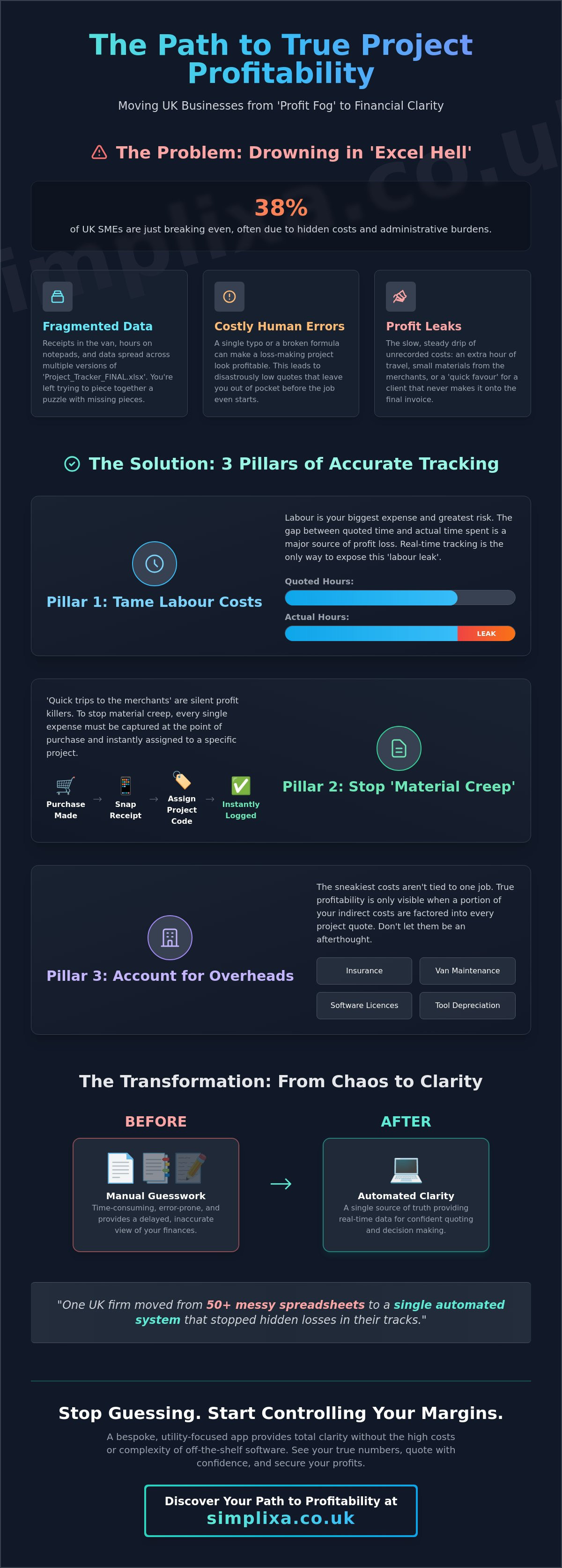

You finish a job, send the invoice, and feel a sense of relief. But then the doubt creeps in. After the fuel, the extra materials, and the hours spent on site, did you actually make a profit? For many UK business owners, learning how to track project profitability feels like a second full-time job. You aren't alone. Research shows 38% of UK SMEs are just about breaking even, often because hidden costs like a quick trip to the merchants or unlogged travel time quietly kill your margins.
We know the frustration of fighting with spreadsheets that never balance and staff who forget to log their hours. It's an administrative burden you don't need. This guide is a practical look at how to move from manual guesswork to a clear, real-time view of every penny spent. You'll discover how bespoke digital tools can replace memory-based tracking and provide the data you need to quote with confidence. It's time to stop guessing and start seeing your true numbers.
Key Takeaways
- Ditch the "profit fog" caused by fragmented spreadsheets and manual data entry errors that hide your true costs.
- Master how to track project profitability by recording labour and material expenses in real-time, right from the job site.
- Follow a simple two-step framework to map your current workflow and identify the critical data points you’ve been missing.
- Learn how a bespoke, utility-focused tracking app provides total clarity without the high costs or complexity of off-the-shelf software.
- See how one UK firm moved from 50+ messy spreadsheets to a single automated system that stopped hidden losses in their tracks.
The Spreadsheet Trap: Why Manual Tracking Fails UK Small Businesses
Most UK small businesses start the same way. You open a blank Excel sheet, type in your costs, and hope for the best. It feels like you're in control. But as the jobs pile up, that spreadsheet starts to feel less like a tool and more like a ball and chain. Manual data entry is a silent thief. It steals hours from your evening and introduces tiny, human errors that snowball into massive financial headaches. When you're trying to figure out how to track project profitability across ten different jobs, a single typo in a cell can make a loss-making project look like a winner.
This creates what we call a profit fog. Your data is fragmented. One person has the fuel receipts in the van. Another has the labour hours scribbled on a notepad. You're left staring at a screen, trying to piece together a puzzle where half the pieces are missing. By the time you actually sit down to update the master file, the data is already a week old. Making business decisions on old data is like trying to drive a van by looking in the rearview mirror. You can't see the hazards right in front of you until it's too late. Spreadsheets simply cannot scale. They might work for two jobs, but they'll buckle under the weight of twenty.
The Hidden Risks of 'Excel Hell'
We've all been there. You're looking for the latest figures and find five different files named "Project_Tracker_FINAL." You don't know which one is actually final. Version control issues lead to massive confusion and wasted time. Even worse are the broken formulas. A single accidental click can delete a sum, leading to disastrously low quotes that leave you out of pocket before the job even starts. Then there's the mental drain. Chasing staff for crumpled paper receipts or trying to remember if that £50 merchant trip was for Job A or Job B is exhausting. It's not just admin; it's a heavy mental burden that stops you from focusing on growth.
Identifying the 'Profit Leak'
A profit leak is the slow, steady drip of unrecorded costs that sink a project. It's the small materials, the extra hour of travel, or the "quick favour" for a client that never makes it onto the invoice. SMEs often miss the true cost of billable hours because they rely on memory rather than real-time data. To truly understand your margins, you might look at the Profitability Index (PI) to see the relationship between costs and benefits. But without accurate, live data, those formulas are useless. Moving to a centralised system isn't just about the numbers. It's about the psychological relief of knowing, with absolute certainty, that every penny is accounted for. No more guessing. No more fog. Just total clarity.
The 3 Pillars of Accurate Project Profitability Tracking
You can't fix what you can't see. To clear the "profit fog" we talked about earlier, you need a single source of truth for every job. This means one place where every hour and every penny is logged the moment it happens. It sounds simple. But for most UK small businesses, it's the hardest part of how to track project profitability. You need a system that doesn't rely on your memory at the end of a long week. One job. One view. Total control.
Labour: Your Biggest Asset and Greatest Risk
Labour is usually your biggest bill. It's also where the most money disappears. Tracking time isn't about being a "Big Brother" boss. It's about honesty and fairness. Effective tracking relies on efficient resource and financial management to ensure your team's time actually turns into profit. You need to know the difference between hours worked and hours billed. If your team spends 40 hours on a job but you only quoted for 30, that's a problem. Labour leak is the gap between estimated and actual time spent on-site. Without a custom staff tracking app, these leaks stay hidden until your bank balance tells you otherwise.
Expenses and Material Creep
Those "quick trips" to the merchants are profit killers. You buy a box of screws, a tin of paint, or a specific tool. You pay on the company card. The receipt goes in the glove box. It never makes it to the invoice. This is material creep. To stop it, you must capture expenses at the point of purchase. Every penny spent needs a project code. If it doesn't have a code, it doesn't exist. Linking purchase orders directly to specific project codes ensures that no out-of-pocket expense goes unrecorded.
You also have to look beyond the obvious. Direct costs are easy: materials and labour. Indirect costs are the sneakiest. Think about your insurance, your van maintenance, and even your software subscriptions. If you aren't factoring a slice of these into every quote, your "profit" is actually just paying for your overheads. Ensuring every supplier invoice is allocated to the correct client is the only way to see your true margin.
- Capture every receipt before you leave the car park.
- Link supplier invoices to specific client codes immediately.
- Differentiate between hours worked and hours that are actually billable.
- Review your "Single Source of Truth" daily to catch material creep early.
Case Study: From Chaos to Clarity in 6 Weeks
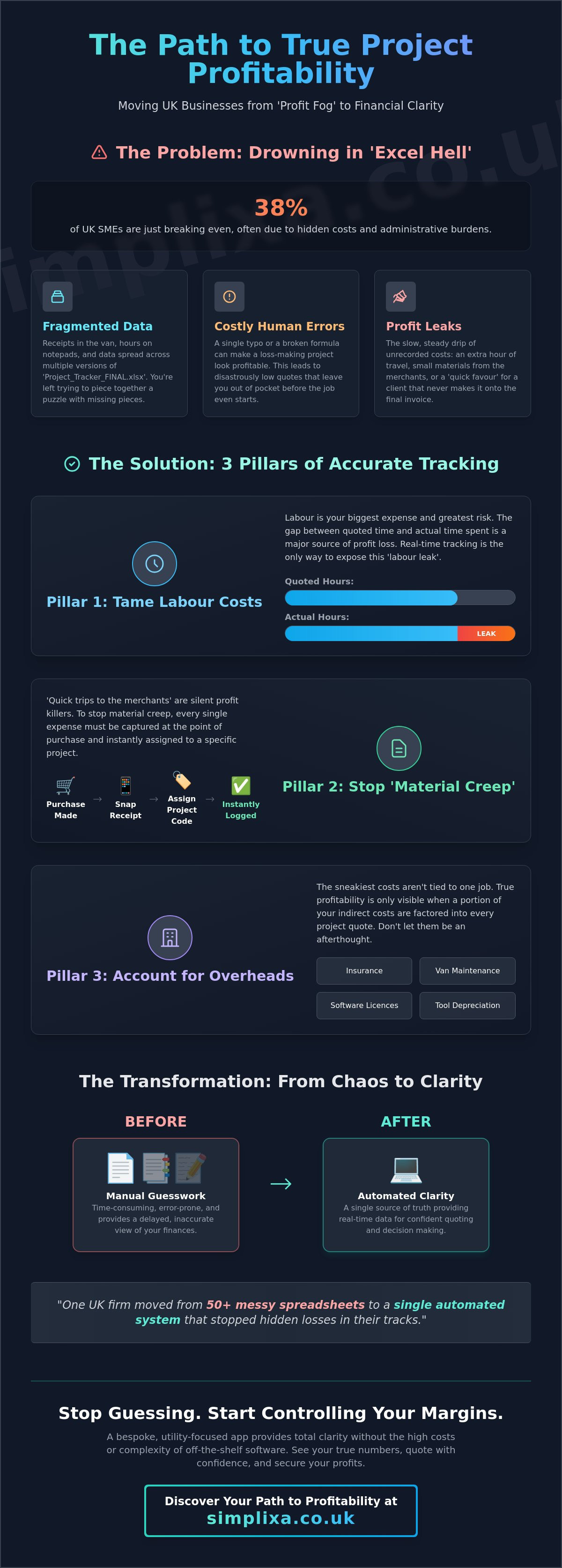
Let's look at a real-world example. A UK-based maintenance firm came to us earlier this year. They were successful but exhausted. They had over 50 spreadsheets on the go. One for labour. One for vans. One for every major client. It was a mess. They thought they knew how to track project profitability, but they were actually just managing a mountain of paperwork. They were drowning in admin whilst trying to keep the business afloat.
The breaking point came with a high-profile contract. On paper, it looked like a clear £15,000 profit. When the final bills were paid and the dust settled, they’d actually lost money. Why? Because three days of extra labour and £2,000 in "small" materials had never been logged. They were working for free. They didn't need more work. They needed to see the work they already had.
The 'Before' State: Living in the Dark
The business owner was losing 10 hours every week just trying to make sense of the files. Sunday nights were spent chasing staff for timesheets and merchant receipts. It was a physical and mental drain. Because the data was so fragmented, their quoting process was based on guesswork rather than history. They were either overquoting and losing work or underquoting and losing money. There was no middle ground. Just a general sense of being overwhelmed and completely disorganised.
The 'After' State: Data-Driven Decisions
We replaced the spreadsheets with a bespoke staff tracking and profitability app. We focused entirely on utility. No bloat. No complex features they didn't need. Just a simple way for engineers to log their time and materials in seconds. This software that makes employees' lives easier transformed the site culture. Staff stopped feeling nagged and started feeling supported because they finally had a tool that worked for them, not against them.
The owner now gets a simple report on his phone every Friday. He can see exactly where every penny is going in real-time. Within the first quarter, their gross margin increased by 15%. They didn't just work harder; they worked smarter. They used this new visibility to drive strategic decisions about which jobs to take on and which to walk away from. Learning how to track project profitability properly didn't just save their bank balance. It gave the owner his weekends back. That is the ultimate promise of relief.
How to Build a Profitability Framework That Actually Works
You've seen the damage that "Excel hell" can do. You know the theory. Now, you need a plan. Building a framework for how to track project profitability isn't about buying the most expensive software on the market. It's about creating a simple, repeatable process that your team will actually follow. If it's too hard, they won't do it. If they don't do it, your data is junk. It's that simple.
Start by mapping your "messy" reality. Where do receipts actually end up? Who is responsible for logging hours? Be honest about the gaps. Once you see the holes in your current net, you can start to plug them. Identify the critical data points you must track: labour, materials, and those "invisible" travel costs. Standardise how this data is entered. If one person logs "3 hours" and another logs "half a day," your reports will be useless. Consistency is your best friend.
Finally, review and refine. Don't just set the system and walk away. Look at the real-world project outcomes every month. If the data shows you're consistently losing money on a specific type of work, change how you quote it. Your framework should be a living tool that grows with your business.
Choosing Your Tracking Method
You have two main paths. You can go for an off-the-shelf SaaS product or a bespoke app. Big-name software often comes with a "per user" monthly fee that grows as you do. They are also packed with features you'll never use. User adoption is the number one reason these systems fail. If an app feels like a chore, your staff will ignore it. For field-based teams, a mobile-first tool is essential. It needs to be easier to use the app than it is to lose a receipt. If you want a tool that fits your specific workflow without the monthly bloat, a custom staff tracking app is often the most practical choice.
Setting Your KPIs (Key Performance Indicators)
Don't get bogged down in complex accounting. Focus on your Gross Profit Margin per project. This is your most vital metric. It tells you, in plain English, if a job was worth the effort. You should also perform a variance analysis on every job that goes over budget. Why did it happen? Was the quote too low, or did the labour leak away? Use this historical data to make your next quote more accurate. Every project is a lesson. If you aren't reviewing the outcomes, you're destined to repeat the same expensive mistakes. Refine your process based on what actually happens on-site, not what you hoped would happen.
Bespoke Apps: The 'Goldilocks' Solution for UK SMEs
The enterprise software market is a minefield. Most tools are built for massive corporations with huge departments. They're bloated. They're complex. They're just another mental burden for a busy operator. On the other hand, you have the broken spreadsheets we've already dismantled. Bespoke apps are the "Goldilocks" solution. They fit just right. At SIMPLIXA, we focus entirely on utility over aesthetics. We don't care about fancy animations or corporate buzzwords. We care about whether your team can log a merchant trip in three taps. By stripping away the fluff, we keep costs low and efficiency high.
One of the biggest worries for UK business owners is the "ticking clock" of hourly developer fees. We hate that model. It's opaque and unfair. That's why we work on a fixed-price basis. You know exactly what you're paying from day one. No hidden extras. No nasty surprises in your inbox. This transparency is how we build trust. It allows you to move from being a slave to a broken system to having a system that actually works for you. Your software should grow as you do. It shouldn't get more complicated; it should just get more useful as your team expands.
The SIMPLIXA Difference
We don't do bloat. If a feature doesn't help you master how to track project profitability, we don't build it. This lean approach means fast delivery. You won't be waiting months for a solution whilst your margins continue to leak. You'll start seeing a real return on your investment in weeks, not years. We're a supportive partner. We understand the specific pressures of the UK small business landscape. We know what it's like to juggle VAT thresholds and rising material costs. We're here to lighten that load and provide a confident, reassuring path to total organisation.
Next Steps to Profit Clarity
Don't let the "profit fog" settle back in. Take control today. Start with a spreadsheet audit this week. Look at your most used files and ask: "Is this helping or hindering my growth?" Identify your most expensive administrative headache. Is it chasing timesheets? Is it lost receipts? Is it the delay in knowing your final margin? Once you know the problem, you're halfway to the solution. It's time to stop the guesswork and start seeing the truth about your numbers. Ready to see where your money is going? Get a fixed-price quote for your custom tracking tool and start your journey to total profit clarity today. Relief is just a few taps away.
Take Back Control of Your Margins Today
You've seen how the "spreadsheet trap" quietly drains your time and your bank balance. It's a heavy physical and mental burden that no business owner should have to carry. By focusing on real-time labour tracking and instant expense capture, you move from guesswork to total clarity. You finally see the true cost of every job whilst it's still happening, not weeks after the invoice has been sent. This is the only way to clear the profit fog for good.
Learning how to track project profitability isn't just about the numbers; it's about giving yourself the freedom to grow without the chaos. You need a tool that your team will actually use, delivered quickly and without the hidden costs of traditional agencies. We specialise in fast, fixed-price development for UK SMEs that cuts through the bloat and gets straight to the utility your business needs. It's about making the system work for you, not the other way around.
Stop the profit leaks with a custom tracking app built for your business.
It's time to ditch the manual entry and start making data-driven decisions that protect your hard-earned margins. You've done the heavy lifting of building your business. Now, let's make sure you get to keep every penny of the profit you've earned. You've got this.
Frequently Asked Questions
What is the simplest way to track project profitability?
The simplest method is to capture every expense and labour hour the moment it happens. You need to move away from memory-based entry and use a tool that records data on-site. When you understand how to track project profitability through real-time updates, you stop the "profit fog" from setting in at the end of the month. It's about making data entry so easy that it becomes a habit rather than a chore.
Why is my business growing but my bank balance staying the same?
You're likely suffering from "profit leaks" where small, unrecorded costs eat your margins. Even if you're winning more work, unlogged travel time or merchant trips for small materials can turn a profitable job into a loss-maker. Growth often hides these inefficiencies until your cash flow feels the pinch. A centralised system ensures that every penny of your increased turnover actually reaches your bank account.
How much does it cost to move from Excel to a custom tracking app?
We provide a fixed-price quote for every project to ensure there are no hidden hourly fees or nasty surprises. Unlike off-the-shelf software that charges a monthly "per user" fee, a bespoke tool is a one-off investment built for your specific needs. This approach is designed to be accessible for UK small businesses that are tired of being overcharged for bloated features they never use.
Can I track project profitability in real-time?
Yes, real-time tracking is possible when you use mobile-first tools that your team can access in the field. By logging hours and materials as they are used, you can see a live pulse of your project's health. This allows you to catch budget overruns before they become disasters. Real-time visibility is the ultimate signal of relief for any busy operator who is tired of waiting for week-old reports.
What are the most common project costs that small businesses miss?
Travel time, fuel, and small consumables like fixings or adhesives are the most frequent offenders. Many SMEs also forget to log "quick favours" or extra site visits that weren't in the original quote. These small leaks might only be £20 or £30 at a time, but they add up to thousands of pounds in lost profit over a year. Recording these at the point of purchase is vital.
Do I need an accountant to set up a profitability tracking system?
You don't need a professional accountant to build the tracking system itself; you need a practical workflow. While accountants are great for end-of-year tax, a digital tracking system handles the daily administrative burden of data collection. It organises your numbers so that when you do speak to your accountant, the data is clean, accurate, and ready to go. It makes their job easier and your business more transparent.
How do I get my staff to actually use a tracking app?
The trick is to provide a tool that is easier to use than a paper timesheet or a messy group chat. If the app focuses on utility and requires only a few taps to log a job, your team will adopt it quickly. We build tools that respect your staff's time. When they see that the software makes their lives easier by reducing paperwork, the resistance to "new tech" disappears almost instantly.
Is bespoke software really affordable for a small business in 2026?
Bespoke software has become a highly practical option for UK SMEs in 2026 because it eliminates recurring license costs. You aren't paying for a "one size fits all" programme that includes hundreds of features you'll never touch. By focusing on how to track project profitability through a lean, custom-built interface, you get exactly what you need for a fair price. It's a long-term asset rather than a monthly drain on your overheads.