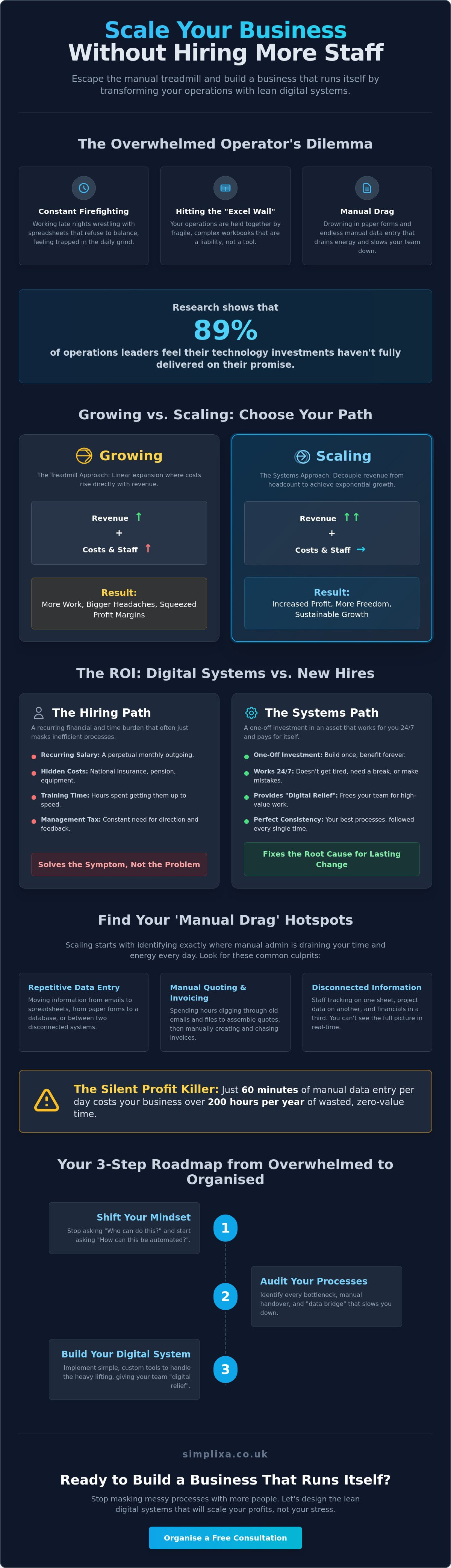

It's 9:00 PM on a Tuesday, and instead of relaxing, you're wrestling with a stubborn spreadsheet that refuses to balance. You want to grow, but the thought of managing more payroll and more personalities feels like a physical burden. You're likely wondering how to scale business operations without more staff when your current team is already at breaking point. It's a common trap. Most independent operators think growth requires more hands on deck, but more staff often just brings more noise and squeezed margins.
You're right to be wary of hitting the "Excel Wall." Drowning in paper forms and manual data entry isn't just exhausting; it's a direct threat to your sanity. Research from early 2026 shows that 89% of operations leaders feel their technology investments haven't fully delivered results. We'll show you how to beat those odds. You can increase your capacity and profit by replacing manual admin with lean digital systems that work whilst you sleep. This guide provides a clear roadmap to digitise your manual tasks, moving you from being overwhelmed to completely organised. We'll explore how custom tools like automated quoting and staff tracking can finally let your business run itself.
Key Takeaways
- Learn the vital difference between growing and scaling, and why adding more headcount often hurts your profit margins rather than helping.
- Discover how to scale business operations without more staff by identifying the "Excel Wall" and removing the manual bottlenecks that slow your team down.
- Compare the long-term value of a one-off custom digital system against the recurring financial burden of a new salary.
- Identify your "data bridges" to pinpoint exactly where manual admin is draining your time and energy every single day.
- Get a clear roadmap to move from being overwhelmed to completely organised with systems that handle the heavy lifting whilst you sleep.
Scaling vs Growing: Why More Staff Isn’t Always the Answer
Most business owners use the words "growing" and "scaling" as if they're the same thing. They aren't. Growth is linear. You add a new client, so you hire a new person. Your revenue goes up, but so does your stress and your outgoings. You're essentially running on a treadmill that just keeps getting faster. If your costs rise at the same rate as your income, you aren't building wealth; you're just building a bigger headache.
Scaling is different. It's about decoupling your income from your headcount. When you scale, you increase your revenue whilst keeping your costs and your team size relatively flat. This is the only way to actually enjoy the fruits of your labour. If you're looking for how to scale business operations without more staff, you've already realised that more people isn't the only answer. It requires an emotional shift. You have to stop being the "doer" who fixes every problem and start being the "system designer" who builds the tools to fix them for you.
The Profit Squeeze of Traditional Hiring
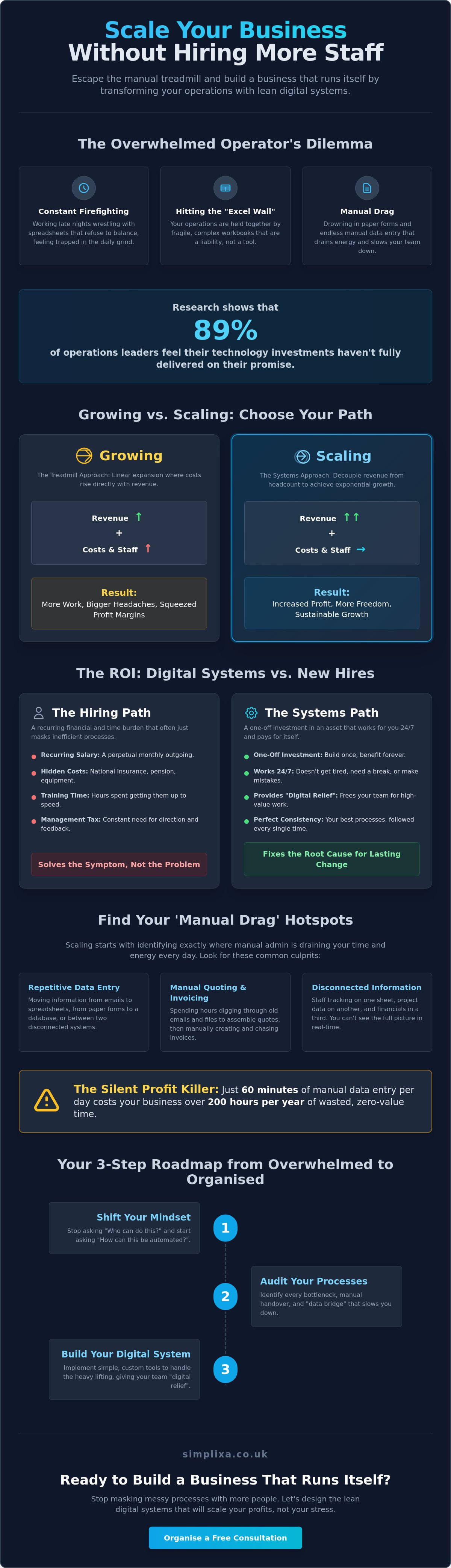
Hiring is often a knee-jerk reaction to feeling overwhelmed. But new staff are a heavy investment that goes far beyond the basic salary. You have to account for National Insurance, pension contributions, and the endless hours spent on training. Then there's the "management tax." Every new person needs direction, feedback, and a bit of hand-holding. Suddenly, you're spending your nights on admin instead of strategy because your team needs you to clear their path.
Often, hiring is just a way to mask a messy process. If your quoting takes three hours because you're digging through old emails, a new hire will just spend three hours doing the same inefficient task. You haven't solved the problem; you've just paid someone else to deal with the mental irritant. There's a tipping point where a business becomes too heavy to move quickly. Too many people and too many manual handovers create a drag that eventually squeezes your profit margins until they're paper-thin.
The Systems-First Mindset
To get out of this trap, you need to change the question. Stop asking "Who can do this?" and start asking "How does this get done?". Your favourite way of working should be built into a tool, not a person's memory. When a process is digitised, it doesn't get tired, it doesn't need a lunch break, and it doesn't forget the details. It's reliable. It's consistent. It's the foundation of a business that runs itself.
This shift is about finding software that makes employees’ lives easier. It provides "digital relief." Instead of your team drowning in manual data entry or hunting for paper forms, they can focus on the high-value work that actually moves the needle. Moving from a people-heavy model to a systems-first mindset is the only way to prevent founder burnout. It’s the difference between a business that owns you and a business that you own.
Identifying the Bottlenecks: The "Excel Wall" and Manual Drag
Every business starts with a spreadsheet. It’s the default tool for a reason; it’s free, familiar, and flexible. But as you expand, you eventually hit what we call the "Excel Wall." This is the moment your workbook becomes so complex and fragile that you’re terrified to change a single cell. It’s no longer a helpful tool; it’s a liability. When your operations rely on one person’s ability to navigate a labyrinth of tabs and broken formulas, you aren't just being inefficient. You're stuck.
Manual data entry is a persistent mental irritant. It’s the friction that slows down your whole team and drains their energy. If you’re searching for how to scale business operations without more staff, you must identify where your data is getting stuck. Paper forms and disconnected sheets create a "manual drag" that prevents you from seeing your business in real time. You can’t make fast, confident decisions when you’re waiting three days for someone to finish re-typing notes from a clipboard into a computer.
The Hidden Cost of Manual Data Entry
The hours lost to re-typing information are a silent profit killer. If an admin staff member spends just 60 minutes a day moving data from paper to a PC, that’s over 200 hours a year wasted on a task that adds zero value. Worse still, manual data entry errors can lead to missed invoices or incorrect stock levels, which directly impact your bottom line. This "admin lag" also hurts your reputation. Customers in 2026 expect instant updates, not a "we’ll get back to you once we’ve checked the files" response.
Why Spreadsheets Stop You Scaling
Spreadsheets are calculators, not scalable business operating systems. The biggest issue is fragmented data. When everyone has their own version of the "master" file saved on their desktop, the truth becomes impossible to find. There is no accountability or audit trail in a shared workbook. You can't see who changed a price or why a deadline was moved. To truly understand how to scale business operations without more staff, you need a single, digital source of truth that everyone can access simultaneously.
Moving away from these manual bottlenecks provides immediate relief. Converting your paper trail into a Digital Form Conversion system is often the first step toward a business that finally feels light enough to move quickly again. It’s about removing the physical burden of admin so your team can focus on growth.
The ROI of Systems: Why Digital Tools Outperform Headcount
When you hire a new person, you’re signing up for a monthly bill that never ends. Salary. Pension. National Insurance. Training time. It adds up fast. A digital system is different. It’s a one-off investment that pays for itself by doing the work of multiple people without the ongoing overhead. If you want to know how to scale business operations without more staff, you have to look at the cold, hard maths. A system doesn’t need a lunch break. It doesn’t call in sick on a Monday morning. It just works, 24 hours a day, whilst you are at home with your family.
It’s not just about the cash flow, either. Good people quit when they’re bogged down in boring, repetitive admin. They want to do the job they were hired for, not act as a human bridge between two spreadsheets. Providing software that makes employees’ lives easier is a massive retention tool. It shows you value their time. It gives them the mental space to be productive. When your team feels supported by the tools they use, they stay longer. That saves you the massive cost of recruitment and retraining.
Systems also provide the clean data you need to make better decisions. You can’t steer a ship if you don’t know your speed or your fuel levels. Digital tools give you a real-time dashboard of your business, showing you exactly where the profit is coming from and where it’s leaking away. This visibility is essential when you are trying to understand how to scale business operations without more staff effectively.
Bespoke vs Off-the-Shelf: Which Scales Better?
Many operators get lured in by the low monthly cost of off-the-shelf SaaS. But these tools are often bloated with features you’ll never use. They force you to change your favourite ways of working to fit their logic. Bespoke tools are the opposite. They are built around your specific processes. They are simpler because they only do exactly what you need. You aren't just renting a solution; you’re building an asset that you own entirely.
Future-Proofing Your Operations
A business that relies on the "magic" of one or two key staff members is incredibly fragile. If they leave, the knowledge leaves with them. A systemised business is a saleable business. Using a custom staff tracking app provides instant oversight without the need for constant micromanagement. It ensures that your technology can grow alongside your customer base. You can double your output without doubling your team because the foundation is built for speed and reliability.
How to Audit Your Operations for Automation
Before you can fix the noise in your business, you have to find where it’s coming from. Most independent operators are so busy doing the work that they don't notice the invisible weight of admin. Auditing your operations isn't about complex diagrams or corporate jargon. It’s about being honest about where your time actually goes. If you want to master how to scale business operations without more staff, you need to start with a pen and a piece of paper.
- Step 1: List every task that takes more than 30 minutes of admin a day. If it’s repetitive, it’s a candidate for a system.
- Step 2: Identify "data bridges." These are the moments where you have to manually move info from an email to a sheet, or from a sheet to an invoice. This is where the most dangerous errors live.
- Step 3: Note recurring client questions. If you’re answering the same thing five times a day, that’s a sign you need a self-service client booking system or an automated portal.
- Step 4: Map the "Happy Path." Follow a customer journey from the first quote to the final invoice. Where does the flow stop? Where does it get stuck on someone's desk?
- Step 5: Prioritise the bottleneck that causes the most "mental irritant." Start with the problem that makes you feel the most overwhelmed.
Spotting the "Low Hanging Fruit"
You don't need to digitise everything at once. Start with the wins that give you immediate breathing room. A great place to begin is to streamline your quoting process. If you can turn a three-hour task into a three-minute one, you’ve already won back half a day. For field teams, look at automating staff check-ins and location tracking. Instead of chasing people for their whereabouts, a custom staff tracking app does it for you. Even simple things, like converting paper sign-off sheets into digital buttons, can remove a massive layer of friction from your daily routine.
Mapping Your Digital Workflow
Take a moment to draw a simple line from lead to completion. This is your workflow. Somewhere along that line, "the ball gets dropped." Maybe it’s in the gap between finishing a job and sending the bill. Or perhaps it’s the inventory management system that doesn't talk to your sales team. Identifying these breaks allows you to define the minimum viable tool needed to fix them. This is how to scale business operations without more staff while keeping your sanity intact. Ready to stop the manual drag? See how our Digital Form Conversion service can turn your paperwork into a streamlined system today.
The SIMPLIXA Approach: Simple Tools for Serious Growth
At SIMPLIXA, we don't just build software. We provide what we call "Digital Relief." It’s that specific feeling of moving from a state of being overwhelmed to a state of complete organisation. We’ve seen too many independent operators get stuck behind the Excel Wall, trying to manage a growing business with tools that were never meant for the job. If you’ve been searching for how to scale business operations without more staff, you’ve already realised that the old way of doing things is holding you back. You need a system that works whilst you sleep.
We do things differently because we know you don't have time for the games traditional agencies play. Our fixed-price model is a key part of that. There are no hourly "billable hour" surprises here. You know exactly what the investment is before we even start. This transparency is rare in our industry, but we believe it’s the only fair way to work with service-based businesses. Whether we are building an inventory system for tracking assets and equipment or a custom CRM, the goal is always the same: a practical tool that your team will actually use.
Why We Build Differently
We focus on utility over aesthetics. Your system doesn't need to look like a piece of modern art; it just needs to work, every time, without fail. We strip away the intimidating industry jargon and corporate buzzwords. We speak your language. We describe tasks as they happen in the real world, not in a textbook. We also prioritise speed. We want to get you from a manual mess to a managed operation in weeks, not months. You shouldn't have to wait half a year to start seeing the benefits of automation.
Your Next Step to Scaling
The journey starts with our Discovery phase. This is where we map out your unique business logic. We don't try to force your favourite processes into a pre-built box. We build the box around you. This is how to scale business operations without more staff effectively. For many of our clients, a simple staff tracking app is the first step. It replaces hours of phone calls and "where are you?" texts with a single, clear dashboard. It gives you the oversight you need without the burden of micromanagement.
Scaling is about freedom. It’s about building a business that can handle double the customers without doubling your stress levels. If you’re ready to stop the endless hiring cycle and start building a lean, digital foundation, we are ready to help. Let’s move your business from a physical burden to a streamlined success. Ready to start? Let’s talk.
Build Your Scalable Foundation Today
You now have the roadmap to move from being overwhelmed to completely organised. Scaling isn't about adding more names to your payroll; it's about replacing the mental irritant of manual admin with systems that never get tired. You’ve seen how the "Excel Wall" and fragmented data bridges are the real obstacles to your freedom. By choosing bespoke tools that fit your specific business logic, you can finally enjoy the relief of an operation that runs itself.
Understanding how to scale business operations without more staff is the difference between a business that owns you and one that you own. We provide fixed-price certainty and UK-based expert support to ensure your digital transformation is fast and effective. There are no "billable hour" surprises here; just practical tools built for serious growth. Ready to scale? Book your fixed-price discovery session today. It’s time to stop the manual drag and start building for the future.
Frequently Asked Questions
Is it really possible to scale without hiring any more staff?
Yes, it is entirely possible to scale by replacing manual labour with automated systems. When you digitise repetitive tasks like quoting or inventory management, your existing team can handle a much higher volume of work without feeling the strain. This is the core of how to scale business operations without more staff; you're building capacity into the system rather than the headcount. You essentially give your current team "superpowers" by removing the admin that slows them down.
How do I know if my business is ready for custom software?
You’re ready when your current tools start to feel like a physical burden. If you’re spending your evenings fixing broken spreadsheets or chasing staff for paper forms, you’ve outgrown the basics. Another clear sign is when "admin lag" starts affecting your customer response times. If the manual drag is stopping you from taking on new work or causing you to miss opportunities, it’s time to move to a bespoke system.
What is the average cost to build a business app in the UK in 2026?
Industry data for 2026 suggests that custom software development for small businesses can vary widely depending on the complexity of the project. Whilst large-scale corporate platforms often reach six figures, smaller bespoke tools designed for specific SME tasks are much more accessible for independent operators. We recommend focusing on the specific bottleneck you need to solve to get a clear picture of the investment required for your unique setup.
Will my staff actually use a new digital system?
They will use it if it actually solves a problem for them. Most staff resist new software because it’s clunky or adds more work to their day. We build tools that provide "digital relief" by stripping away the boring, manual parts of their routine. When a custom staff tracking app replaces a messy paper trail or a dozen phone calls, the team usually embraces it because it makes their own lives easier and more organised.
How long does it take to automate a manual business process?
Most manual processes can be digitised and automated in a matter of weeks. We don't believe in long, drawn-out corporate projects that take months to deliver. By focusing on the "Happy Path" and the most critical bottlenecks first, you can start seeing a return on your investment almost immediately. It’s about moving from a manual mess to a managed operation as quickly as possible without disrupting your daily trade.
What happens if our business processes change in the future?
Bespoke systems are built to be flexible, unlike rigid off-the-shelf software. Because you own the business logic, the tool can be updated and refined as your requirements evolve. Whether you add new services or change how you handle inventory, your digital foundation can grow alongside you. This flexibility is a key part of how to scale business operations without more staff over the long term; your tools adapt to you, not the other way around.
Do I need to be "tech-savvy" to manage a custom app?
Not at all. We build tools for real-world operators, not IT departments. The interface is designed to be as simple as using a basic mobile app or a website. You don't need to understand the code or the technical "under the hood" details; you just need to know how your business works. We handle the technical heavy lifting so you can focus on strategy and growth rather than troubleshooting software.
Can custom software really replace my complex Excel spreadsheets?
Yes, and it’s much safer than relying on a fragile workbook. A custom system can handle the same complex calculations as Excel but with better security, accountability, and a "single source of truth." It removes the risk of broken formulas or someone accidentally deleting a master file. You get all the power of your spreadsheet without any of the fragility, allowing everyone to work from the same data at the same time.