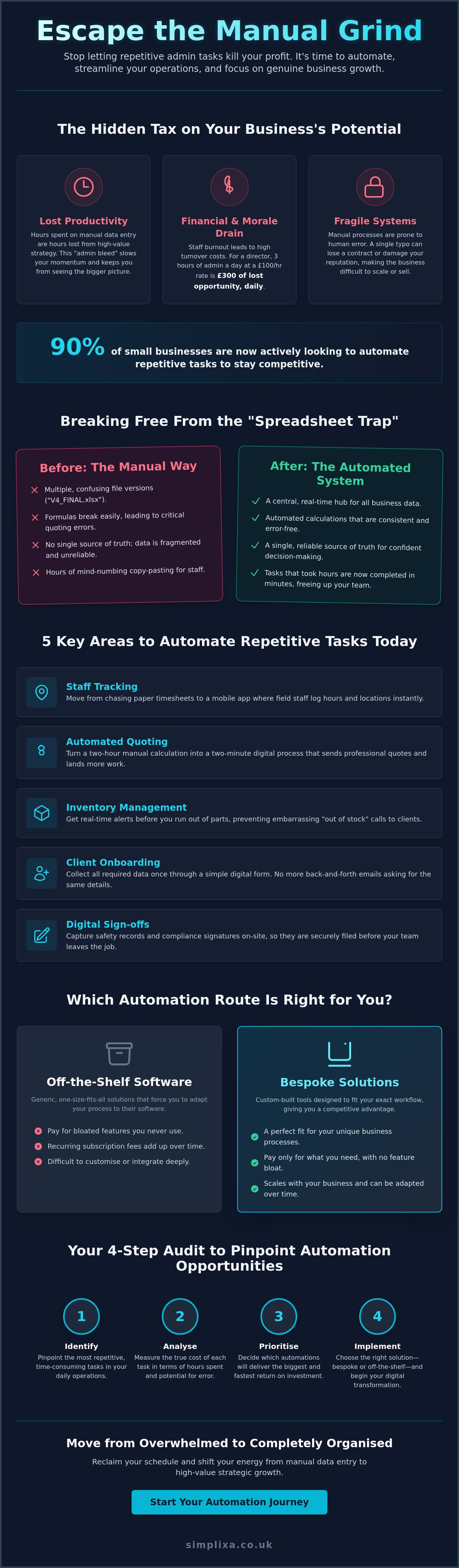

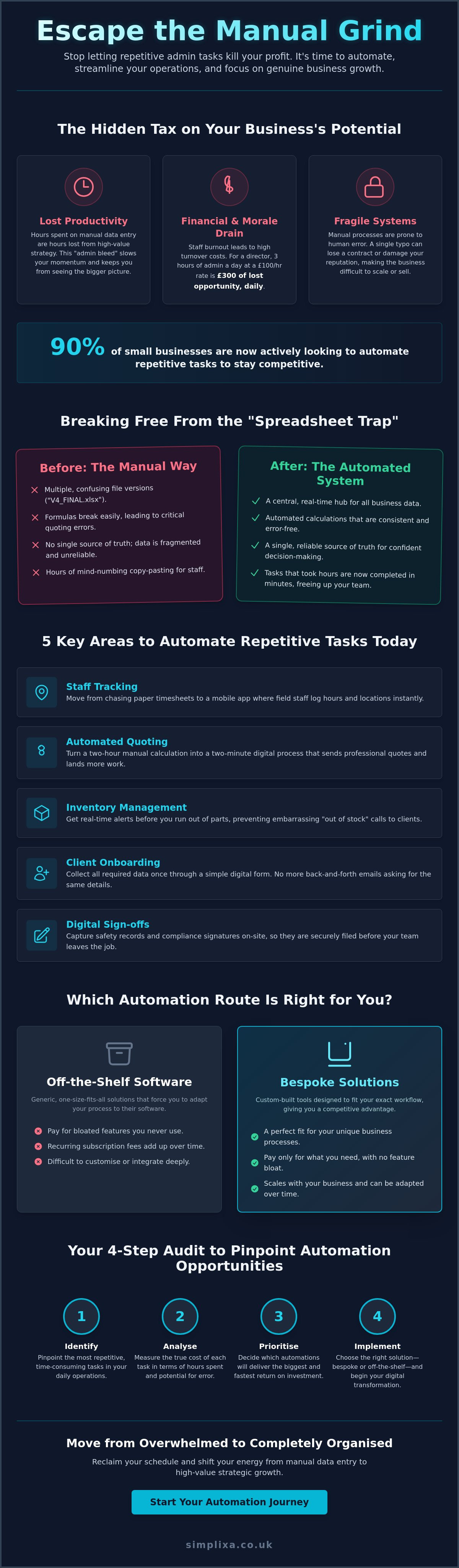
What if the biggest obstacle to your business growth isn't your competition, but your own inbox? It’s frustrating to lose hours to manual data entry. You know the feeling. One wrong digit in a quote leads to a lost contract. A missed email means a missed booking. It’s a mental irritant that keeps you from the work that actually matters. Most independent operators feel stuck in the "doing" rather than the "growing". This is exactly why 90% of small businesses are now looking at how to automate repetitive business tasks to stay competitive; a trend confirmed by Visa in early 2026.
We understand that you need relief from the daily administrative grind. This guide promises to show you how to identify, audit, and fix the manual chores that are stalling your progress. We will preview the best ways to replace broken spreadsheets with bespoke digital tools that reduce errors and streamline your entire operation. It’s time to move from being overwhelmed to being completely organised. You’ll learn how to reclaim your schedule and find the time to focus on high-value strategy instead of just keeping your head above water.
Key Takeaways
- Learn how to identify "mental irritants" and data bottlenecks that act as a physical burden on your daily operations.
- Discover a practical four-step audit to decide exactly how to automate repetitive business tasks without needing a technical degree.
- Break free from the "spreadsheet trap" by exploring custom tools for staff tracking and quoting that turn hours of work into minutes.
- Compare bespoke solutions against bloated off-the-shelf software to ensure you only pay for the features your business actually needs.
- Shift your energy from manual data entry to high-value strategy and finally get back to growing your business.
The Hidden Tax: Why Manual Business Tasks Are Killing Your Profit
Running a service-based business shouldn't feel like dragging a sack of bricks through the mud. Every manual invoice you type out or data entry line you double-check is a hidden tax on your growth. It’s a physical burden that slows your momentum. If you spend your mornings dreading the pile of paperwork on your desk, you aren't alone. When you are stuck in the weeds of daily admin, you simply cannot see the horizon. This is why many independent operators are looking for ways to implement Business process automation (BPA) to clear the path. Moving from a state of being overwhelmed to a state of complete organisation starts with admitting that your current manual chores are costing you more than just time.
The Emotional and Financial Cost of Admin
Admin is a morale killer. Your best staff didn't join your team to copy and paste numbers between windows for hours on end. When talented people feel like robots, they stop caring. Burnout follows; then they look for the exit. This hits your bottom line twice. You lose productivity whilst they are there, and you pay massive recruitment costs when they leave.
Think about your own time as a director. If your hourly value is £100 but you spend three hours a day on manual data entry, you are effectively burning £300 every single day. That is the "opportunity cost" of staying small. Furthermore, a business built on manual processes is incredibly difficult to sell. No buyer wants to inherit a "system" that only exists in your head or a filing cabinet. They want a streamlined machine that runs itself.
Why Spreadsheets Fail as You Scale
The "Spreadsheet Trap" is the primary obstacle for most SMEs. Excel is a brilliant tool for a start-up, but it becomes a mental irritant as you grow. Files get emailed back and forth. Formulas break. Suddenly, "Master_Sheet_V4_FINAL.xlsx" is the only thing standing between you and a massive quoting error. This is a recipe for disaster.
A single typo in a shared file can lead to human errors in invoices that ruin your reputation. This is why we focus on getting a single source of truth for business data. Without a central, automated hub, you are constantly second-guessing your own numbers. Understanding how to automate repetitive business tasks means moving away from these fragile, shared files and into a system that actually supports your scale. It's about replacing the stress of "did I save the right version?" with the confidence of a professional, automated operation.
5 Key Areas Where You Can Automate Repetitive Business Tasks Today
Automation isn't just for tech giants or Silicon Valley startups. For a local service business, it’s about fixing the small, persistent leaks in your day. Task automation is now the standard for anyone wanting to stop the "admin bleed". By looking at how to automate repetitive business tasks, you can turn a chaotic office into a streamlined operation. Here are five specific areas where you can start seeing relief immediately.
- Staff Tracking: Stop chasing paper timesheets. A custom mobile app lets field staff log hours and locations instantly.
- Automated Quoting: Move from a two-hour manual calculation to a two-minute digital process that looks professional and lands more work.
- Inventory Management: Get real-time alerts before you run out of parts, preventing those embarrassing "out of stock" calls to clients.
- Client Onboarding: Collect data once. No more back-and-forth emails asking for the same address or phone number.
- Digital Sign-offs: Capture safety records and compliance signatures on-site so they are filed before your team even leaves the job.
Streamlining Staff and Field Operations
If you manage a mobile workforce, you know the Friday night "timesheet chase" all too well. It’s a mental irritant for you and a chore for your team. By moving to a Custom Staff Tracking App, you gain real-time visibility without being a micromanager. You see where the jobs are moving and where they are stalled. This level of organisation allows you to scale business operations without more staff, as your current team becomes far more efficient. If you want to see how this works in practice, you can explore our custom software solutions designed for local operators.
Inventory and Supply Chain Efficiency
Running out of a critical component mid-job is a profit killer. It’s not just the cost of the part; it’s the wasted fuel and the frustrated customer. Understanding how to automate repetitive business tasks like stock control is about removing the guesswork. You can automate stock alerts to trigger the moment inventory hits a certain level. Learning how to manage supplier stock levels for small business is about removing the guesswork. Digital purchase orders handle the heavy lifting, ensuring your supply chain keeps moving whilst you focus on the next big project.
Customer Experience and Onboarding
First impressions matter. If your onboarding process involves three different PDF forms and a dozen emails, you look disorganised. Using digital forms to collect data once creates a professional edge. Following a proven seamless client onboarding process ensures that nothing falls through the cracks. When you pair this with an Automated Quoting Tool, you aren't just saving time; you are building trust. Clients appreciate the speed, and you’ll appreciate the reduced administrative errors.
Off-the-Shelf vs Bespoke: Which Automation Route is Right for You?
Most business owners think they only have two choices. You either keep doing things by hand or you sign up for a massive software subscription that promises the world. This is a false choice. When you are looking at how to automate repetitive business tasks, the tool should fit your business; you shouldn't have to twist your business to fit the tool. The "SaaS Struggle" is real. You end up paying for a toolkit with 50 features whilst only ever using three of them. It’s a waste of money and a waste of focus.
Generic software often forces you into "workarounds". If the system won't let you log a job the way you actually do it, you end up creating another spreadsheet to bridge the gap. Suddenly, you are back where you started. Bespoke software is no longer just for corporate giants with massive budgets. It’s now a practical, no-nonsense option for small teams who want to kill their specific mental irritants once and for all. It’s about building exactly what you need and nothing you don't.
The Limitations of Generic Software
Subscription costs are a slow leak in your bank account. They never stop, and they often go up without warning. Beyond the price, generic platforms are often bloated. They try to be everything to everyone, which makes them confusing for your staff. Simple is almost always better. If a tool is too complex, your team will simply stop using it. You end up back with paper notes and broken Excel files. Why pay "licence rent" for a system that creates more friction than it solves?
The Bespoke Advantage for SMEs
The biggest benefit of going bespoke is ownership. You own the tool. You own the data. There is no monthly fee per user that grows as your team grows. You focus entirely on the tasks that actually move the needle for your operation. For many, this starts with a custom CRM for tradespeople uk. A tailored system like this handles your specific workflow, from the first enquiry to the final sign-off, without the unnecessary clutter of a corporate platform.
We believe in fixed-price certainty. You shouldn't have to worry about the "black hole" of hourly developer rates where the bill keeps climbing but the software is never finished. By choosing a partner who understands the daily pressures of running a service business, you get a solution that works from day one. You get relief from the admin grind without the stress of hidden costs or technical jargon. It’s about utility over aesthetics, every single time.
The 4-Step Audit: How to Spot a Task That Needs Automating
You can't fix everything at once. Trying to overhaul your whole business in a single weekend is a recipe for more stress, not less. To get real relief, you need a logical way to decide how to automate repetitive business tasks without wasting money on features you won't use. This audit helps you find the "low-hanging fruit" that will give you back the most time for the least effort. By looking at your daily grind through these four lenses, you can move from being overwhelmed to being completely organised.
- Step 1: Identify the "Mental Irritants". These are the jobs you put off until the last minute because they are boring, clunky, or just plain annoying.
- Step 2: Map the Data Flow. Trace a piece of info from the moment it enters your business to the moment it’s filed away. Does it move from an email to a notepad, then to a spreadsheet, then to an invoice? Every "hop" is a chance for things to go wrong.
- Step 3: Count the Touches. How many people have to handle that data before the job is finished? If three people are re-typing the same customer address, you have a massive efficiency leak.
- Step 4: Calculate the Error Risk. Think about the worst-case scenario. What happens if a digit is wrong on a quote or a staff member misses a safety sign-off? High-risk tasks are your top priority for automation.
Identifying Your High-Value Targets
Focus on tasks that happen every day but don't require a degree to perform. If a job is high-frequency and low-complexity, it belongs in a system, not on your to-do list. Be wary of the phrase "we’ve always done it this way". This is usually a red flag for a process that is ripe for disruption. A mental irritant is a task that drains energy without adding value. By removing these, you free up your team to do the work they actually enjoy.
Building Your Automation Roadmap
Don't try to build a spaceship when a simple tool will do. Start by prioritising tasks based on how much time they save versus how much they cost to build. Deciding how to automate repetitive business tasks is easier when you start small. Sometimes, the power of a single digital form to replace a paper checklist can save hours every week. It’s also vital to ensure your roadmap aligns with your budget for custom software uk. Planning ahead prevents nasty surprises and ensures your digital transformation stays on track.
Ready to stop the admin bleed? You can get an honest assessment of your systems to see which tasks are truly holding you back.
Taking the Leap: How to Start Automating Without the Stress
Taking the first step into digital transformation doesn't require a computer science degree. It just requires a bit of honesty about what isn't working. Many owners hesitate because they fear a complex, expensive project that never ends. But learning how to automate repetitive business tasks is actually about simplification. It’s about stripping away the clutter. You don't need to understand the code. You just need to know that when you click a button, the invoice goes out and the inventory updates. It’s the relief of a system that just works, every single day, without you having to babysit it.
Finding the Right Practical Partner
The tech industry is full of sterile agencies that speak in confusing jargon. They focus on "disruption" and "synergy" whilst you just want your quotes to be accurate. You need a partner who understands the daily pressures of a service-based business. We value utility over aesthetics. A tool doesn't need to be pretty; it needs to be fast and reliable. At Simplixa, we deliver bespoke tools with fixed-price certainty. This means you know exactly what you are paying before we even start. No hidden fees. No "black hole" of hourly rates. Just a straightforward, no-nonsense path to a better operation.
Your First 30 Days of Automation
The first month is where the magic happens. During the design and delivery phase, we take the audit results from the previous section and turn them into a working tool. We don't just dump a new system on your desk. We help you onboard your staff without friction. Because the tool is built specifically for your workflow, it feels familiar to your team from day one. They won't need a thick manual to understand it. They’ll see the benefit immediately when their Friday night admin disappears.
The ultimate promise of this journey is the "Done" signal. It’s that moment of complete organisation when a project is finished and filed automatically. You move from a state of being overwhelmed to a state of total control. By understanding how to automate repetitive business tasks, you aren't just buying software. You are buying back your evenings. You are reclaiming the headspace to focus on high-value strategy and growth. It’s time to stop doing the chores and start leading the business.
Reclaim Your Day and Focus on Growth
Manual admin is a physical burden that shouldn't be part of your daily life. You've seen how the spreadsheet trap acts as a primary obstacle to your scaling, and you now have the tools to audit your own processes. By focusing on your high-value targets and moving away from bloated, generic software, you can finally find the relief of a streamlined operation. Learning how to automate repetitive business tasks is simply about replacing mental irritants with tools that actually work for you.
We are UK-based practical problem solvers who specialise in building bespoke tools for SMEs. We don't believe in jargon or hidden fees; we believe in utility and fixed-price certainty. It is time to move from being overwhelmed to being completely organised. You can start small, but the important thing is that you start today.
Ready to kill the spreadsheet? See how Simplixa builds custom tools for a fixed price.
Reclaiming your time is the best investment you'll ever make for your business. You've done the hard work of building your company. Now, let’s build the systems that let it thrive. You've got this.
Frequently Asked Questions
What business tasks are easiest to automate first?
Start with tasks that happen every day but don't require complex decision making. Quoting and data entry are the classic starting points for anyone looking at how to automate repetitive business tasks. These jobs are high frequency and low complexity, making them perfect for your first step. By fixing these first, you get immediate relief and prove the value of the system to your team without a massive upheaval.
Is automation too expensive for a small business with under 10 staff?
Automation is often cheaper than the cost of the manual mistakes you are currently making. For a team under 10, every hour spent on manual data entry is an hour not spent on billable work. We focus on utility over aesthetics to keep costs grounded and fair. You aren't paying for corporate bloat; you are paying for a tool that solves a specific burden on your profit.
Do I need to be tech-savvy to use automated business tools?
You don't need a technical degree to use a tool that was built for your specific workflow. Good automation should feel like a natural part of your day, not a new hurdle to jump over. If a system is too complex, it is a bad system. Our goal is to make your admin disappear so you can focus on the work you actually enjoy.
Can I automate my business if I still use paper forms and whiteboards?
Paper forms and whiteboards are the primary obstacles we help you replace. We specialise in Digital Form Conversion, turning those physical bits of paper into instant digital records. You don't need to change how you work; we just change the tool you use to do it. It’s about moving from a messy desk to a completely organised digital hub.
How much time can I realistically save by automating repetitive tasks?
It is common to see a two-hour manual quoting process turn into a two-minute digital one. Whilst every business is different, removing the Friday night timesheet chase and manual invoicing usually saves several hours per week for both directors and staff. This isn't just about saved minutes; it is about reclaiming your mental energy for high value strategy.
What happens if my business processes change after the automation is built?
Bespoke software is built to be flexible because your business isn't static. Unlike rigid off the shelf apps, a custom tool can be adjusted as you scale or change your service offerings. You own the tool, so you aren't stuck with a workaround when your needs evolve. We build systems that are ready to grow alongside your team as your goals change.
Is bespoke software better than buying a monthly subscription for an app?
Bespoke software is often the better route because you avoid licence rent for features you never use. Monthly subscriptions for generic apps can become a slow leak in your bank account as your team grows. With a custom tool, you only build what solves your specific mental irritants. You own the system and the data, providing long term certainty for your operation.
How do I ensure my business data is secure when I automate?
Centralising your info in a custom CRM or database is far more secure than emailing spreadsheets back and forth. You control who sees what, and you have a clear audit trail for every action. This reduces the risk of data leaks and ensures you are meeting modern privacy standards. It moves your data from a vulnerable shared file to a secure, professional environment.