
It’s Sunday evening and you’re huddled over a laptop, squinting at a spreadsheet that looks more like a logic puzzle than a rota. You’ve got three staff members requesting the same Saturday off, a new starter who can’t work lates, and a nagging worry that you’ve double-booked the floor. Learning how to manage complex staff shift patterns shouldn’t feel like a second full-time job. It’s a massive drain on your energy. You didn't start a business to become a professional data entry clerk.
We get it. The manual updates, the constant errors, and the frustration from staff when rotas are late are enough to make anyone want to chuck their computer out the window. It’s time for a change. This article shows you how to ditch the spreadsheet headache for good. We’ll walk through a clear framework to organise your team, ensure you’re meeting the latest 2026 UK employment standards, and finally get your admin time back. You’ll discover how to create a system that practically runs itself so you can focus on actually growing your business and keeping your team happy.
Key Takeaways
- Stop fighting version control nightmares and learn why colour-coded spreadsheets are the primary obstacle to your free time.
- Master how to manage complex staff shift patterns using a practical framework that accounts for 24/7 coverage and varying contract types.
- Plug the payroll leak by identifying common manual errors that lead to overpaying or unfair shift distribution.
- Use a five-step audit to align your staff levels with actual demand, ensuring you are never understaffed during peak hours.
- See why bespoke digital tools beat generic apps by following your specific business rules instead of forcing you to adapt.
Why Complex Staff Shift Patterns Break Your Spreadsheets
Excel is a bit like a trusty old van. It’s brilliant for a quick trip down the road, but it’ll start smoking the moment you try to haul a five-tonne load across the country. Managing Shift work across a 24/7 operation is that five-tonne load. When you’re dealing with rotating cycles, three different contract types, and varying levels of seniority, a standard grid just isn't enough. A complex shift pattern is a system where variables like staff availability, skill sets, and legal rest periods intersect.
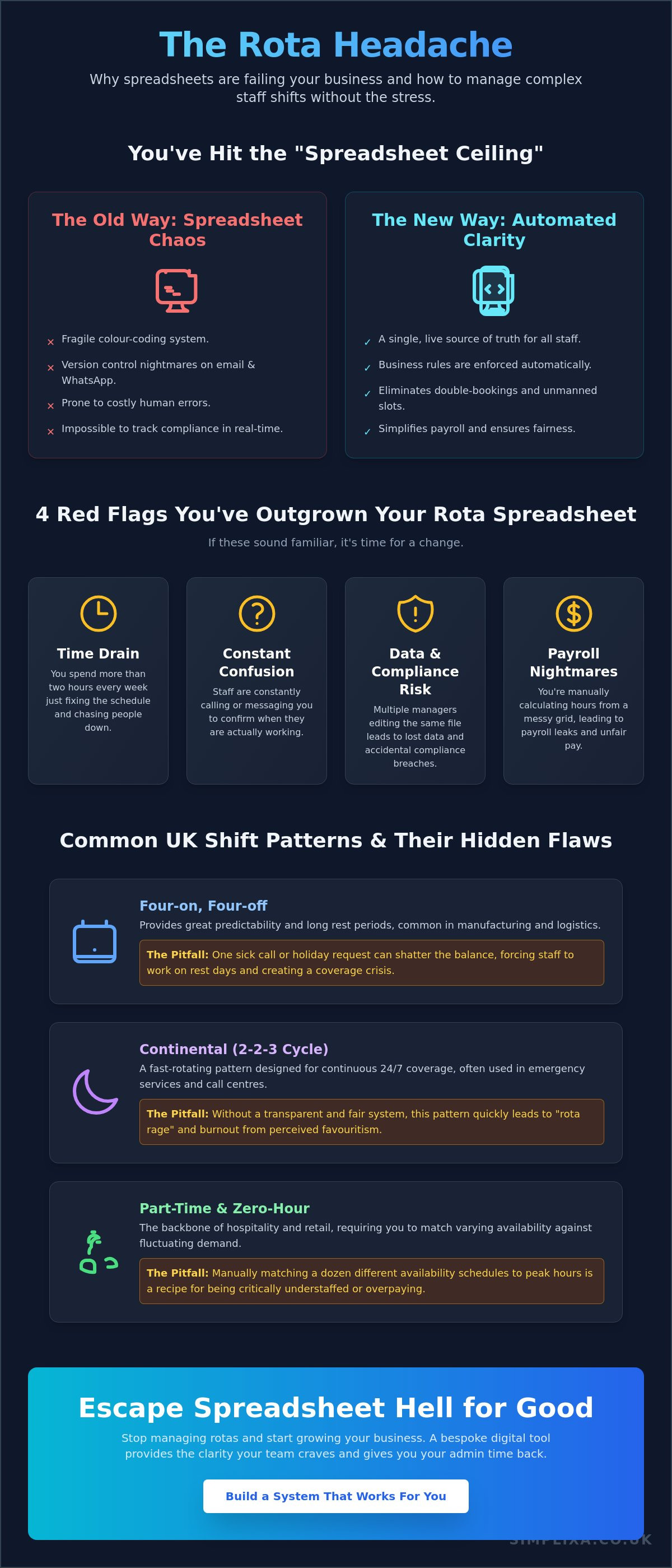
You hit the "Spreadsheet Ceiling" when the tool becomes a liability rather than a help. Colour-coding cells might feel organised at first, but it’s a fragile system. One accidental drag-and-drop can wipe out a week of planning. Then there’s the version control chaos. You send out a PDF on Friday, but by Saturday morning, two people have swapped shifts. Suddenly, you have three different versions of the rota floating around on WhatsApp. Nobody knows which one is the "real" one. This is exactly where you find yourself in Spreadsheet Becoming Too Complex? How to Escape Excel Hell in 2026 territory.
The Risks of Managing Rotas Manually
The biggest danger is human error. A single typo in a cell can leave a site unmanned or lead to double-booking. It’s not just an admin annoyance; it’s a compliance risk. With the 2026 Fair Work Agency keeping a closer eye on things, accidentally breaching the 48-hour Working Time Regulations or failing to track statutory leave can lead to serious headaches. Manual entry makes it almost impossible to track these limits in real time without losing your mind.
Signs You Have Outgrown Excel
If you are constantly searching for how to manage complex staff shift patterns, you’ve likely already passed the breaking point. Look for these red flags:
- You spend more than two hours every week just "fixing" the schedule or chasing people.
- Staff are constantly calling or messaging you to ask when they are actually working.
- You’ve got more than one manager trying to edit the master file at the same time, leading to lost data.
- Payroll is a nightmare because you’re manually calculating hours from a messy grid.
The "Sunday Night Rota Stress" is a choice, not a requirement. When the variables of your business outpace the capabilities of a spreadsheet, it’s time to look at a system designed to handle the weight.
Common UK Shift Patterns and Their Unique Challenges
Every industry has its own rhythm. Manufacturing often relies on the consistency of a four-on, four-off cycle, whilst hospitality thrives on the high-energy chaos of split shifts. On paper, these patterns look like simple blocks of time. In reality, they are moving targets. Knowing how to manage complex staff shift patterns requires more than just filling slots; it’s about anticipating the "domino effect" when things change.
Take the four-on, four-off pattern. It provides great predictability for the team until someone books a week of holiday or calls in sick. Suddenly, you’re pulling people from their rest days, and your carefully balanced spreadsheet starts to crumble. Then there’s the Continental shift pattern, the fast-rotating 2-2-3 cycle that keeps a site running 24/7. Without a clear, transparent system, these rotations lead to "rota rage" where staff feel they are being treated unfairly or losing out on precious weekend time.
The "Fairness Factor" is a massive driver of staff turnover in the service sector. If your manual system makes it look like the same three people always get the plum shifts whilst others are stuck with every Friday night, resentment builds. Transparency is the only cure for perceived favouritism. If your current method feels more like guesswork than a system, a custom staff tracking app can provide the clarity your team craves.
Managing Rotating Shifts (The 24/7 Challenge)
Keeping a business running around the clock is a heavy lift. You have to ensure adequate rest periods between "lates" and "earlies" to keep your team sharp. It isn't just about morale; it’s about safety. Poorly managed cycles contribute significantly to the health hazards of shift work, including chronic fatigue and increased error rates. Using a "shadow rota" for emergency cover can help, but tracking these overlaps manually is a recipe for burnout.
Part-Time and Zero-Hour Complexity
The rise of the flexible workforce brings its own set of headaches. You’re often matching varying availability from a dozen different people to your peak business demand. The administrative burden of tracking "actual hours worked" against what was scheduled can take hours every week. You need to ensure a "fair share" of unpopular shifts amongst your part-time staff to maintain a healthy culture. When you’re juggling zero-hour contracts alongside full-time roles, the data handling quickly outgrows any standard office tool.
The Real Cost of Getting Your Rota Wrong
A mistake on the rota isn't just a typo. It's a bill you didn't see coming. When you're figuring out how to manage complex staff shift patterns, the stakes are higher than just a messy spreadsheet. You are dealing with the two most expensive parts of your business: your people and your legal liability. Getting it wrong leads to a slow, silent drain on your resources that eventually becomes a flood.
"Rota rage" is a genuine problem in the service sector. It is that simmering resentment when an employee cannot plan a dentist appointment or a family dinner because the schedule changes at the last minute. This frustration is a leading cause of staff walking out. Replacing a team member costs far more than the time spent on a rota. Then there is the "Payroll Leak." Manual tallies and "rounding up" errors might seem small, but they add up fast. A 1% error rate in shift scheduling can cost an SME thousands of pounds in overpaid wages and lost productivity every year.
Employee Morale and the "Work-Life" Balance
Predictability is the ultimate currency for shift workers. When the rota is a mystery until Sunday night, stress levels at home skyrocket. Predictable patterns do not just make life easier; they improve retention and stop your best people from looking elsewhere. If you want to grow, you need systems that support your team rather than exhausting them. You can find more on this in our guide on How to Scale Business Operations Without More Staff.
The Compliance Minefield
The legal landscape in 2026 is stricter than ever. With the Fair Work Agency now enforcing rules on holiday and sick pay, keeping sloppy records is a massive risk. You have to track the 48-hour weekly limit, which is typically calculated over a 17-week reference period. Are you certain your manual system catches every breach before it happens?
You also need to guarantee the mandatory 11 hours of rest between shifts. In a 24/7 environment, managing banked hours and annual leave whilst staying compliant is a constant headache. If you cannot prove compliance with records kept for at least two years, you are wide open to tribunal claims. It is simply too much weight for a basic spreadsheet to carry.

A 5-Step Framework for Managing Complex Rotas
Shift patterns aren't just a list of names and times. They are the logic that keeps your business breathing. If you’ve been struggling with how to manage complex staff shift patterns, you need to stop reacting to individual requests and start building a repeatable process. It’s about moving from a state of constant fire-fighting to a system that handles the heat for you. This five-step framework is designed to get you there without the technical jargon.
Step 1 & 2: Mapping the Groundwork
The first step is auditing your demand. Don't rely on gut feeling; look at your historical data. When are you actually "slammed"? Many independent operators overstaff on quiet Tuesdays whilst drowning on Friday nights because they haven't mapped their peak periods. Once you know when you need people, define your constraints. Create a "Skill Matrix." This is a simple list of who can do what. It ensures you never have a shift without a supervisor, a key-holder, or a first-aider. Identify your "unmovable" shifts, those core roles that must be filled, and separate them from flexible slots that can change based on staff availability.
Step 3 is building your Master Pattern. This is your "ideal" week. Think of it as the gold standard that works perfectly if nobody ever called in sick and nobody ever went on holiday. It’s the blueprint you aim for every time. Step 4 is establishing a Swap Protocol. You don't need to be the middleman for every minor change. Let your team manage their own swaps, but set strict rules. They can only swap if the Skill Matrix stays balanced and they don't breach legal rest periods. This empowers your staff whilst protecting your business.
Step 5: Creating the Single Source of Truth
The final step is moving to a single source of truth. If you are still using a mix of email, WhatsApp, and paper rotas, you are asking for trouble. A central digital record is non-negotiable if you want to grow. Transitioning staff from paper to digital doesn't have to be a battle. When they realise they can check their shifts on their phone and won't be caught out by a "version 3" update they didn't see, the friction disappears.
Tired of the same manual grind every week? You can find more advice on streamlining your operations in our guide on How to Automate Repetitive Business Tasks. Reclaiming your time starts with better systems.
If you're ready to ditch the paperwork and the "Sunday Night Rota Stress," let us build a custom staff tracking app tailored specifically to your business rules and your team's needs.
Beyond the Rota: Custom Tools for Stress-Free Scheduling
The framework we have discussed provides the structure, but the final piece of the puzzle is the engine that drives it. Off-the-shelf apps often fail because they are designed for generic businesses with standard needs. When your operation involves site-specific certifications or unique travel time logic, those "one-size-fits-all" subscriptions become just another administrative burden. You end up fighting the software rather than using it. You need a tool that follows your rules, not the other way around.
The problem with generic software is that it doesn't understand your unique mess. It doesn't know that your night shift requires a specific seniority mix or that certain team members can't work together. You end up spending your time trying to "trick" the app into doing what you need. This is why many independent operators find that they eventually hit a ceiling with standard tools, just as they did with spreadsheets.
Why Custom Beats Generic for Complex Shifts
Bespoke tools allow you to bake your specific business rules into the software itself. At SIMPLIXA, we build Custom Staff Tracking Apps that act as a digital safety net. If a shift requires a supervisor with a specific qualification, the app simply won't let you book anyone else. It removes the risk of compliance breaches and human error. This is the ultimate way to master how to manage complex staff shift patterns without the mental fatigue of manual checking.
There is also the matter of cost. Most generic apps lure you in with a low starting price, then hammer you with "per-user" monthly hikes as you grow. With a custom tool, you own it. There are no sneaky price increases just because you hired more people. It integrates directly with your existing systems, so data flows where it needs to go without you lifting a finger.
Getting Started with a Simple App
Moving away from the manual grind doesn't have to be a multi-month project. We specialise in taking your messy, colour-coded spreadsheets and turning them into streamlined mobile tools. We offer a "Fixed-Price" promise. You’ll know exactly what the investment is upfront. No hidden fees. No "pro" tiers. Just a tool that works exactly the way you do. It is about relief, moving from a state of being overwhelmed to a state of complete organisation.
Stop losing your evenings to data entry. See how a Custom Staff Tracking App could reclaim your Sundays and give you the clear, automated system your business deserves.
Take Control of Your Time and Ditch the Rota Stress
The manual grind of building a rota isn't just a time-sink; it is a physical burden that keeps you from focusing on the bigger picture. You now have a framework to audit your demand and define your constraints. You understand why the spreadsheet ceiling is holding you back. Mastering how to manage complex staff shift patterns is about more than just filling slots on a grid. It is about creating a resilient system that protects your profits and your team's well-being.
At SIMPLIXA, we believe small businesses deserve tools that actually work. We provide fixed-price delivery for budget certainty and build bespoke systems tailored to your specific logic. Our UK-based experts understand the unique challenges you face every day. It is time to reclaim your weekends and move from a state of chaos to complete organisation. Kill the rota headache with a Custom Staff Tracking App from SIMPLIXA. You have done the hard graft of building a business. Now, let’s build the system that lets it scale without the headache.
Frequently Asked Questions
What are the most common shift patterns used in the UK?
The most frequent patterns are four-on four-off, Continental (2-2-3) cycles, split shifts, and double days. These are the standard workhorses for the UK manufacturing and service sectors. Each pattern has its own administrative weight, so the right choice depends entirely on your specific demand cycles and team size.
How far in advance should I publish a staff rota?
You should aim for at least 14 days in advance, although a rolling four-week schedule is the gold standard for staff retention. Late releases are a primary cause of "rota rage" and employee burnout. A clear system makes long-term planning much easier than fighting with a spreadsheet every Sunday evening.
What is the legal limit for hours worked in a week in the UK?
The legal limit remains an average of 48 hours per week, typically calculated over a 17-week reference period. Employers must keep records to prove compliance for at least two years. Understanding how to manage complex staff shift patterns is vital to ensuring you don't accidentally breach these 2026 Working Time Regulations.
Can I change a staff member’s shift at short notice?
Yes, provided the employment contract allows for it, but you should always check for a "reasonable notice" clause. Without this, you generally need the employee's consent to change their hours. Sudden changes are a massive mental irritant for staff, so use them only when absolutely necessary to keep your team on side.
How do I manage holiday requests in a complex 24/7 rota?
Use a "first-come, first-served" protocol backed by a solid Skill Matrix. This ensures you never have too many supervisors or key-holders off at the same time. A central digital record stops holiday requests from getting lost in a sea of WhatsApp messages or scraps of paper on your desk.
What is the best way to track "actual hours" vs "scheduled hours"?
A digital time-and-attendance system is the only reliable way to plug the payroll leak. Manual tallies are prone to "rounding up" errors that drain your profits over time. Tracking actual clock-in times against your scheduled rota highlights exactly where your planning needs to tighten up.
Is it better to use a generic rota app or a custom solution?
Generic apps often feel like another spreadsheet with a different coat of paint. They force you to work their way. A custom solution is a bespoke tool designed around your specific business rules. It handles your unique site certifications or travel time logic without you having to trick the software.
How do I ensure my shift patterns are fair to all employees?
Transparency is the only way to kill the suspicion of favouritism. Share the rota early and ensure unpopular shifts are distributed evenly amongst the team. When the logic behind the schedule is visible to everyone, it builds trust and keeps your staff morale high.