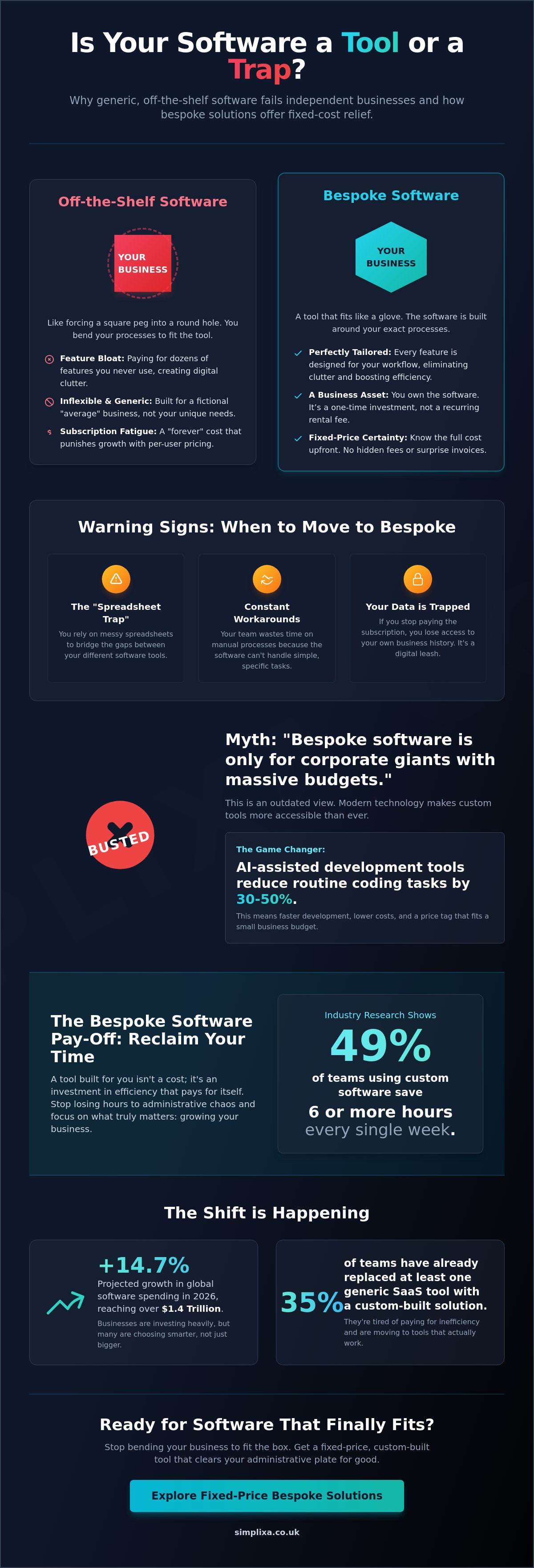

Why are you still bending your business to fit a software box that was never built for you? It's a common trap. You buy a subscription thinking it'll solve your problems, but you end up spending your afternoons on manual workarounds. You're paying for dozens of features you never touch whilst your vital data stays trapped in messy, separate spreadsheets. It's frustrating; it's a massive drain on your energy. You know exactly when off-the-shelf software isn't flexible enough because you start feeling like you're working for the tool rather than the tool working for you.
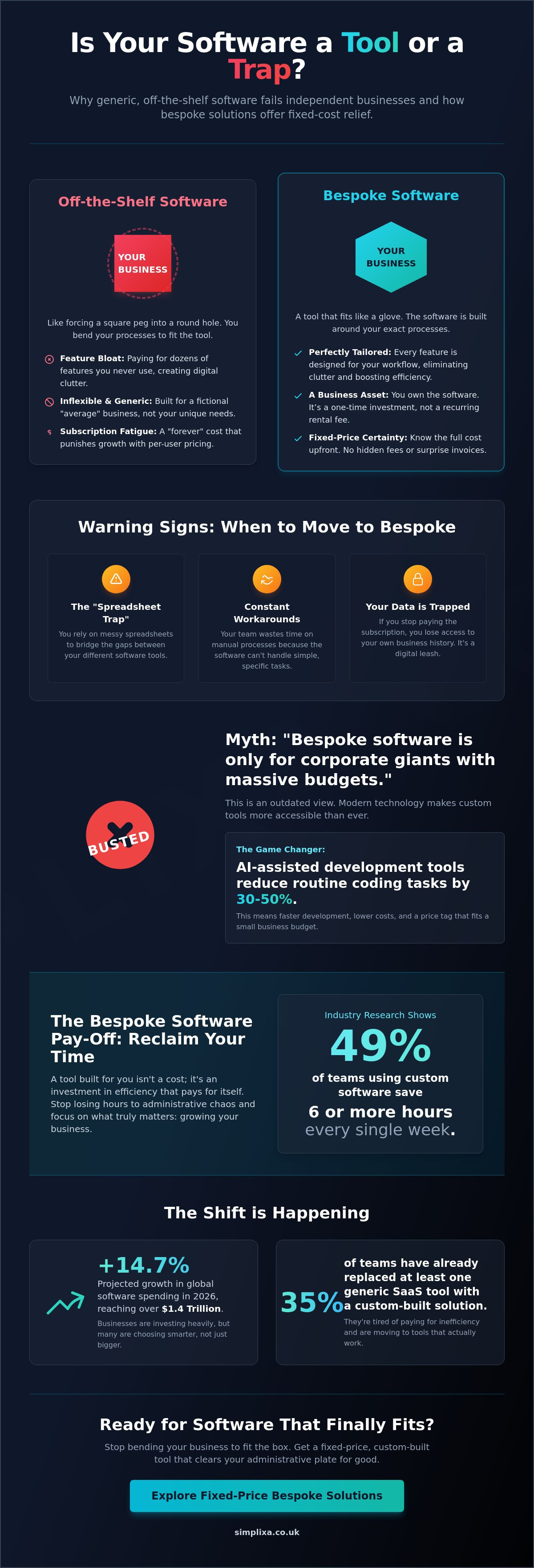
We agree that the "standard" way of doing things is often just a fancy way of saying "not quite right." The good news is that the old myth about bespoke software being too expensive for small operators is dead. Industry research shows that 49% of teams using custom software save six or more hours every single week. This article explains why generic apps fail independent businesses and how bespoke tools provide fixed-cost relief. You'll learn how custom staff tracking or automated quoting tools can finally clear your administrative plate without the corporate price tag.
Key Takeaways
- Stop paying for bloated software that wasn't built for your specific trade. Learn why generic tools often leave you doing more manual work than they save.
- Identify the exact warning signs when off-the-shelf software isn't flexible enough by auditing your manual bridges and spreadsheet workarounds.
- Bust the myth that custom software is only for corporate giants. Modern development means you can get a tool that fits like a glove without a six-figure bill.
- Calculate the "Frustration Factor" to see how much time your team is losing to systems that just don't talk to each other.
- Move from administrative chaos to complete relief with fixed-price tools like custom CRM software or inventory management systems designed for your real-world needs.
Why Off-the-Shelf Software Hits a Wall in 2026
Buying a "ready-made" software subscription often feels like buying a suit that's three sizes too big. You’re told it’s the industry standard, but it doesn't quite fit anywhere. In 2026, global spending on software is expected to grow by 14.7 per cent to over $1.4 trillion. Businesses are pouring money into digital tools, yet many are finding that these generic "boxes" are actually slowing them down. The problem is simple. Standard software is built for a fictional "average" business. It isn't built for your specific team, your unique local clients, or your particular way of getting things done.
You know the feeling. It’s that exact moment when off-the-shelf software isn't flexible enough to handle a simple request without a "workaround." You start changing your internal processes to suit the app rather than the other way around. This is backwards. When you find yourself clicking through ten different screens just to update a single record, or paying for a "Premium" tier just to access one tiny feature you actually need, the tool has become a burden. "Good enough" software eventually stops being a bargain and starts costing you real time and money through sheer inefficiency.
The One-Size-Fits-All Fallacy
Software developers build for the masses because that’s how they maximise their own profits. They want ten thousand subscribers using the exact same interface. This leads to "feature bloat," where you’re forced to navigate a cluttered dashboard filled with a hundred tools you'll never touch. For an independent operator, this digital clutter is a mental irritant. Generic tools often lack the specific data fields or tracking your trade requires. You end up with a system that is 80 per cent useful and 20 per cent obstacle. That 20 per cent gap is where your profit leaks out.
When Your Business is the 'Edge Case'
Most major SaaS platforms are US-centric. They often ignore UK-specific reporting needs or the nuances of local regulations. If your business has complex staff shift patterns or a very specific type of inventory, "standard" systems usually fail to cope. This is why 35 per cent of teams in 2026 have already replaced at least one SaaS tool with a custom-built solution. They’re tired of the "Spreadsheet Trap" where they have to use Excel just to bridge the gaps between their different apps. Training staff on a counter-intuitive system is expensive; it's much faster to hand them a tool that speaks their language from day one.
Myth: 'Custom Software is Only for Big Companies with Massive Budgets'
Many business owners hear the word "bespoke" and immediately think of a six-figure price tag. They assume custom-built tools are a luxury reserved for corporate giants with endless IT budgets. This is an outdated view that belongs in the past. Modern technology has completely shifted the landscape. AI-assisted development tools are now estimated to reduce routine coding tasks by 30-50 per cent. This makes building a tailored tool faster and more affordable than it has ever been. You don't need a massive bank balance to get relief when off-the-shelf software isn't flexible enough to handle your daily workload.
The True Cost of Subscription Fatigue
Subscription software looks cheap on day one. You pay a few pounds per user and think you've found a bargain. But SaaS companies are masters of the slow squeeze. They increase their monthly fees almost every year without adding a single feature that actually helps your specific trade. Worse still, per-user pricing actively punishes you for being successful. If you hire three more people, your software bill jumps. It's a "forever" cost that never ends. Your data is often trapped in their system; if you stop paying, you lose your history. That isn't a tool; it's a digital leash.
Fixed Pricing: The Small Business Game Changer
Traditional software agencies love the "billable hour." They'll quote you a vague range and then charge for every phone call and email. For an independent operator, this is a recipe for constant anxiety. We believe in a different approach. Small businesses need fixed-price certainty to manage their cash flow properly. You should know exactly what you're paying before a single line of code is written. No hidden fees. No nasty surprises. No open-ended invoices that keep you up at night.
A bespoke tool is an asset you own, not a service you rent. When you invest in a custom CRM software or a tailored tracking app, the goal is pure utility. If that tool saves your team just six hours of manual data entry a week, it can pay for itself in a matter of months. You stop paying for a hundred features you never touch and start using a system that does exactly what you need. It’s about moving from a state of being overwhelmed to a state of complete organisation. That sense of relief is worth more than any generic subscription could ever offer.
The Hidden Cost of 'Making Do' with Inflexible Systems
Using a tool that doesn't fit feels like wearing boots that are two sizes too small. You can still walk, but every step is a struggle. This is exactly what happens when off-the-shelf software isn't flexible enough to handle your specific workflow. You don't just stop; you start building "manual bridges" to get the job done. Usually, this means falling into the Spreadsheet Trap. You end up with a dozen different Excel files trying to do the work that one proper system should be doing for you. It's a mental irritant that never goes away.
This "making do" culture is a silent profit killer. Manual data entry isn't just boring; it's dangerous. One tired employee typing a single wrong digit into a quote can cost you thousands in lost margin. When your data is fragmented across paper notes, separate spreadsheets, and clunky apps, you lose the big picture. You can't see your business health because the numbers are scattered. It’s messy. It’s stressful. And it’s completely avoidable. Beyond the money, think about your staff. Forcing good people to use broken, clunky tools destroys morale. They want to do a good job, not fight a system that hates them.
The Perils of the 'Workaround' Culture
Workarounds are administrative scars. You might find your team writing job details on scraps of paper because the official app is too slow to load on-site. Then comes the double-entry. Someone has to type that info into the CRM, then again into the accounting software, and probably once more into a tracking sheet. It's a massive waste of human potential. There is also the constant, low-level dread that one broken formula in a master spreadsheet will ruin your entire month's projections. That isn't a professional way to run an operation.
Lost Opportunities and Slow Turnarounds
Speed is everything. If it takes you three days to pull together a complex quote whilst your competitor does it in twenty minutes, you’ve already lost. Inflexible systems make you slow. You miss out on lucrative jobs because you can't see staff availability or inventory levels in real-time. Even your physical gear is at risk. Using a dedicated system for tracking assets and equipment ensures that expensive kit doesn't just "go missing" between jobs because nobody logged it properly. Clunky tools don't just frustrate your staff; they actively push your customers toward the competition.
Knowing When to Move: A Practical Checklist for Small Businesses
How do you tell the difference between a minor technical glitch and a system that's fundamentally broken? It's a question every growing business eventually faces. You've likely reached the point when off-the-shelf software isn't flexible enough to support your team if your daily routine feels like an uphill battle. To get a clear picture, you need to step back and audit the friction in your current setup. It’s about being honest about the "manual bridges" you’ve built to keep things moving. This reality check is the first step toward finding a tool that actually works.
- Audit your Manual Bridges: Count how many times a day you or your staff reach for a spreadsheet or a piece of paper to record something the software can't handle. These are the gaps in your system that lead to errors.
- Calculate the Frustration Factor: Ask your team how much time they spend fighting the interface. Industry data shows that 49 per cent of teams with custom tools save six or more hours per week. If your staff are currently losing that time to workarounds, you're burning cash.
- Identify the Growth Ceiling: Think about the last time you wanted to launch a new service or change a pricing model. Did you hesitate because the software would make it too difficult to track? That's a ceiling on your profit.
- Review Total Spend: Add up every single "small" monthly subscription you pay for. Compare that "forever" cost to the price of a one-off tool you actually own.
- Seek a Practical Partner: Look for someone who talks about your business outcomes, not just lines of code. You need a tool that speaks your language and understands your trade.
Spotting the 'Flexibility Ceiling'
The flexibility ceiling is that frustrating moment you have to tell a client "no" because your system won't allow a specific request. It might be a custom billing arrangement or a specific reporting format they need for their own records. If adding a new service line feels like a technical nightmare rather than an exciting opportunity, your software is holding you back. A tell-tale sign is when you realise you have more spreadsheets than employees. At that point, you aren't using software; you're just managing a digital paper trail whilst your competitors move faster than you.
Choosing the Right Partner for the Leap
Don't get dazzled by agencies that only talk in technical jargon. You need a partner who understands the daily grind of running an independent operation. They should focus on utility over aesthetics. It’s vital to use a guide for finding a developer who understands small business to ensure your new tool actually helps your team instead of adding more complexity. Make sure you'll own your data and have a clear plan for hosting. You want a clean break from subscription traps, not a new one. If you're ready to stop fighting your tools, chat with us about building a system that actually fits.
Relief is a Custom App Away: The Simplixa Way
You’ve spent enough time fighting tools that don't fit your daily reality. Simplixa exists to provide that missing relief. We build tools that fit your business like a glove, focusing entirely on utility and ease of use. You won't find flashy gimmicks or unnecessary buttons here. Instead, you get a system designed for the way you actually work. We move you from messy, fragmented data to a simple, mobile-friendly app in weeks, not years. Most importantly, we do it with fixed-price delivery. There are no hidden fees or nasty surprises. You know exactly what it costs to get the job sorted.
It is a clear turning point when off-the-shelf software isn't flexible enough to keep up with your pace. We don't just give you another login to manage; we give you a tool you own. This isn't about renting a service forever. It’s about investing in an asset that clears your administrative plate and lets you breathe again. By stripping away the intimidation factor of custom tech, we make bespoke tools accessible for independent operators who are wary of being overcharged.
Tools Built for Your Daily Grind
We focus on the specific tasks that currently act as a mental irritant for your team. A custom staff tracking app needs to work in the real world, not just a posh office. Our tools are built to handle the field, even when the signal is spotty. We create automated quoting tools that make you look like a pro whilst saving you hours of manual calculation. Our inventory management systems are designed to tell you exactly what is in the van right now, not just what’s sitting in the warehouse. It’s about practical help for the people doing the hard work.
The Promise of an Organised Future
The ultimate goal is to move you from a state of being overwhelmed to a state of being completely organised. When your systems work, the physical burden of admin disappears. You stop worrying about missing data or broken spreadsheet formulas. This frees up your time to focus on growth and looking after your clients. If you are ready to kill the spreadsheet and reclaim your afternoons, let’s have a chat. We’ll build a tool that actually works for you. Job sorted.
Reclaim Your Time and Kill the Admin Headache
You've seen why generic software eventually hits a wall. It forces you into the "Spreadsheet Trap" and wastes hours of your team's potential. Realising when off-the-shelf software isn't flexible enough is the first step toward a more organised, profitable future. You don't have to settle for tools that only do half the job or punish your growth with per-user fees. Modern tech means a tailored tool is finally within reach for independent operators who need results, not more subscriptions.
Custom tools are no longer a corporate luxury. With fixed-price certainty and fast delivery, you can have an inventory system or a quoting tool that actually fits your daily grind. You get UK-based support and a system you truly own. It’s about moving away from the frustration of "making do" and toward the relief of total organisation. You deserve a partner who understands the real-world pressures of your trade and values fairness over billable hours.
Ready to ditch the clunky software? See how Simplixa builds tools that actually fit your business.
Your business is unique; your tools should be too. Let's get it sorted.
Frequently Asked Questions
Is custom software really affordable for a small business in 2026?
Yes, it is. Modern development tools and AI-assisted coding have made bespoke tools accessible for independent operators. Research suggests that AI-assisted tools can reduce routine development tasks by 30-50 per cent. This significantly lowers the entry bar. Instead of paying for a bloated subscription forever, you invest in a tool you actually own. It’s about long-term value rather than just the initial price tag.
How long does it take to move from off-the-shelf to a bespoke system?
You can often be up and running in a matter of weeks. We don't believe in projects that drag on for years. By using a phased approach, we focus on your most painful administrative burdens first. This provides immediate relief whilst we build out the rest. It’s a fast, rhythmic process designed to get you organised without disrupting your daily trade.
Will I need to hire a tech expert to manage my custom app?
No, you won't. We build tools that are simple, grounded, and easy for anyone to use. The technical heavy lifting is handled behind the scenes. You don't need to understand code to run a custom CRM software or a tracking app. Our goal is to lighten your workload, not add "managing an IT department" to your already busy plate.
Can bespoke software integrate with my existing tools like Xero or Sage?
Absolutely. One of the biggest tell-tale signs when off-the-shelf software isn't flexible enough is that it won't talk to your other apps. We design custom tools to bridge these gaps. We can connect your new system to accounting software like Xero or Sage. This kills the need for double-entry and ensures your data isn't trapped in separate, messy spreadsheets.
What happens if my business processes change after the software is built?
Your software grows with you. Unlike rigid off-the-shelf apps that force you to work their way, bespoke tools are built to be updated. If UK regulations change or you launch a new service, we can adjust the tool to fit. You aren't stuck with a system that has reached its "flexibility ceiling." It’s a permanent solution for an evolving business.
Do I own the software and the data once it's finished?
Yes, you own the lot. This is the antithesis of the SaaS model. You aren't renting a service that can be switched off if you stop paying monthly fees. You own the tool and every scrap of data inside it. This removes the "lock-in" effect and gives you complete control over your business assets. It’s fair, transparent, and yours.
Is custom-built software as secure as big-brand off-the-shelf options?
Yes, it is. We use industry-standard security protocols and reliable hosting centres to keep your data safe. In fact, being a smaller target can often be an advantage. Large SaaS providers are frequent targets for mass data breaches. A custom-built system is specific to you, making it much harder for generic attacks to find a way in.
What if my staff find the new custom tool too difficult to use?
They won't, because it’s built for their daily grind. We strip away the "feature bloat" that makes corporate software so intimidating. Your team only sees the buttons and fields they actually need to do their jobs. Because it mirrors your real-world processes, it feels intuitive from day one. It’s about utility and speed, not flashy gimmicks that slow people down.