
The most expensive mistake you can make in 2026 isn't hiring a bad coder; it's hiring a brilliant one who doesn't care about your profit margin. For most independent operators, finding a developer who understands small business feels like a constant battle against jargon and opaque pricing. You've likely experienced the headache of a "simple" update taking months or a developer who builds a complex maze when all you needed was a straight line. It's exhausting to feel like your business needs are being ignored in favour of "cool" tech that doesn't actually help you get home on time.
We know you're tired of being overcharged for features you'll never use. This guide promises to help you find a partner who speaks plain English and focuses on your specific business outcomes. We'll walk through the 2026 checklist for vetting a developer who can deliver a custom staff tracking app or an automated quoting tool without the usual agency bloat. You'll learn how to secure fixed-price solutions that save actual hours every week, moving your business from a state of being overwhelmed to complete organisation.
Key Takeaways
- Stop wasting money on experimental tech and start vetting partners based on their ability to deliver real-world utility and ROI.
- Use our fluency checklist to simplify finding a developer who understands small business and can talk about your workflow in plain English.
- Protect your cash flow by ditching the hourly rate "money pit" in favour of fixed-price digital tools that provide total budget certainty.
- Spot the red flags early, like developers who insist on building from scratch when a simpler, more direct solution is right in front of them.
- Learn how to swap your clunky spreadsheets for a custom staff tracking app or an automated quoting tool that actually lightens your workload.
Why Finding a Developer Who Understands Small Business is a Unique Challenge
Most tech agencies are built for firms with deep pockets and rooms full of middle managers. They thrive on long timelines and "billable hours" that keep their own lights on. For an independent operator, this is a recipe for disaster. You don't need a three-month discovery phase or a designer debating the exact shade of cerulean for a login button. You need a tool that stops your inventory from going missing or your quotes from being late. To ensure your digital presence is just as effective, you can check out Webexpand for professional, bespoke web design. Finding a developer who understands small business is a struggle because most are trained to solve technical puzzles, not operational ones.
The core of the problem is a massive disconnect between high-level engineering and your daily admin reality. A developer might want to discuss scalable cloud architecture whilst you just want to know if your staff tracking app will work when the internet drops out on-site. When you begin understanding business software needs, it becomes clear that one-size-fits-all software usually fails independent operators. These generic systems are built for a hypothetical user who doesn't exist. They don't account for the specific, messy way your business actually runs.
The Jargon Trap and the Language Barrier
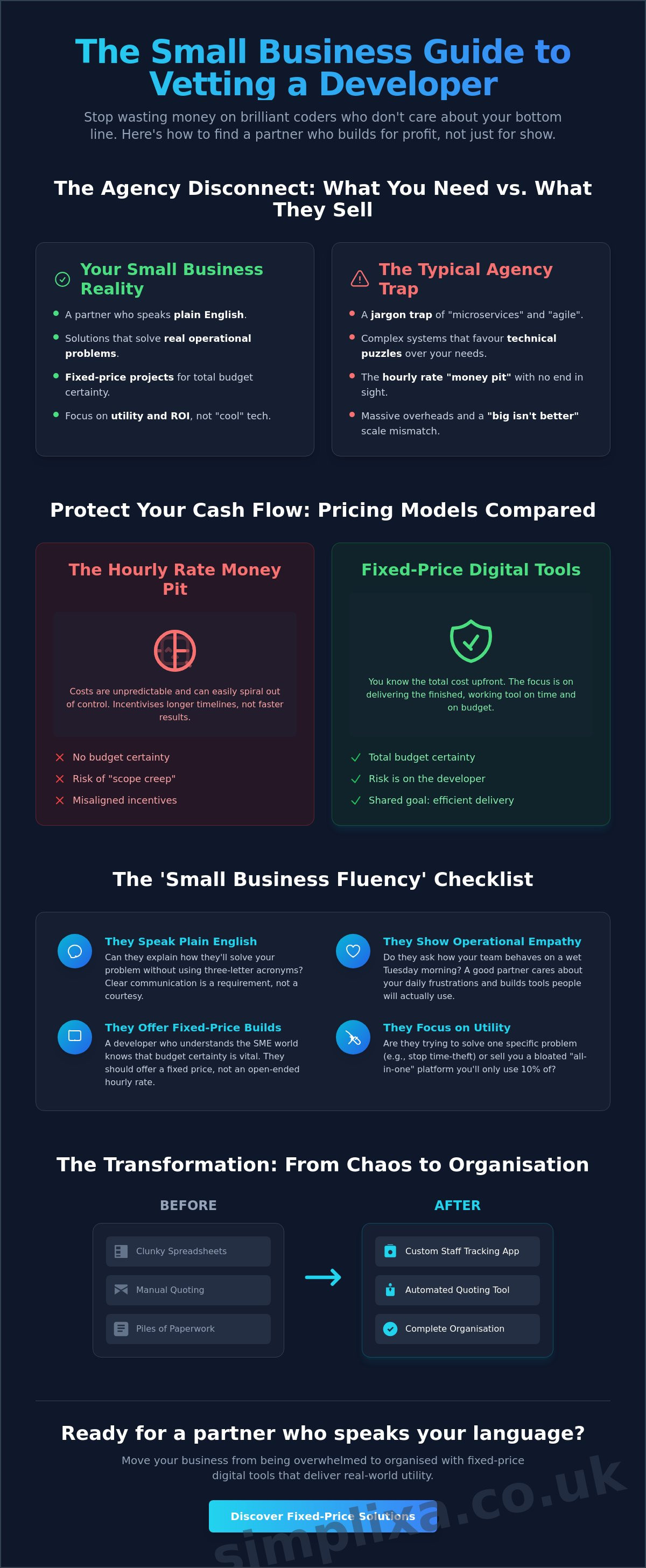
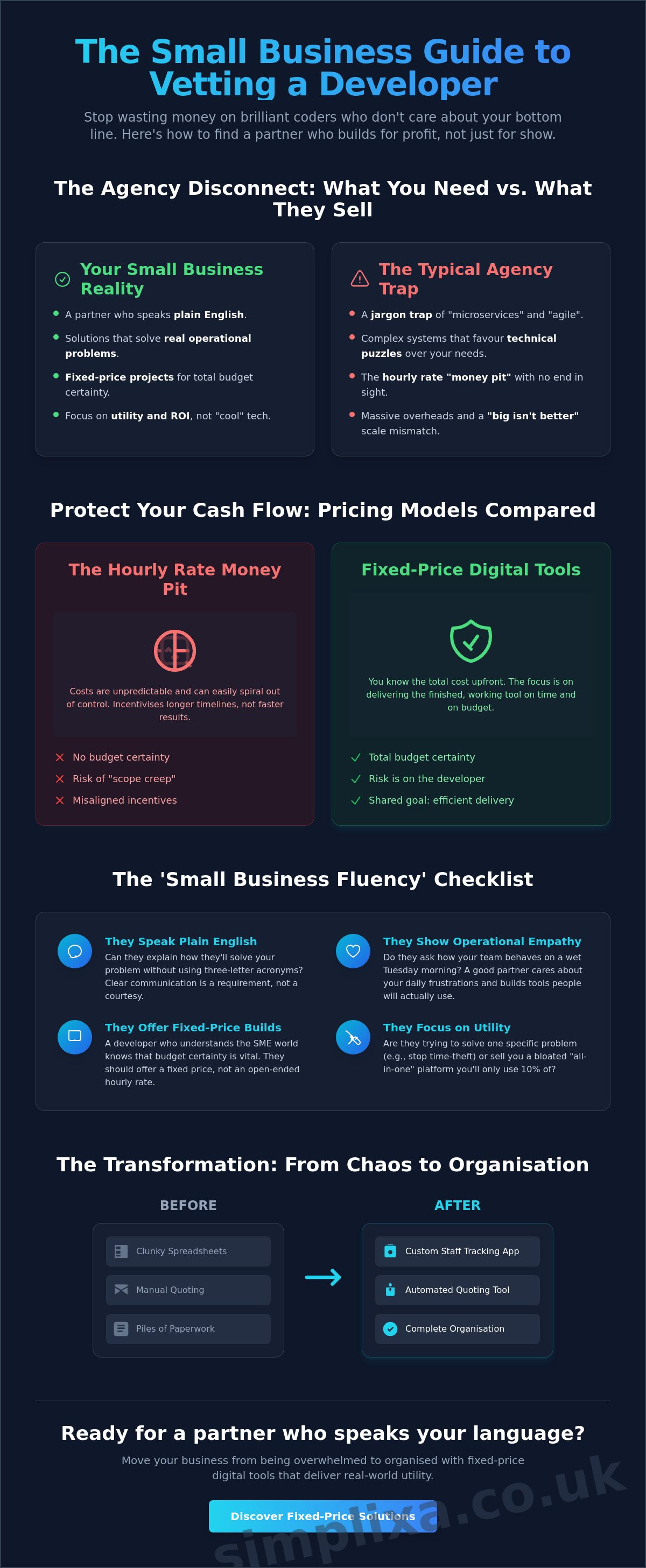
Technical buzzwords like "microservices" or "agile methodology" are often used as a smoke screen. They mask a lack of actual business understanding. If a developer can't explain how they'll fix your double-entry problem without using a three-letter acronym, it's a red flag. You should always favour a developer who asks about your process rather than your tech stack. They need to understand how paperwork moves from the van to the office. Plain English isn't just a courtesy; it's a requirement for project success. If they can't speak your language, they can't build your solution.
The Scale Mismatch: Why "Big" Isn’t Better
Large firms have massive overheads. They have glass-fronted offices and account managers who never touch a line of code. You end up subsidising those costs. Even worse, at a major agency, your project is often the small fish. It gets pushed to the bottom of the pile or handed to a junior whilst the senior team focuses on corporate giants. A lean, practical partner is a better fit. They value your business because they operate with the same urgency you do. They focus on utility over aesthetics because they know your cash flow depends on actual results, not fancy design awards. Whether you are working with local specialists or international experts like Xell Technology, the goal should always be to find a developer who prioritises your bottom line over technical vanity.
The 'Small Business Fluency' Checklist: How to Vet Your Partner
Finding a developer who understands small business isn't just about checking their technical CV. It's about checking their common sense. You need someone who can listen to your admin headache and describe it back to you in plain English. If they start talking about "database schemas" before they've even understood how your staff book their holidays, they aren't the right fit. The process of finding a developer who understands small business should feel like hiring a skilled local tradesman, not a detached corporate consultant. A fluent partner should be able to look at your current pile of paperwork or your messy Excel file and explain exactly how to digitise it without making your life harder.
When hiring coders for the first time, look for those who focus on solving one specific problem. Are they building you a custom staff tracking app to stop time-theft? Or are they trying to sell you a massive, "all-in-one" platform that costs a fortune in monthly fees? You want utility. You don't want a bloated system you'll only use 10% of. Ask about pricing early. A developer who gets the SME world knows that budget certainty is vital. They should offer a fixed price for the build, not an open-ended hourly rate that could double by next Tuesday. Finally, check if they provide ongoing support and hosting without a massive corporate contract. You need a partner who stays around to keep things running, not one who vanishes the moment the final invoice is paid.
Operational Empathy: The Number One Skill
Operational empathy is the ability to understand how your team actually behaves on a wet Tuesday morning. It's no use having a perfect system if your staff find it too fiddly to use in the field. Vetting for this means looking for a developer who has worked with real-world service businesses. They should be asking: "How will this tool save your team five hours a week?" If they don't care about your staff's daily frustrations, the software will end up as "shelfware" that nobody touches.
Portfolio Relevance: Looking Beyond the Shiny Graphics
Ignore the big corporate logos in their portfolio. They don't matter to you. Instead, look for practical tools they have built for businesses your size. Have they created an inventory management system or an automated quoting tool that actually works? You might find it helpful to see a system for tracking assets and equipment they've built for others. This shows they understand the physical reality of running a business. If you want to stop the admin bleed, you can start with a simple digital tool that solves your biggest headache first.
Commercial Clarity: Fixed Pricing vs. The Hourly Rate Money Pit
Hourly billing is a trap. It creates a direct conflict of interest between you and your developer. If they take longer to solve a problem, you pay more. If they get stuck on a technical glitch, your bill goes up. This model rewards inefficiency and leaves you holding the bag when things get complicated. For an independent operator, this is a financial nightmare. You wouldn't hire a builder to renovate your shop on an open-ended hourly rate without a firm quote, so why do it with your software? Budget certainty isn't just a preference; it's a necessity for managing your monthly cash flow.
Part of finding a developer who understands small business is identifying someone who is willing to put skin in the game. A fixed-price quote is a massive signal of confidence. It shows the developer has a proven process and knows exactly how to build your Inventory Management System or Automated Quoting Tool. They aren't guessing; they are committing. If they hit a snag, it's on them to fix it, not on you to pay for their learning curve. This alignment of interests is the only way to ensure your project stays on track and within reach without the stress of an ever-expanding invoice.
Why SMEs Need Upfront Cost Certainty
Nothing kills the relief of a new digital tool faster than a surprise invoice at the end of the month. You need to know exactly what is leaving your bank account before the work starts. Fixed pricing removes the "Scope Creep" nightmare where a simple project doubles in price whilst in development. It forces the developer to be efficient and stay focused on the specific problems you need to solve. A Fixed-Price Guarantee acts as the ultimate trust-builder for SMEs, ensuring that the price you agree on is the price you actually pay. This allows you to plan your growth without worrying about a technical bill that might suddenly swallow your profits.
The Hidden Costs of Traditional Agency Models
Traditional agencies are often bloated with costs that add zero value to your daily operations. You end up paying for account management fees, "discovery" surcharges, and endless meetings that could have been an email. You shouldn't have to subsidise an agency's fancy city-centre office or their latest espresso machine. When you are finding a developer who understands small business, look for total transparency. You need to know exactly what your monthly hosting and support will cost from day one. This means no hidden extras and no nasty surprises. You want a partner like Distemicha who values fairness and speed over corporate bloat and unnecessary complexity, offering comprehensive IT solutions that help you focus on your core business.
Red Flags and Green Lights: A Practical Selection Guide
Finding a developer who understands small business is a bit like hiring a lead mechanic. You don't want someone who just recites the manual; you want someone who hears the rattle and knows exactly which bolt to tighten. During your initial chats, keep a keen ear out for red flags. If they can't explain how your Custom CRM Software will work without hiding behind three-letter acronyms, walk away. They are either trying to confuse you or they don't understand the solution well enough to simplify it. Another warning sign is a developer who insists on building every single feature from scratch. In 2026, plenty of reliable tools exist to handle the heavy lifting. If they want to reinvent the wheel, they are likely just padding their hours at your expense.
On the flip side, look for the green lights that signal a true partner. A good developer will suggest a "Minimum Viable Product" (MVP). This is a way of getting you a working tool quickly so you can start seeing results without waiting months for a "perfect" version. They should also be brutally honest about what software won't fix. If your team has a habit of ignoring paperwork, a new app won't magically change their behaviour. Finally, they must prioritise the mobile experience. Your field staff don't work at desks. If your Custom Staff Tracking App doesn't work perfectly on a cracked smartphone screen in the rain, it's useless.
Communication Styles: The "Gut Feeling" Test
When you are finding a developer who understands small business, trust your instincts during the first meeting. Do they listen more than they talk? A developer who gets your world will spend more time asking about your admin bottlenecks than bragging about their coding skills. They should also be comfortable saying "no" to your ideas. If you ask for a feature that won't add real value to your bottom line, a reliable partner will tell you straight. You also need direct access to the person actually building your tool. You shouldn't have to fight through layers of account managers just to get a simple update on your Automated Quoting Tool.
Technical Independence and Ownership
Don't let yourself get trapped. Ensure you aren't being locked into a proprietary system that makes it impossible to leave. You need to own your data. Always ask about portability: "Can I get my records out if I need to?" A trustworthy partner uses secure cloud hosting that you don't have to manage yourself, but they ensure you keep the keys to the kingdom. If you want a partner who respects your independence and focuses on utility, you can book a straightforward chat with us today to see how we work.
From Spreadsheets to Systems: The SIMPLIXA Approach
Most independent businesses are held together by a "messy" spreadsheet. It's the digital equivalent of a heavy backpack you're forced to carry every single day. You know the one. It's got too many tabs, broken formulas, and only one person in the office actually knows how it works. This outdated tool is the primary obstacle to your growth and your free time. Finding a developer who understands small business means finding someone who respects the work you've already done in those files but knows how to turn them into a professional Inventory Management System or a Custom Staff Tracking App. We don't scrap your logic; we just give it a proper home.
Our approach is built on a "No-Nonsense" promise. We offer fixed prices so you aren't left guessing what the final bill will be. We provide fast delivery because we know you need relief now, not in six months. Most importantly, we speak your language. There's no jargon here. Finding a developer who understands small business shouldn't feel like a gamble. We focus entirely on your daily operations, from an Automated Quoting Tool to a Client Booking System. We organise your data so your business can practically run itself, leaving you free to focus on actual growth rather than chasing paperwork.
Simplifying the Development Journey
We start by identifying your single biggest administrative burden. What's the one task that makes you sigh every Monday morning? That's our starting point. By focusing on that specific irritant, we can build tools that your team will actually enjoy using. We don't believe in bloated software that requires a manual to understand. We want to move you from a state of being overwhelmed to a state of complete organisation in weeks, not months. It's about lightening your workload and giving you back those lost hours every week.
Your First Step to Automation
You don't need a massive, complex system to see a massive difference in your bank balance and your stress levels. In fact, it's often better to start small. By digitising one process at a time, such as a Digital Form Conversion for your field staff, you can scale as your business grows. This prevents you from being overcharged for features you don't need yet. It's a practical, fair way to build your digital future. Ready to get started? Let’s talk about your business and kill that spreadsheet for good.
Take Control of Your Digital Future Today
Running a business is hard enough without fighting your own tools. You've seen why utility must always come before fancy design and why fixed pricing is the only way to protect your cash flow. Finding a developer who understands small business is about choosing a partner who values your time as much as you do. It's about moving away from those fragile, messy spreadsheets and into a system that actually works for you. You deserve a tool that lightens your load instead of adding to it. This drive for efficiency should ideally extend to your external identity as well; working with a creative partner like OS.labs allows you to organise your entire online presence into a coherent system.
As UK-based SME specialists, we focus on delivering fast results with total ROI in mind. We don't do jargon or hidden fees. We just build practical tools that help you get home on time. You can stop feeling overwhelmed and start feeling completely organised within weeks. It's time to put down the physical burden of manual admin and let automation do the heavy lifting for you.
Ready to see the difference? Get a fixed-price quote for your custom business tool today and experience the relief of fixed-price certainty and fast delivery. Let's get your business moving again.
Frequently Asked Questions
How much does it typically cost for a small business to build a custom app in the UK?
The cost of a custom app depends entirely on the complexity of your workflow and the specific problems you need to solve. Instead of looking for the lowest price, you should focus on the potential return on investment. A tool that automates your quoting or inventory can pay for itself within months by saving you several hours of manual admin every single week. Most reliable developers will provide a clear, upfront quote once they understand your requirements.
How do I know if my business is "ready" for custom software or if I should stay with Excel?
You are ready to move away from Excel when your spreadsheets start feeling like a physical burden on your daily operations. If you're spending your evenings fixing broken formulas or re-typing data from paper forms, you've outgrown your current tools. Custom software is designed to fit your specific process perfectly, whereas spreadsheets often force you to change how you work to suit the software.
What is the difference between an offshore developer and a UK-based agency for small businesses?
Offshore developers often have lower hourly rates, but they can struggle with the "business translation" part of the project. A UK-based agency usually has a better grasp of local business culture and regulations. Finding a developer who understands small business in the UK means picking a partner who can have a straightforward chat with you without time-zone delays or language barriers getting in the way of your project.
How long does it usually take to build a simple staff tracking or quoting tool?
A focused tool like a staff tracking app can often be built and launched in just a few weeks. We don't believe in the long, drawn-out timelines that corporate agencies prefer. By starting with a simple version that solves your biggest headache first, you can get immediate relief and start seeing the benefits of automation almost straight away. You can then scale the system as your business grows.
Can a custom app integrate with the tools I already use, like my accounting software?
Yes, modern custom software is designed to talk to other platforms using things called APIs. This means your new tool can send data directly to your accounting software or your client booking system. It eliminates the need for double-entry and ensures your records are always accurate across your entire business. Your developer should handle all these technical connections so you don't have to worry about them; for those exploring specialized transaction simulation systems, you can learn more about the professional security checklists required for safe operation.
What happens to my software if the developer or agency goes out of business?
You should always ensure that you own the rights to the code and, more importantly, your own data. A professional developer will set up your system on secure cloud hosting that belongs to you. This means you keep the "keys to the kingdom" at all times. If the agency vanishes, your software keeps running, and you can simply hire another professional to look after it for you.
Do I need to be "tech-savvy" to manage a custom software project for my company?
Not at all. Your job is to be the expert on how your business runs; the developer's job is to handle the tech. A good partner will speak to you in plain English and won't expect you to understand code. They should be able to listen to your admin frustrations and suggest a practical solution that makes your life easier, not more complicated.
Why is fixed pricing better than an hourly rate for a small business software project?
Fixed pricing provides the budget certainty that every small business needs to manage cash flow. It removes the conflict of interest where a developer gets paid more if they take longer to finish the job. Finding a developer who understands small business means finding someone who is willing to commit to a price upfront. This ensures they stay focused on delivering your tool quickly and efficiently without any surprise invoices.