
You wouldn't start building a house by pointing at a patch of dirt and telling a builder to just get on with it. Yet, many small business owners are tempted to skip the planning and dive straight into the code. It is a natural reaction. You are tired of that clunky spreadsheet breaking every Tuesday. You are fed up with manual data entry stealing your evenings. You want a solution now. But asking what is a software discovery phase isn't just a technical curiosity. It is the only thing stopping your budget from catching fire.
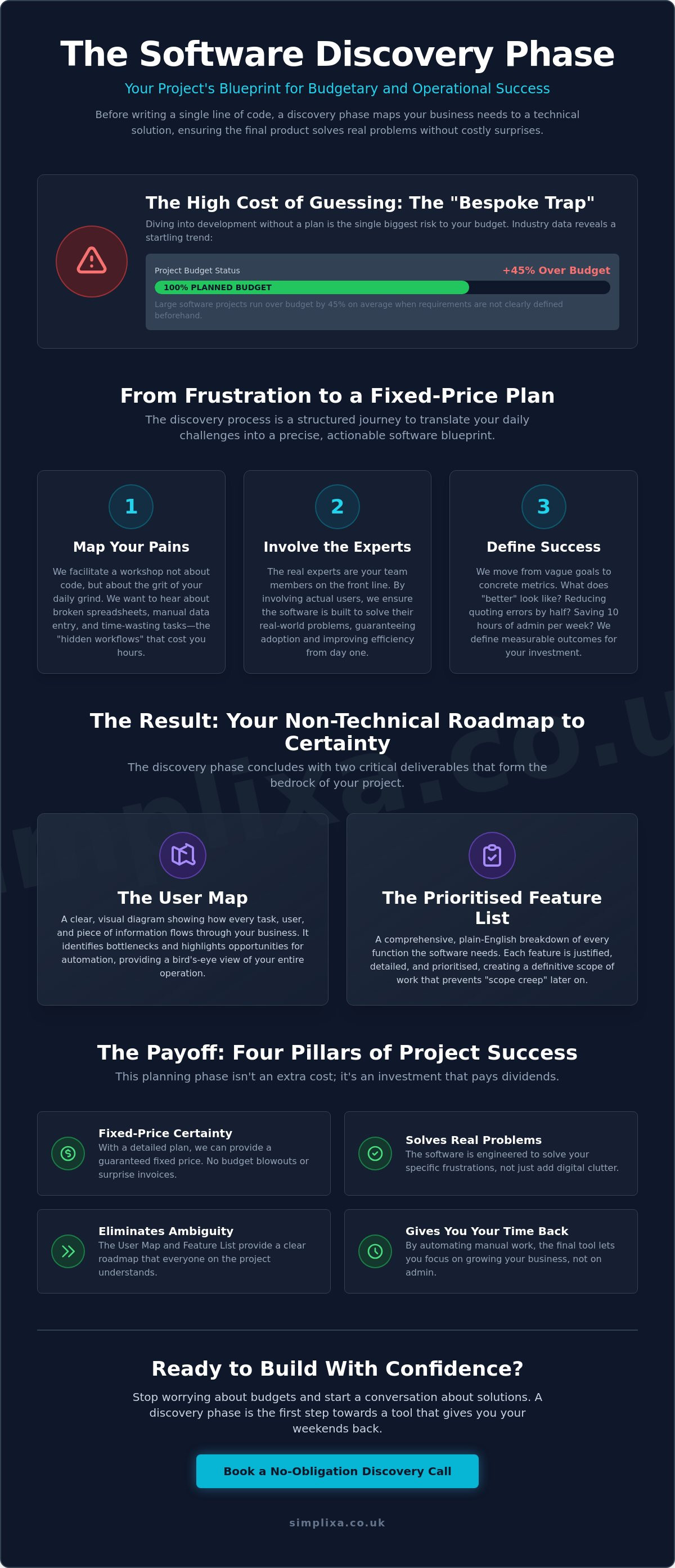
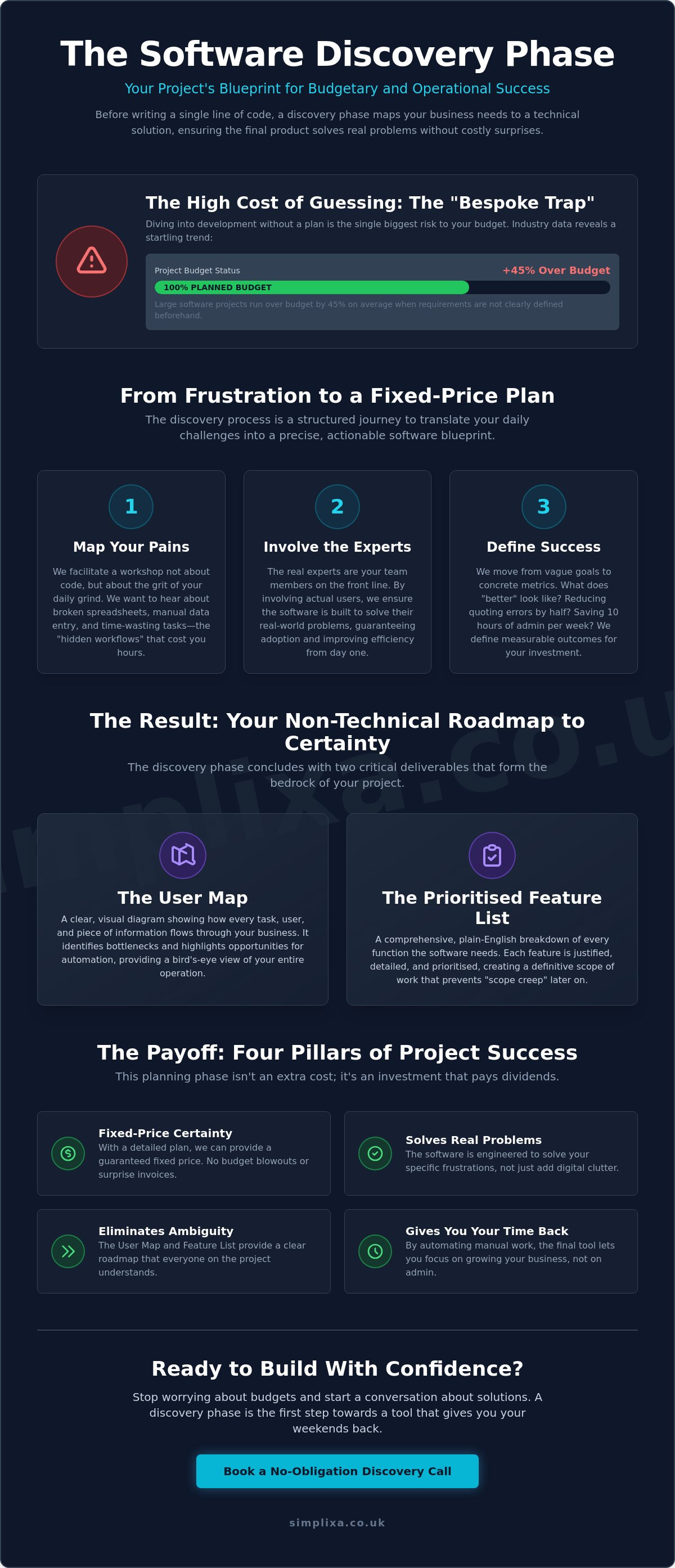
We agree that the "bespoke trap" is a nightmare you want to avoid. Industry data shows that large software projects run over budget by 45 per cent on average when requirements aren't nailed down early. This guide explains how a discovery phase protects your hard-earned cash and ensures your custom tool actually solves your daily frustrations. We will show you how to get fixed-price certainty and a clear roadmap for your new inventory management system or automated quoting tool. It is time to stop guessing and start building something that actually gives you your weekends back.
Key Takeaways
- Learn exactly what is a software discovery phase and why it acts as a vital safety net for your budget before a single line of code is written.
- Discover how mapping your daily business frustrations ensures your new tool solves real problems rather than just adding more digital clutter.
- Avoid the "bespoke trap" by understanding how to spot scope creep before it turns a simple project into an expensive headache.
- Identify the two critical deliverables—the User Map and the Feature List—that provide a clear, non-technical roadmap for your custom software.
- See how a structured planning process leads directly to practical tools like custom staff tracking apps or inventory systems that actually save you time.
What is a Software Discovery Phase? (And Why Your SME Needs It)
It is the bit where we stop guessing and start planning. If you are wondering what is a software discovery phase, think of it as the "look before you leap" stage of building your tool. It is a collaborative process where we sit down to map out exactly how your business breathes. We don't care about fancy code yet. We care about how a job moves from a phone call to a paid invoice. Most developers want to start typing code on day one. That is a recipe for a budget blowout. Discovery is the handbrake that keeps your project on track and your bank account intact.
Instead of a vague "I need an app," discovery gives us a blueprint. It is the foundation of the Systems Development Life Cycle (SDLC), ensuring that every feature we build has a purpose. We aren't here to build software for the sake of it. We are here to kill off the bottlenecks that make your daily grind harder than it needs to be. It is about translating your real-world work into a digital system that actually fits.
The "Spreadsheet Wall": Why discovery starts here
Most small businesses reach a point where their favourite Excel file starts to groan. You know the one. It has twelve tabs, three broken macros, and only one person in the office actually knows how to use it. This is the "Spreadsheet Wall." You've outgrown the manual way of doing things, but jumping into a custom tool without a plan is risky. Discovery uncovers the hidden dangers of running a business on manual data. We look at where the errors happen and where the time is being wasted. It is the bridge between knowing you have a massive headache and finally having the right medicine.
Is discovery just corporate jargon?
It is easy to think this is just an unnecessary extra cost. You might feel like it's a way for agencies to pad the bill before the real work begins. But look at it this way. You wouldn't hire a brickie to start laying foundations without an architect's plan. You'd end up with a house that has no front door or a kitchen in the garden. Discovery is simply business organising. We shift the focus from confusing technical specs to practical utility. We aren't just planning an app; we are planning your freedom from administrative clutter. It turns a "maybe" project into a "done" project with a fixed-price certainty that respects your bottom line.
Inside the Workshop: Mapping Your Daily Business Frustrations
Don't expect a room full of suits talking about technical architecture. A proper discovery workshop is a no-nonsense conversation about the grit of your daily grind. It is about the bits of your job that make you want to throw your laptop out of the window. When people ask what is a software discovery phase, they usually expect a lecture on code. In reality, it is a chance to vent. We want to know how a job actually travels through your business, from the moment a lead calls to the second the invoice is settled.
We don't just talk to the boss. We talk to the people in the thick of it. The person who handles the bookings or the warehouse manager who knows where the inventory always goes missing. These are the real experts. By involving the actual users, we stop building "cool features" and start removing "manual friction." We follow a structured approach similar to university SDLC standards to ensure every requirement is captured. This isn't about making a long list of buttons. It is about understanding the human behaviour behind the business.
Uncovering the "Hidden" Workflow
Most business owners do half their work subconsciously. You might copy a customer's address from an email into a spreadsheet, then into a quote, then into a calendar. You do it so often you don't even notice the labour involved. Discovery finds these hidden steps. We challenge the "we’ve always done it this way" mindset. If a step doesn't add value, we don't automate it; we bin it. The goal is to find the simplest, straightest path to getting the job done. If you are ready to see how your processes could be leaner, you might want to explore our custom software solutions for a better way to work.
Defining Success Metrics for Your App
What does "better" actually look like for you? We don't settle for vague goals. We want to know if success means saving ten hours of admin a week or cutting down quoting errors by half. Small businesses need metrics they can actually measure. There is no point in building a fancy new system if it just moves the problem from one department to another. We ensure the software solves the specific bottleneck we identified. It is about making sure that when the project is finished, you can actually feel the relief in your bank account and your schedule.
The Real Cost of Skipping Discovery: Avoiding the "Bespoke Trap"
Skipping the early stages of a project is a gamble that rarely pays off. You might feel like you are saving time today, but you are likely walking straight into the "bespoke trap." This happens when a business invests thousands in a tool that eventually fails because it was built on assumptions rather than facts. When people ask what is a software discovery phase, they should see it as a financial safety net. It stops "scope creep" in its tracks. Scope creep is just a polite way of saying your bill is spiralling because the project is growing without a plan.
The risk of a project failing is much higher when the developer doesn't live in your world. This is why finding a developer who understands small business is so vital. They won't just nod and say "yes" to every feature. They will use the discovery phase to challenge ideas that don't add value. This level of planning is the foundation of any successful project, as detailed in IBM's guide to the SDLC. It ensures that every pound you spend is moving you closer to a solution that actually works.
Sometimes, a workshop reveals that you don't even need custom code yet. A thorough discovery helps you decide when off-the-shelf software isn’t flexible enough. It is far better to realise that a cheap subscription won't fit your needs during a planning session than six months into a failed implementation. What is a software discovery phase if not the moment you gain total clarity on your digital future?
The "Invisible" Expenses of Poor Planning
Re-coding is the most expensive part of any software project. If a developer starts building without a roadmap, they are essentially guessing. When those guesses are wrong, you are the one who pays to fix them. You also lose money through staff frustration. Time lost by your team trying to navigate a clunky, half-baked system is time they aren't spending on your customers. A structured discovery phase prevents these hidden costs from eating your profits.
Budget Certainty: Moving from Guesses to Fixed Costs
Hourly rates are a major red flag for small business owners. They put all the financial risk on your shoulders. If the developer hits a snag, your bill goes up. Discovery changes the game. It gives the developer enough information to provide an honest, one-off project cost. You get the relief of knowing exactly what you will pay before the first line of code is written. This certainty is essential for managing your cash flow and keeping your business stable.
What Does a Successful Discovery Phase Look Like? (The Deliverables)
You shouldn't pay for a service and walk away with nothing but a headache and a few scribbled notes. When you ask what is a software discovery phase, the answer should always include a stack of tangible results. These aren't just for the developers. They are for you. They translate your business needs into a language everyone understands. By the end of this stage, you'll have a clear, visual roadmap that removes the guesswork from your build.
- The User Map: This is a visual guide. It shows the journey your staff and clients take through the app. It ensures no one gets lost between a booking and an invoice.
- The Feature List: We categorise every idea. We separate the essential "must-haves" from the "nice-to-haves." This keeps the project lean and focused on your biggest pain points.
- The Wireframe: Think of these as the blueprints for your house. They are simple, non-colour sketches that show where every button and menu will live.
- The Final Quote: No more "roughly" or "about." You get a transparent, fixed-price breakdown of exactly what the build will cost.
The Wireframe: Seeing Your App Before It Exists
Wireframes are not about picking your favourite shade of blue. They are about logic and flow. Seeing the layout in black and white helps you spot missing steps in your process before they are baked into the code. It is much cheaper to move a button on a sketch than it is to rewrite a whole database later. You get to sign off on the feel of the app early. This ensures the final tool actually fits the way your team works. If you want to see how this looks in practice, you can view our custom software solutions to see the types of tools we plan.
Prioritising Your Investment (The MVP)
We often talk about a "Minimum Viable Product" or MVP. It sounds like corporate jargon, but it is actually a small business owner's best friend. It means focusing on the 20 per cent of features that give you 80 per cent of the relief. You don't need a gold-plated system on day one. You need a tool that works. We help you plan for the future without making you pay for it all upfront. This approach keeps your initial investment manageable while giving you the freedom to grow when you are ready. What is a software discovery phase if not the smartest way to protect your cash flow?
Moving from Map to Mobile App: Your Next Steps with SIMPLIXA
Once you have your roadmap in hand, the real magic happens. At SIMPLIXA, we don't believe in letting a good plan sit on a shelf gathering dust. We take the stress out of the transition from planning to building. We move quickly from the conceptual stage to creating tools that actually work for you. Whether it is a custom staff tracking app or a robust inventory management system, our focus remains on utility. We prioritise speed and practical results over corporate fluff and unnecessary features. We know you need a solution that works now, not a bloated project that takes years to launch.
The beauty of our process is the hand-off. Because we've already answered what is a software discovery phase through our collaborative workshop, there are no surprises. We move straight into our fixed-price development phase. You've already seen the wireframes. You've already prioritised the features. Now, you get to watch your digital tool take shape. It is a seamless shift from identifying a burden to finally feeling the relief of a streamlined business. We handle the heavy lifting of the code so you can get back to running your operation.
Your Role in the Process
You don't need a degree in computer science to work with us. In fact, we prefer it if you don't. You bring the deep business knowledge; we bring the technical "know-how." You are the expert on your daily grind. You know exactly where the friction is. Our job is simply to translate that knowledge into a working system. There is a massive sense of relief when you finally see a plan that makes sense. You don't have to worry about "techy" jargon. You just have to tell us how you want your day to look. We do the rest.
Getting Started: Killing the Admin Headache
It is time to stop letting that clunky spreadsheet win. Booking a discovery session is the first step toward reclaiming your time. You don't need to prepare a massive presentation or a complex brief. Just bring your frustrations. Tell us about the manual data entry that keeps you late at the office. Show us the broken processes that cause errors in your quoting. We promise a clear path from spreadsheet chaos to a streamlined, automated business. This is what is a software discovery phase at its best: a direct route to a tool that finally gives you your weekends back. Let's get started on your custom CRM software or client booking system today.
Take Control of Your Digital Future
You've seen how jumping into code without a plan is a shortcut to a budget disaster. By now, you understand that what is a software discovery phase isn't just a technical step; it's the moment you get total control over your business growth. It's about turning those broken spreadsheets and manual workarounds into a bespoke tool that actually fits your daily grind. We've discussed the importance of User Maps and Wireframes to ensure you get exactly what you need without the "bespoke trap" of spiralling costs.
At SIMPLIXA, we specialise in fast delivery for SMEs who are tired of corporate fluff and empty promises. We don't do hourly rates or vague estimates that change every week. We offer fixed-price certainty so you can invest with total confidence. Whether you need a custom staff tracking app, an inventory management system, or an automated quoting tool, we build for real-world operations. It's time to stop fighting your admin and start automating it. You've done the hard work of building your business. Let's make this next stage feel like a genuine relief.
Book Your Discovery Phase and Kill the Spreadsheet Chaos
Frequently Asked Questions
How much does a software discovery phase typically cost for a small business?
The cost is usually a small percentage of your total project budget. Industry standards suggest that discovery and planning typically account for 5 to 15 per cent of the total software development investment. It is a protective measure designed to ensure you don't waste money on features that your team won't actually use.
How long does the discovery process take from start to finish?
For most small businesses, the process takes between two and four weeks. This timeframe allows us to conduct workshops, interview your staff, and create your visual roadmap without losing momentum. It is a brisk, focused effort that moves you from administrative chaos to a clear plan as quickly as possible.
Do I own the deliverables from the discovery phase if I don’t proceed with the build?
Yes, you own every document we create during the workshops. This includes your User Map, prioritised Feature List, and wireframes. These are your property to keep, providing you with a professional blueprint that you can take to any developer or use when your budget allows for the next step.
Can I skip discovery if I already have a detailed list of features I want?
Skipping this stage is a major risk that often leads to the "bespoke trap." A list of features tells us what you want, but it doesn't explain how your staff actually work. Understanding what is a software discovery phase helps you see that we are testing your ideas against real-world operations to prevent a 45 per cent budget overrun later.
Who from my team needs to be involved in the discovery workshops?
You need the person who pays and the people who play. This means involving the business owner to handle budget decisions and the staff who will use the tool every day. This combination ensures the final system solves the real bottlenecks without becoming too complex or expensive for the business to handle.
What is the difference between a discovery phase and a software requirements document?
Discovery is the collaborative process, whilst the requirements document is the final output. Think of discovery as the deep-dive conversation where we uncover your frustrations. The resulting document is the technical instruction manual that tells the developers exactly how to build your custom CRM or inventory system.
Will discovery help me choose between a custom app or an off-the-shelf solution?
It is the best way to make that choice. We look at your specific needs to see if a cheap, ready-made tool can actually do the job. If we find an off-the-shelf option that fits, we'll tell you. If not, you'll have the evidence you need to justify the investment in a bespoke solution.
What happens if we find out the project is too expensive during discovery?
We pivot and prioritise. If the full vision is too costly, we identify the 20 per cent of features that will provide 80 per cent of the relief. This allows you to build a lean, effective tool that fits your current cash flow whilst keeping a roadmap for future growth when you are ready.