
Last Tuesday, you realised the "15" in cell B42 was actually a zero on the warehouse shelf. It's a sinking feeling. You've spent three hours hunting for the broken formula whilst a customer walked away because you couldn't fulfil their order. This is the reality of the limitations of spreadsheet inventory management in 2026. When your business was smaller, a quick update was no bother. Now, with staff using three different versions of the same file, it's a recipe for a right mess.
You probably feel like you're babysitting a file instead of running a business. It's exhausting. You know deep down that a tool designed for basic sums isn't built to handle a dynamic operation. It shouldn't be this hard to know what you have left to sell. You need to spend your time growing, not squinting at a screen.
Discover why your trusty spreadsheet is quietly sabotaging your stock levels and how to move to a system that actually works. I will show you exactly why these files fail under pressure and how a custom inventory management system can get your business organised. Sorted.
Key Takeaways
- Spot the exact moment your "free" spreadsheet transforms from a handy tool into a mental burden that drags your daily operations down.
- Understand the five critical limitations of spreadsheet inventory management to prevent costly stockouts and stop staff from using the wrong version of a file.
- Calculate the true cost of "Admin Debt" and see how much profit you are losing whilst fixing broken formulas and chasing manual data errors.
- Take a practical stress test to see if adding new staff or a second storage centre means your business has finally outgrown the grid.
- Discover how a bespoke Inventory Management System offers a clean, simple way to get organised without the high costs of bloated, off-the-shelf software.
The Spreadsheet Trap: Why Excel is Your Favourite (and Worst) Inventory Tool
We've all been there. You start with a simple list. It's easy. It's familiar. You already have the software on your laptop, so it feels like a free win. This is how the "Spreadsheet Trap" begins. It's that sneaky tipping point where a tool meant to save you time starts stealing it instead. At first, your spreadsheet is a helpful assistant. Then, as you grow, it becomes a demanding boss that requires constant feeding and fixing.
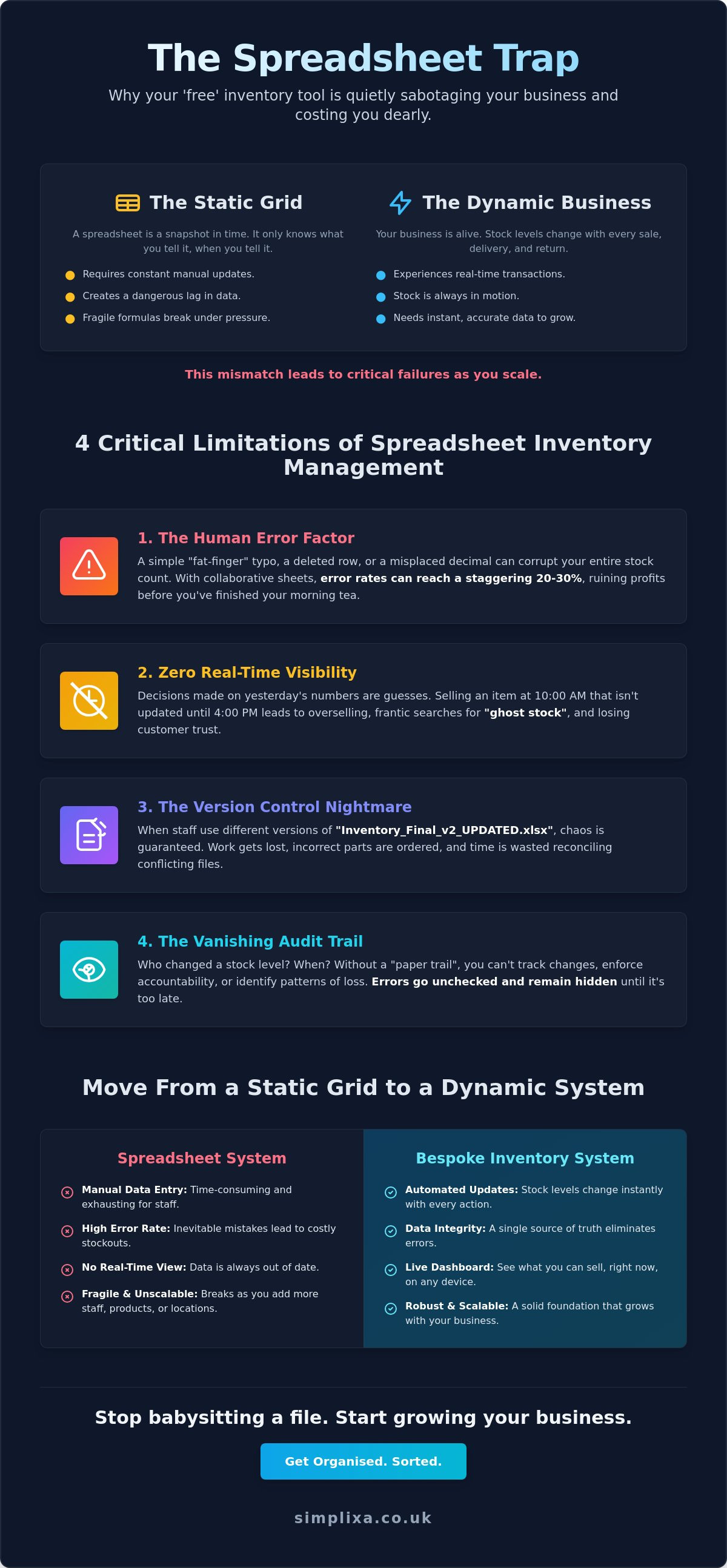
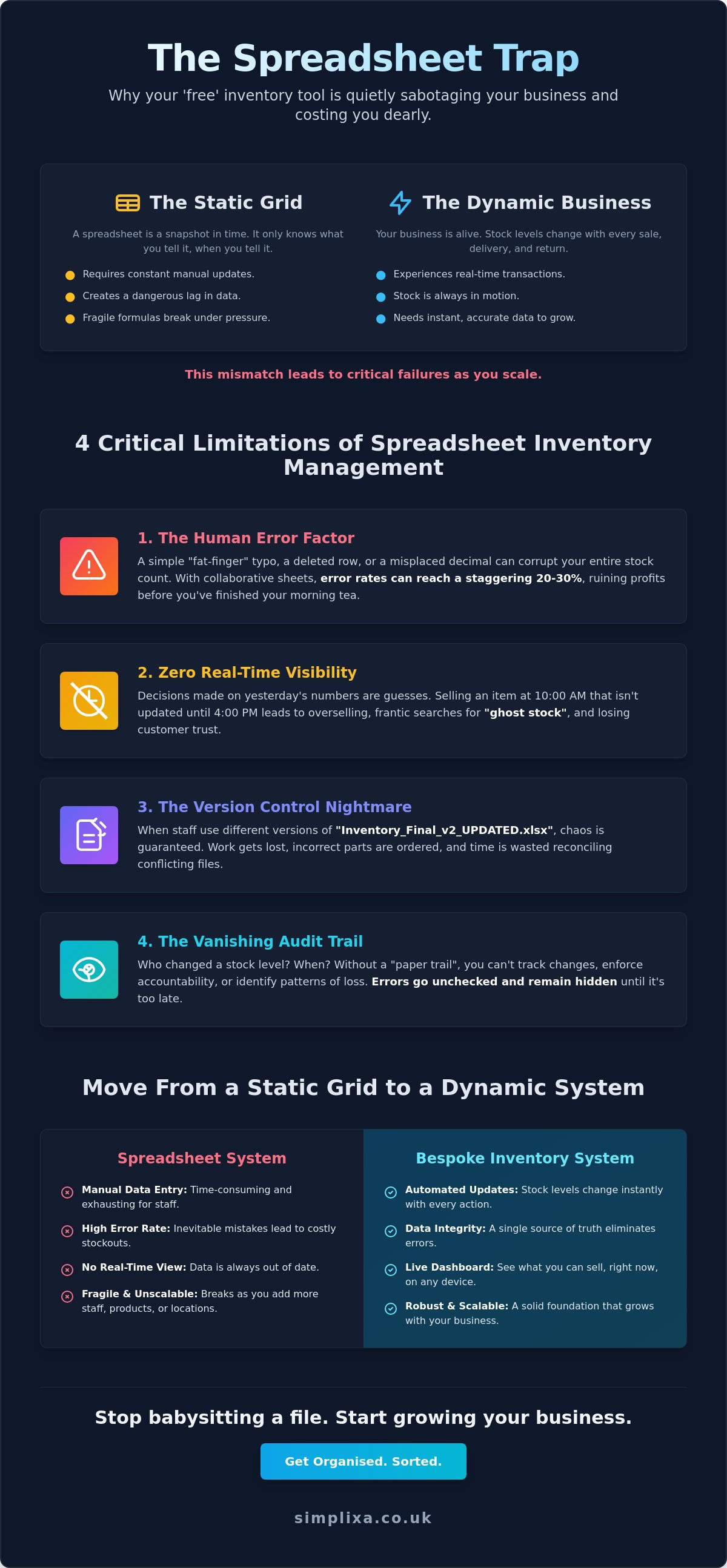
The core problem is that your business is a living thing. Your stock levels change every time a van leaves the yard or a customer clicks "buy". However, a spreadsheet is a static grid. It doesn't know what's happening in the real world until you manually type it in. This fundamental mismatch is the reason the limitations of spreadsheet inventory management become so painful as you scale. You aren't just managing a list; you are trying to maintain a functional Inventory control system using a tool designed for accounting and static data.
The Illusion of Control
There's a certain comfort in seeing neat rows and columns. It feels like you're on top of things whilst the reality on the warehouse floor might be completely different. Those numbers in the cells often lie. One accidental delete or a stray decimal point can throw your entire stock count off by thousands. If you're the only one who knows how the "Master File" works, you've created a massive bottleneck. You become the only person who can update the system. It's a heavy burden to carry. In a busy environment where multiple staff members need access, the fragility of formulas is a constant risk; one wrong click from a tired employee can break the logic that your entire business relies on.
Static Grids vs. Moving Parts
Inventory is dynamic. It's always in motion. Spreadsheets, on the other hand, only move when someone sits down to type. This creates a dangerous lag. A sale happens at 10:00 AM, but the spreadsheet isn't updated until 4:00 PM. In those six hours, you might sell the same item twice. This delay is where the real frustration lives. It leads to awkward phone calls to customers and frantic searches in the warehouse for stock that isn't there. You're making decisions based on "ghost data" rather than what's actually on the shelf. It's not just an admin headache. It's a direct threat to your reputation and your profit.
5 Critical Limitations of Spreadsheet Inventory Management
Growth is usually a cause for celebration. But for a spreadsheet, growth is a death sentence. As you add more products to your range or more staff to your warehouse, the cracks start to widen. It's not just about the software failing; it's about how these limitations of spreadsheet inventory management affect your team's sanity and your bottom line. These issues compound quickly. What was a minor annoyance with ten items becomes a full-blown crisis with a hundred. The human element is where it usually falls apart first.
1. The Human Error Factor
We've all had those "fat-finger" moments. A typo here, a deleted row there; it happens to the best of us. In collaborative environments, spreadsheet error rates can reach 20-30%. That is a staggering number. A single decimal point in the wrong place can ruin a week’s profit before you've even finished your morning tea. When you're busy, these mistakes are inevitable. The stress of trying to be perfect whilst the phone is ringing off the hook is a recipe for disaster.
2. Zero Real-Time Visibility
If it isn't on your screen right now, does it actually exist? This is the problem with out-of-date data. You cannot make snap decisions whilst looking at numbers from yesterday. If a customer calls asking for fifty units, and your sheet says "yes" but the shelf says "no", you've lost their trust. It's that simple. Real-time visibility isn't a luxury; it's the bare minimum for staying competitive in 2026.
3. The Version Control Nightmare
"Inventory_Final_v2_UPDATED.xlsx". We've all seen this file name. It’s a nightmare. When two people edit the same file at the same time, someone's work is going to get lost. You risk working from an old version and ordering the wrong parts, which just adds more clutter to your workspace and more stress to your day.
4. The Vanishing Audit Trail
Who changed the stock level for the blue widgets? With a basic file, you'll never know. There is no "paper trail" or audit log to show who touched what and when. Without accountability, errors go unchecked and patterns of loss remain hidden. You can't fix a problem if you can't see how it started. It leaves you guessing instead of managing.
5. The Manual Maintenance Burden
Research shows that planners in mid-market operations often spend 40-60% of their time just on manual spreadsheet maintenance. That is half your week gone. Instead of finding new customers or improving your service, you're babysitting cells. Moving to a bespoke Inventory Management System stops this cycle of wasted hours. It’s time to get your life back and focus on the work that actually brings in the money. Sorted.
The Hidden Cost of 'Free' Software: Why Spreadsheets Kill Profitability
It’s a common mistake. You think because you don’t pay a monthly subscription for a custom tool, your spreadsheet is "free". It isn't. In fact, it might be the most expensive piece of software you own. The real price isn't measured in pounds; it's measured in the hours you spend wrestling with a file that doesn't want to cooperate. This is the core of the limitations of spreadsheet inventory management. You’re trading your growth for a grid. Every time you fix a broken link or re-type a stock count, you're paying "Admin Debt". It's interest on a bad system that only gets more expensive as you grow.
Spreadsheets also hide the big picture. When you’re buried in rows, you can’t see high-level profit trends. You might be selling plenty of one item, but if the admin time to track it is too high, is it actually profitable? Manual systems make it nearly impossible to spot these patterns. You’re just reacting to stockouts rather than planning for success. It’s like driving with a dirty windscreen. You can see the road, but you can't see the hazards ahead.
Time: The One Resource You Can’t Buy Back
Let's be honest. If you’re spending just five hours a week fixing formulas or double-checking stock, that’s 260 hours a year. That is over six full working weeks spent on admin. For an independent operator, that time is better spent on-site or finding new leads. Every minute you spend manually typing data is a profit killer. It’s a physical burden on your schedule that stops you from learning how to scale business operations without more staff. You can't buy that time back.
The Mental Load of Uncertainty
Then there’s the "spreadsheet dread". That nagging feeling in your gut that the numbers are wrong. You can't lead with confidence when you're second-guessing your own data. It’s a mental irritant that keeps you up at night. Moving from this state of being overwhelmed to a state of complete organisation isn't just about efficiency. It's about relief. It’s about knowing, for a fact, that your stock is sorted. No more guessing. Just clear, actionable data that helps you win. Sorted.
Signs Your Business Has Outgrown the Grid
Outgrowing your spreadsheet isn't a failure. It's a badge of honour. It means your business is no longer the small, simple operation it was on day one. You’ve got more customers, more stock, and more responsibility. But staying loyal to an old tool when you’ve clearly moved past it is a risk you don't need to take. The limitations of spreadsheet inventory management become impossible to ignore when your operations reach a certain level of complexity. If you're opening a second storage centre or finding that your "simple" file now has twenty tabs, you've hit the wall.
It’s time for a quick stress test. If you can't answer a customer's stock query in under 30 seconds, your system is broken. If you’re constantly fixing #REF! errors, it's broken. Recognising these signs early saves you from a total operational collapse later on. You wouldn't use a bicycle to deliver a pallet of bricks; don't use a basic file to manage a growing warehouse. If you also need to manage physical kit alongside your stock, check out this guide on a system for tracking assets and equipment to see how professional tools handle the load.
The "Staff Threshold"
There is a hard limit to how many people can use one spreadsheet before it implodes. Usually, that number is two. Once you hire more staff, the "Master File" becomes a nightmare. You’ll notice your team starts "working around" the system because it’s too slow or too confusing. Look out for the warning signs: bits of paper taped to desks, private lists kept on phones, or staff asking each other "who has the file open?" These workarounds are a cry for help. They lead to fragmented data and expensive mistakes. Your team wants to do a good job. They just need a tool that lets them work without the constant fear of breaking a formula.
The Complexity Wall
How many tabs does your inventory file have? If you have to scroll to find the right sheet, you’ve hit the complexity wall. A spreadsheet is great for a flat list, but it struggles with relationships between data. When you have multiple suppliers, different tax rates, and various storage locations, the formulas start to get heavy. You’ll find yourself fixing the file more often than you’re actually using it. This "formula fatigue" is a major drain on your mental energy. It's one of the most exhausting limitations of spreadsheet inventory management because it never actually ends. If you're ready to stop babysitting cells and start managing your growth, it’s time to get a custom Inventory Management System built for your specific needs. Sorted.
The Modern Alternative: Bespoke Apps Without the Agency Price Tag
You’ve seen how the limitations of spreadsheet inventory management can quietly bleed your business dry. The broken formulas, the version chaos, and the constant manual double-checking are more than just admin tasks. They are physical burdens on your time. But the jump from a spreadsheet to a massive corporate software package feels just as risky. You don't want to trade one headache for another. You need a "Goldilocks" solution. Something that is just right for your specific operation without the eye-watering monthly fees of bloated off-the-shelf platforms.
This is where a custom approach changes the game. At Simplixa, we don't believe in selling you a thousand features you'll never use. We build tools that do exactly what you need and nothing else. It’s about moving from a state of constant guessing to a state of complete organisation. When your system is built around your actual workflow, the friction disappears. You stop fighting the software and start using it to win back your evenings. Sorted.
Why Custom Beats "Off-the-Shelf"
Most inventory software is built for everyone, which usually means it’s built for no one in particular. You end up paying for complex modules meant for international shipping when you just need to know how many pallets are in the shed. With a bespoke Inventory Management System, the app fits your business. You don't have to change how you work to suit a programmer's logic. Your staff will actually enjoy using it, too. We create simple, clean interfaces that work perfectly on a mobile phone whilst your team is on the move. No more shouting across the warehouse to check a stock level. It's all right there in their pocket.
Fixed Prices. Fast Delivery. Zero Stress.
We know the word "custom" usually sounds expensive. Traditional agencies love to hide behind opaque pricing and endless "discovery phases". We’ve binned that model. We offer fixed prices so you know exactly what you’re paying before we even start. There’s no fear of the unknown here. We focus on utility over aesthetics, getting your system up and running quickly so you can see the relief on your team's faces immediately.
The transition process is simpler than you think. We handle the heavy lifting of moving your data from the grid into a proper, secure database. You get a tool that grows with you, not one that holds you back. Stop letting a file from 2002 run your 2026 business. Ready to kill the spreadsheet? See how we can help.
Stop Babysitting Cells and Start Growing
You’ve built a successful business. That’s the hard part. Why let an outdated grid hold you back now? We’ve looked at how spreadsheets drain your time, hide your profits, and create chaos amongst your team. These limitations of spreadsheet inventory management aren't just technical glitches. They are mental irritants that stop you from focusing on what matters. You're trading your growth for a file that was never meant to handle your ambition.
You deserve a system that works as hard as you do. One that lives on your phone and actually reflects the stock on your shelves. Simplixa provides bespoke tools built specifically for SMEs. You get fixed-price certainty and support from UK-based experts who understand the daily grind of independent operators. No bloated features. No hidden costs. Just total organisation and the relief of a job well done.
Kill the spreadsheet and reclaim your time with a custom Simplixa app.
It’s time to move from being overwhelmed to being completely sorted. You’ve done the heavy lifting of building this business; now get the tools you deserve to take it further. You've got this.
Frequently Asked Questions
What are the biggest risks of using Excel for inventory management?
Data corruption and accidental deletion are the biggest technical risks you face. Unlike a proper database, a spreadsheet doesn't have "undo" buttons that work across different users or sessions. If someone deletes a row on Monday and you don't notice until Friday, that data is gone for good. It leaves you with a massive hole in your records that can take days to reconstruct.
Can I link my Excel spreadsheet to a mobile app?
You can't easily link a standard file to a professional mobile app without using clunky third-party connectors. These workarounds often break or lag, which defeats the purpose of having live data on-site. A custom Inventory Management System is built from the ground up to work on your phone. This means your warehouse data is always in your pocket, not stuck on a desktop in the back office.
How do I know if my business has outgrown its spreadsheet?
You've likely reached the limitations of spreadsheet inventory management if you spend more time fixing the file than actually checking stock. A clear sign is when you start keeping "side lists" because the main file is too slow or confusing. If your team is shouting across the yard to confirm numbers, your spreadsheet has officially become a burden rather than a tool.
Is custom inventory software expensive for a small UK business?
Custom software doesn't have to break the bank for a local operator. Because we build only the features you actually need, you aren't paying for the bloated extras found in off-the-shelf packages. We use a fixed-price model to keep things transparent. It’s an investment in your time that pays for itself by killing off the "Admin Debt" that's currently eating your profit.
What is the best alternative to a spreadsheet for stock tracking?
A bespoke Inventory Management System is the best alternative for businesses that find spreadsheets too simple and SaaS too complex. It gives you the "Goldilocks" solution: a tool that fits your specific warehouse layout and staff workflow. You get real-time tracking and automated alerts without having to change how you operate to fit someone else's software logic.
How long does it take to move from Excel to a custom system?
Moving from a grid to a custom system usually takes a few weeks, not months. We handle the heavy lifting of converting your existing data so you don't have to start from scratch. The transition is designed to be as painless as possible, ensuring your daily operations don't grind to a halt whilst we get your new database sorted and ready for action.
Can a custom app handle multiple warehouse locations?
Yes, a custom app handles multiple storage centres or vans with ease. Unlike a spreadsheet that requires complex formulas to track stock across different sites, a database handles these relationships naturally. You can see exactly what is in Warehouse A versus Warehouse B at the tap of a screen. This prevents you from ordering new stock when you already have it sitting in another location.
Will my staff find it hard to switch from a spreadsheet to an app?
Most staff find the switch to an app much easier than wrestling with a complex spreadsheet. We design interfaces that are as simple to use as a banking app. There are no hidden formulas to break and no confusing tabs to navigate. Because the tool is built for their specific jobs, they usually feel a sense of relief rather than frustration. Sorted.