
You arrive at the job site, open the van doors, and realise the one component you need is missing. Back at the office, that beastly spreadsheet says you have three in stock, but the shelf is empty. It is a massive waste of petrol and a blow to your reputation. Learning how to manage supplier stock levels for small business in 2026 shouldn't feel like a constant battle against your own data. With QuickBooks Desktop 2023 support officially ending on 31 May 2026, those old manual methods are becoming a genuine liability for independent operators.
We know the headache of wasting money on duplicate orders or hunting for parts that simply aren't there. You need a system that supports your hard work rather than adding to the administrative pile. This guide will show you how to strip away the stress of manual stock tracking and build a supplier management system that actually works for your business. We will explore how to achieve a real-time view of your shelves, set up automatic low-stock alerts, and give your staff a simple way to update levels whilst they are on the go.
Ensuring your team is professionally identified while they are on the go is just as important as their efficiency; click here to browse photo ID badges from Imagin Products Ltd.
Key Takeaways
- Drop the mental load of manual tracking and learn how to stop "stock-outs" from damaging your client relationships and project timelines.
- Use the 80/20 rule to identify the vital items that drive your profit and apply FIFO techniques to keep your stores organised.
- Learn how to manage supplier stock levels for small business by centralising supplier data and building a resilient backup plan for your most critical parts.
- Stop relying on fragile spreadsheets that hide errors and switch to a custom inventory management system designed for your specific workflow.
The Hidden Weight of Poor Supplier Stock Management
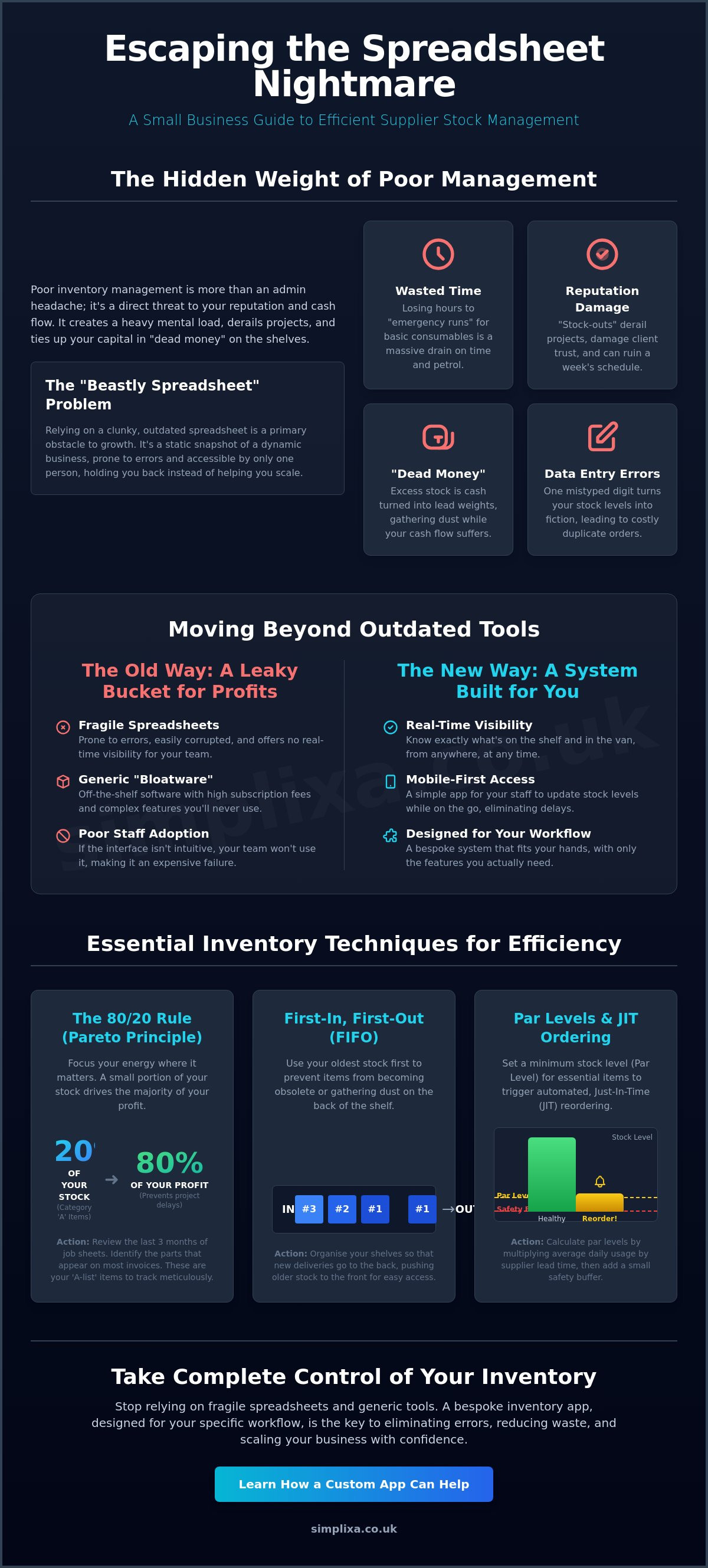
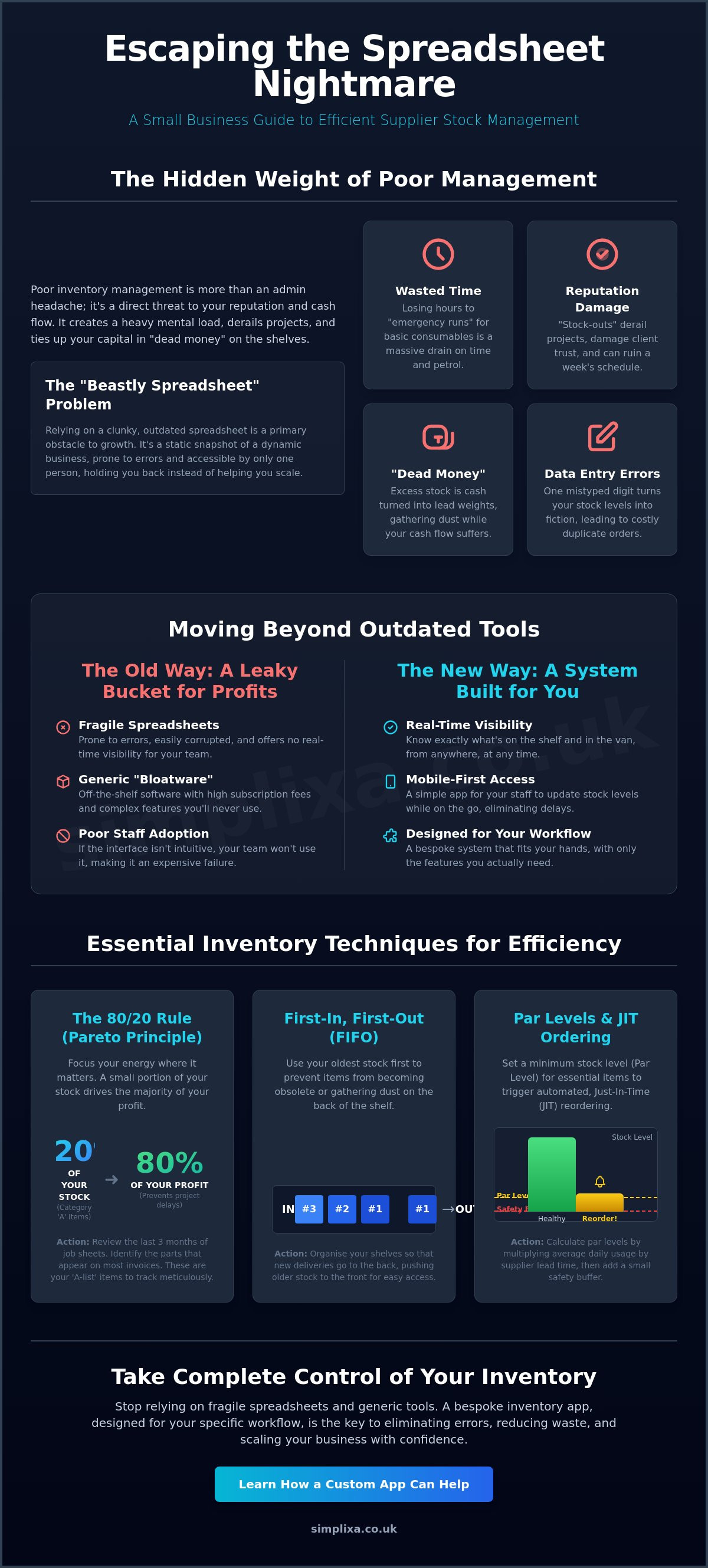
You shouldn't have to keep a mental tally of every nut, bolt, and bracket in your workshop. That constant "did I order that?" loop in your head is a recipe for burnout. It is a heavy mental load that drains your energy before you even get to the job site. When you are trying to figure out how to manage supplier stock levels for small business, the goal is simple. You need to get the data out of your head and into a system that actually works for you.
Poor inventory management is not just an admin headache; it is a direct threat to your reputation. A single "stock-out" on a Tuesday morning can derail a week's worth of projects. You lose the client's trust, and you lose the day. Worse still is the "dead money" sitting on your shelves. Excess stock is just cash that has been turned into lead weights. It sits there, gathering dust, whilst your cash flow takes a hit. You are essentially paying to store your own mistakes.
Then there is the beastly spreadsheet. You know the one. It is the primary obstacle to your growth. It is clunky, out of date, and usually only lives on one person's laptop. It doesn't help you scale; it just holds you back. It is a static snapshot of a business that is supposed to be moving.
Identifying the Manual Process Profit-Killers
Manual tracking is a leaky bucket for your profits. Without real-time visibility, your team ends up placing duplicate orders because they didn't realise the parts were already in the van. You also lose hours to "emergency runs." Driving to a supplier for basic consumables is a massive waste of time and fuel. For those looking to curb these transport costs, Fleetmaxx Solutions offers a free fuel bill analysis to help manage your fleet more effectively. In a busy environment, manual data entry is always prone to errors. One mistyped digit and your stock levels become a work of fiction. These small mistakes add up to thousands in lost time every year.
Why Small Businesses Struggle with Generic Tools
Off-the-shelf software often feels like buying a sledgehammer to crack a nut. These tools are packed with "bloat" features you will never use, but you are still paying for them. High monthly subscriptions for complex systems can eat into your margins quickly. If the interface is not intuitive, your staff simply won't use it. You end up with an expensive system that nobody touches, and you are right back where you started with the beastly spreadsheet. You need a tool that fits your hands, not a generic corporate platform.
Essential Inventory Techniques for Small Business Efficiency
You don't need a degree in logistics to get your stores in order. Most small businesses overcomplicate things by trying to track every single washer and screw with the same intensity. It is a waste of your energy. Instead, you should master a few essential inventory techniques that actually make your life easier. Learning how to manage supplier stock levels for small business effectively starts with knowing which items actually matter to your bottom line.
First, embrace the 80/20 rule. In almost every trade, 20% of your stock drives 80% of your work. These are your bread-and-butter parts. If you run out of them, the job stops. By focusing your tracking efforts on these high-impact items, you save hours of admin time without losing control of the workshop. It is about being smart with your time rather than being busy for the sake of it.
You should also implement FIFO (First-In, First-Out). Even if your parts don't have an expiry date, using the oldest stock first prevents items from gathering dust at the back of the shelf. It keeps your inventory moving and ensures you aren't holding onto components that might become obsolete. When you combine this with "Par Levels", which is a set minimum amount for every essential item, you create a safety net. You only reorder when you hit that limit. This leads to Just-In-Time (JIT) ordering, keeping your cash in the bank rather than tied up in piles of clutter. For those in the health or food sectors, coordinating this with a specialist contract packer like simplepack.co.uk ensures your stock levels remain lean and efficient.
Applying the 80/20 Rule to Your Stockroom
Start by categorising your stock based on how often you use it. Focus your energy on "Category A" items. These are the parts you use on almost every job. By keeping a tight grip on these, you prevent the most common causes of project delays. Identify your "A-list" inventory by reviewing your job sheets from the last three months to see which specific parts appear on the majority of your customer invoices.
Calculating Your Minimum Stock Levels
To set your reorder points, you must understand your supplier lead times. If a part takes four days to arrive, you need enough stock to cover those four days plus a small "buffer" for emergencies. A simple formula is to multiply your average daily usage by the lead time and add your safety buffer. This removes the guesswork and prevents that sinking feeling when you realise the shelf is empty. If you want to automate this process, a custom inventory management system can send you an alert the moment you hit your minimum level.
How to Organise Supplier Information Effectively
Your phone's contact list is likely a graveyard of old numbers, half-remembered names, and "Dave from the warehouse." It is a terrible way to run a professional operation. If you want to truly master how to manage supplier stock levels for small business, you have to move beyond the "contacts" app. Centralising your supplier data is about more than just having a tidy list. It is about building a resilient system that keeps your business moving when things go wrong.
Resilience comes from mapping every critical part to both a primary and a secondary supplier. If your main source runs out of a specific component, you shouldn't be scrambling to find an alternative whilst the clock is ticking on a job. Having that backup ready to go is a massive weight off your shoulders. You also need to hold your suppliers accountable. By tracking actual lead times against their promises, you can see who is actually reliable and who is just talk. For specialists in product development, you can read more about VPrint3D Limited to see how they provide integrated prototyping solutions. When your records are automated, the friction of raising a purchase order disappears. You stop second-guessing and start ordering with confidence.
This level of professional accountability should extend to every facet of your business operations, including your team's presentation. By managing your workwear requirements through The Staff Uniform Company, you can ensure that your staff—particularly those in client-facing service or beauty roles—are always equipped with high-quality attire that reflects your brand's standards.
This level of accountability is essential whether you are sourcing mechanical parts or professional marketing materials; for example, you can discover Print It ZA print and packaging to see how a specialist supplier maintains high standards in litho and digital production.
The 5 Steps to a Centralised Supplier Database
Building a database doesn't have to be a mountain of work. Start with an audit of your current list. Remove the "one-offs" and the "ghosts" you haven't used in a year. Next, digitalise your price lists so your quotes are always based on current costs, not a guess from six months ago. Establish clear terms and lead times for every major partner. Finally, link specific parts to their SKU codes and assign a secondary supplier for every "Category A" item. This structure turns a mess of info into a genuine business asset.
Linking Stock Levels to Supplier Reordering
The real magic happens when your stock levels talk to your supplier data. When you hit a "Par Level" on the shelf, your system should trigger an automatic notification. This isn't just a vague "we are low" alert. It should tell you exactly what you need, which supplier has it, and the specific SKU code to use. This removes the "admin lag" that often leads to stock-outs. Your team will know exactly who to call for what equipment, ensuring that nobody is ever left guessing on a job site. It is about creating a smooth, predictable flow from the warehouse to the customer.
If your business growth involves moving from field-based services to selling products online, you might discover Boost3PL as a solution for managing the logistics of your order fulfillment.
Moving Beyond the Spreadsheet: Evaluating Your Toolset
You've likely relied on a single Excel file for years. It feels safe because it's familiar. But running your entire operation on a flat file is a massive risk. Spreadsheets are static. They don't update when your team is out on a job. They don't alert you when a supplier changes their lead times. They are essentially a digital paper trail that someone always forgets to update. It is a fragile way to manage your livelihood and your reputation.
Many small businesses fall into the trap of "free" tools. They think they're saving money. In reality, they end up losing hundreds in lost hours and avoidable errors. When you're trying to figure out how to manage supplier stock levels for small business, you need a tool that moves at your pace. Generic SaaS platforms often come with a monthly subscription for features you'll never touch. They're bloated, intimidating, and often too complex for a five-person team. A bespoke app, on the other hand, is built around your specific workflow. It gives your staff mobile access so they can update stock levels from the van, not three days later back at the office.
Mobile access is the game-changer for field-based teams. If your staff can't update the system whilst they're holding the part, the data is already wrong. Real-time updates mean you always have a clear view of what's actually on the shelf. No more "ghost" stock. No more duplicate orders because someone forgot to write it down. It moves you from a state of constant guessing to complete organisation.
When to Sack Your Spreadsheet
Signs your data has become too complex are everywhere. If you have multiple versions like "Stock_Final_v2_UPDATED" floating amongst your emails, you've lost the single source of truth. You spend more time fixing broken formulas than actually ordering parts. A spreadsheet becomes a liability the moment more than one person needs to update it simultaneously whilst working on different job sites.
The ROI of Custom Digital Tools
Removing manual stock-takes saves hours of administrative drudgery every month. That's time you could spend on billable work or growing your client base. Better tracking means you can see exactly what was used on a job, leading to faster project sign-offs and invoicing. Accuracy prevents the "emergency run" to the supplier, which saves petrol and keeps your schedule intact. If you're still deciding on the right path, check out The Ultimate Guide to Choosing a System for Tracking Assets and Equipment in 2026. We can help you ditch the spreadsheets for good with a custom inventory management system built specifically for your team.
Bespoke Inventory Apps: The SIMPLIXA Way to Total Control
You have seen the hidden costs of sticking with the status quo. The beastly spreadsheet and those manual errors aren't just irritants; they are active drains on your profit. At SIMPLIXA, we build tools that fit your business, not the other way around. We don't believe in forcing you into a generic box designed for a different industry. Instead, we take your specific, real-world workflow and turn it into a streamlined mobile app. This is how to manage supplier stock levels for small business without the usual technical headache or corporate jargon.
We provide fixed-price certainty from the very start. You won't find any hidden hourly fees or bloating costs here. We are honest about the investment because we value fairness and speed. Our goal is to move you from a state of being overwhelmed to a state of complete organisation. We replace tatty paper forms and forgotten notes with simple, digital sign-offs. Your staff can update stock levels in seconds whilst they are still on the job. It moves your data from a dusty office computer to the palm of your hand.
A System Built for Your Growth
A custom tool only includes the features you actually use. No bloat. No confusion. This allows your inventory system to scale naturally as you take on bigger projects. You won't need to hire more admin staff just to keep up with the mounting paperwork. Most importantly, bespoke software creates real, saleable value for your business. It proves to potential buyers or partners that you run a professional, automated operation that doesn't rely on one person's memory. For businesses that eventually outgrow bespoke apps and require enterprise-level integration, NaviWorld (Thailand) Co., Ltd. provides specialised implementation of Microsoft Dynamics 365. It is a job done right.
As your business matures, you may transition towards more complex models where enterprise-scale operations become necessary; in such cases, platforms like ommni.io can offer the advanced infrastructure required for high-volume growth.
Getting Started with Your Custom Inventory App
Everything starts with our "Discovery Phase." We sit down with your team to map out exactly what digital success looks like for your specific trade. We don't drag our feet. Our fast delivery means you get relief from admin stress sooner rather than later. It is about getting the job done right so you can get back to your actual work. See how a custom inventory system could work for you. It is time to stop fighting your tools and start using them to grow.
Take Back Your Time and Your Profit
Stop letting the beastly spreadsheet dictate your weekends. You have seen how poor tracking drains your cash and your energy. By applying the 80/20 rule and centralising your supplier data, you move from constant guesswork to total organisation. Mastering how to manage supplier stock levels for small business isn't about working harder. It is about using tools designed specifically for your daily operations.
At SIMPLIXA, we provide UK-based bespoke development that focuses entirely on utility. We strip away the bloat of generic software to give you exactly what you need. With our fixed-price project costs, you get the certainty you deserve without any hidden surprises. It is time to move your business from a state of being overwhelmed to a state of complete control.
Kill the spreadsheet and regain control with a custom inventory app
You have built a successful business through hard work and grit. Now, let us help you build the system that supports your next level of growth. You have got this.
Frequently Asked Questions
Is it better to use a spreadsheet or an app for stock tracking?
An app is far superior once you move beyond being a solo operator. Spreadsheets are static, fragile, and prone to "version control" nightmares where no one knows which file is current. A dedicated app provides real-time updates and multi-user access. This ensures that when a part is used in the field, your records update instantly back at the office.
How often should a small business perform a physical stock-take?
You should aim for "cycle counting" every month rather than one massive annual count. Focus on your high-value "A-list" items every four weeks to keep your data sharp. This prevents the need to shut down your entire operation for a day of counting. It keeps your inventory accurate without the administrative burnout of a traditional stock-take.
What is the most effective way to track stock in a service van?
Mobile-first digital updates are the only way to keep van stock accurate. Your staff should log parts as they use them on the job site via their phones. This stops the "Friday afternoon scramble" where everyone tries to remember what they used. It ensures your how to manage supplier stock levels for small business strategy actually works in the real world.
Can I link my inventory management to my quoting process?
Yes, and you should. Linking these systems ensures your quotes are based on live stock levels and current supplier pricing. It prevents you from promising a component to a client that is actually out of stock. This automation removes the manual lag between winning a job and ordering the parts, which protects your margins and your schedule.
How do I handle suppliers with long or unpredictable lead times?
Set higher "Par Levels" for these specific suppliers and always have a secondary backup partner on file. By tracking historical delivery performance in your system, you can see exactly how long a supplier actually takes. You can then adjust your buffer stock based on hard data rather than just hoping for the best on a Tuesday morning. This data-driven approach is particularly useful when dealing with specialist providers like Grabex Windows Ltd, where lead times for bespoke timber or aluminium products must be factored into your project timelines.
What are the main benefits of a bespoke inventory management system?
The main benefit is a tool that fits your specific trade workflow without any unnecessary "bloat." You get exactly the features you need to understand how to manage supplier stock levels for small business without paying for complex extras. It is a no-nonsense solution that scales with you, creating real value for your business without adding to your admin pile.
How much does it cost to build a custom stock tracking app in the UK?
The cost depends entirely on the complexity of your workflow and the specific features your team needs. We focus on fixed-price certainty so you know exactly what the investment is before we write a single line of code. This avoids the "open chequebook" trap of traditional agencies and ensures you get a tool that delivers genuine utility.
Can my staff update stock levels from their mobile phones?
Yes, our custom apps are designed specifically for mobile use in the field. This allows your team to update quantities or sign off on parts whilst they are still on the job site. It removes the friction of manual data entry and ensures your central records are always 100% accurate. It is about making life easier for your team, not harder.