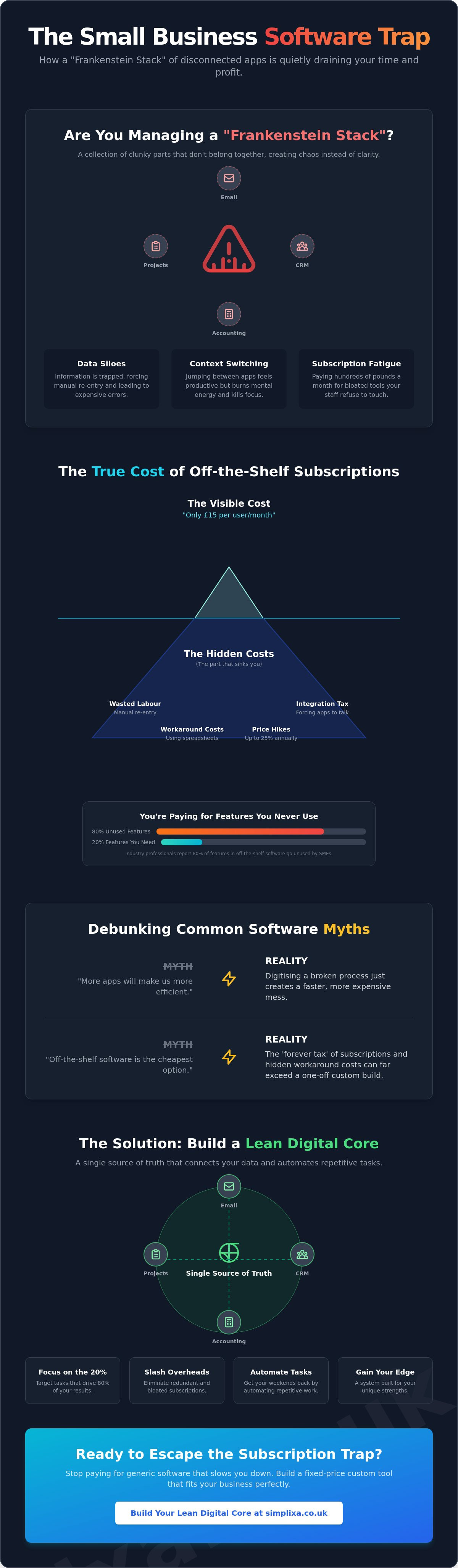

Your latest software subscription isn't the lifesaver you were promised. It's likely just another tab open in a browser already full of headaches. We've been told for years that there's an "app for that," but for most independent operators, this has created a digital "Frankenstein's Monster." You're likely tired of logging into five different systems just to find one client's phone number. Finding the right software to improve small business efficiency isn't about collecting more icons on your home screen. It's about making your data work in one place.
It's exhausting when you're paying hundreds of pounds a month for tools your staff refuse to touch. You want a single source of truth, not a dozen data siloes and endless manual re-entry. We're going to debunk the myth that more apps equals more speed. You'll discover how to trim the fat from your digital overhead and build a streamlined system that automates the repetitive tasks. We're moving away from subscription fatigue whilst focusing on a lean core that finally lets you get your weekends back.
Key Takeaways
- Stop trying to fix messy processes with more downloads. Digitising a broken workflow just creates a faster, more expensive mess.
- Understand the "Integration Tax." Using disconnected apps leads to data siloes and hours of wasted labour spent on manual data re-entry.
- Focus on your "Lean Digital Core" to find the right software to improve small business efficiency. Target the 20% of tasks that drive 80% of your results.
- Kill the "Frankenstein Stack" of subscriptions. A streamlined system provides a single source of truth and slashes your monthly overheads.
- Learn how custom tools like automated quoting or staff tracking apps offer a better fit than generic, bloated software.
The Efficiency Paradox: Why More Software Often Means Less Work Done
Most UK business owners are sold a dream. They're told that the right software to improve small business efficiency is just one more download away. But here's the reality. You're likely working harder now than you were when you just had a notebook and a pen. This is the Efficiency Paradox. It's the point where adding more tools actually starts to steal your time instead of giving it back. You're not being supported by your tech. You're being bullied by it.
Every time you jump from your email to a tracking app, your brain pays a price. It's called context switching. It feels like you're being productive. In reality, you're just burning mental energy. When your software doesn't talk to each other, you're the one forced to bridge the gap. You become the human link between disconnected systems. We call this the Frankenstein Stack. It’s a collection of parts that don't belong together. It's ugly, it's clunky, and it's exhausting to manage. The "there's an app for that" mentality hasn't solved your admin. It's just digitised the mess.
The Subscription Trap: Paying for Productivity You Never See
Those "cheap" monthly seats are a slow puncture in your bank account. It starts at £15 per user. Before you know it, you're paying for five different platforms. Research shows that 75% of small and midsize businesses plan to increase their software spending in 2025. With providers like QuickBooks hiking prices by up to 25% in May 2026, the cost of generic Business software is becoming a major drain on profit. Most of these apps are bloated with features you'll never touch. Some industry professionals report that 80% of features in off-the-shelf software go completely unused by SMEs. You're paying for the kitchen sink when all you needed was a tap. Managing all those logins and permissions is a full-time job in itself. It's a psychological burden that keeps you from focusing on the actual work.
Data Siloes: The Silent Killer of Small Business Growth
Data siloes happen when your information is trapped in different corners of your business. Your customer's phone number is in one app, whilst their project history is in another. This isn't just annoying. It's dangerous for your growth. Moving data manually between these apps is where the expensive mistakes happen. A typo in a postcode or a missed decimal point in a quote can cost you a contract. To truly scale, you need a single source of truth. You need one place where everything is accurate and up to date. Without it, you're just guessing. Finding the right software to improve small business efficiency means killing these siloes once and for all. It means having your staff tracking, inventory, and quoting all speaking the same language.
Myth-Busting: Debunking the Top 3 Efficiency Software Lies
You have been sold a pup. The software industry is brilliant at making you feel like your business is just one more subscription away from perfection. They promise that "the right tools" will solve all your problems. Usually, they just add more tabs to your browser. It is time to pull back the curtain on the fairy tales. Real software to improve small business efficiency doesn't come from a generic template. It comes from understanding how you actually work.
Myth 1: Digitising Chaos Doesn't Create Order
If your current way of working is a muddle, putting it on a screen won't fix it. You'll just have a digital muddle that moves slightly faster. You must map out your manual workflow before you ever click "sign up" for a trial. Without a plan, you fall victim to "feature creep." This happens when a generic app forces you to change your successful business habits just to fit its rigid buttons. Digital waste is the digitisation of unnecessary steps. Why pay to automate a task that shouldn't exist in the first place? Strip the process back to the basics before you touch the tech.
Myth 2: The 'False Economy' of Off-the-Shelf Subscriptions
Off-the-shelf looks cheap on day one. But "per user, per month" is a forever tax. Add up those costs over three years and compare it to the cost of a one-off build. Often, the "cheap" app doesn't actually do what you need. Your team ends up using spreadsheets to fix the gaps the software left behind. That's an expensive "workaround cost" in lost labour. If you use the same generic tools as every competitor, you're losing your edge. You're working like everyone else instead of playing to your unique strengths. You can often get a fixed-price custom tool that does exactly what you need without the bloated agency price tag.
There is also a dangerous assumption that staff will automatically "figure out" complex generic tools. They won't. If a system is too clunky, your team will find ways to avoid using it. They'll go back to their old, messy habits because they're easier than fighting with a confusing interface. Genuine software to improve small business efficiency should be so simple that training takes minutes, not weeks. It shouldn't be a puzzle for your staff to solve. It should be a tool that feels like it was made for them. Because when software is built for your specific business, it actually gets used.
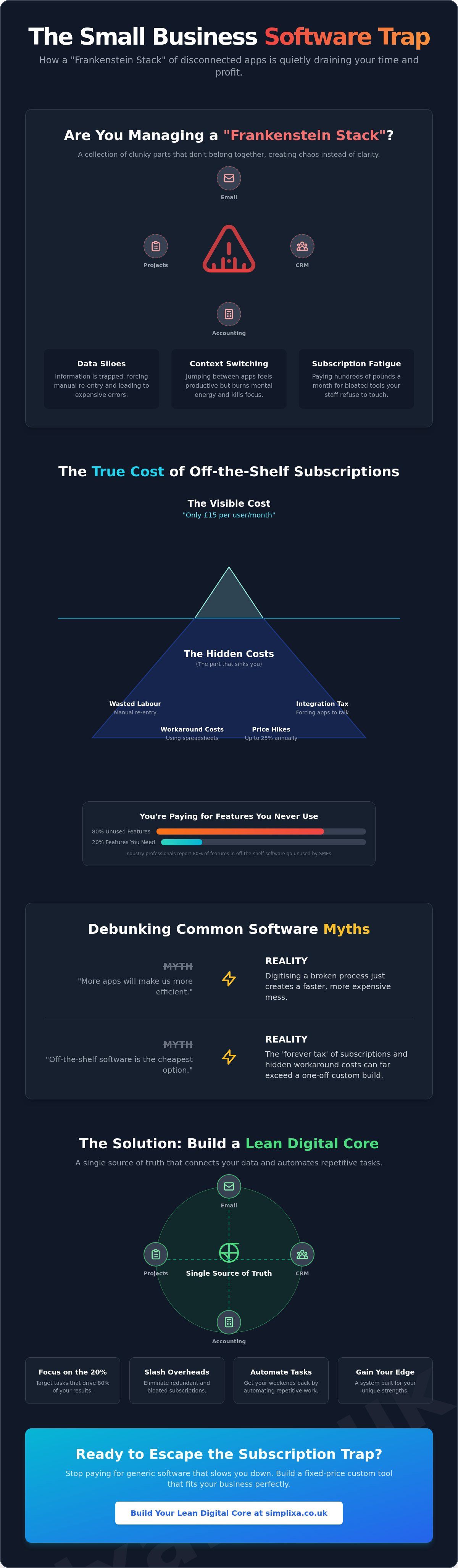
The True Cost of 'Cheap' Off-the-Shelf Subscriptions
Don't be fooled by the low entry price of a new app. It's a hook. Most UK operators look at the monthly fee and think they've found a bargain. They forget about the "Total Cost of Ownership." This is the real price of your software after you've added up the setup time, the monthly "per user" tax, and the hours lost to training. When your software to improve small business efficiency is a collection of generic tools, you're often paying a premium for a system that only does half the job.
Then there is the "Integration Tax." If your apps don't talk to each other, you pay for it in labour. You pay every time a staff member has to copy a name from an email into a CRM, then into an invoice. It's a silent drain on your bank account. Worse still is the risk of "shadow IT." If your official systems are a faff to use, your team will find their own ways to work. They'll start using personal WhatsApp groups or private cloud storage to get the job done. Suddenly, your sensitive client data is scattered across personal devices you don't control. That's a security nightmare waiting to happen.
Subscription Creep: The Silent Profit Leak
Subscriptions have a way of multiplying when you aren't looking. Take a moment to audit your bank statement. You'll likely find "zombie subscriptions"—tools you signed up for during a busy period and haven't touched for months. These small monthly leaks add up to a massive annual drain on your profit. Generic software providers are also prone to sudden price hikes. In May 2026, Intuit increased QuickBooks Online rates by up to 25%. For an independent business, these jumps make budgeting impossible. Moving to a fixed-price model for your core tools provides the financial certainty you need to actually plan for growth.
The Hidden Labour Cost of Manual Data Syncing
Manual data entry is a relic of the past that's still killing modern businesses. Every time you manually sync data between tools, you're inviting errors. A simple typo in a quote can ruin your professional reputation before the job even starts. The time cost is even higher. Verified data from late 2025 shows that 63% of small businesses using automation and AI report saving over 20 hours per month. That is nearly three full working days handed back to you. Imagine what you could do with an extra 20 hours. You could focus on high-value clients instead of fighting with a spreadsheet. True software to improve small business efficiency should act as a single source of truth, not a manual data-entry chore.
Building a Lean Digital Core: A Strategy for Genuine Efficiency
You don't need a hundred tools to run a successful business. You need a few that actually work together. To find the right software to improve small business efficiency, you must first identify your "Core Workflow." This is the 80/20 rule in action. Look for the 20% of tasks that drive 80% of your value. Usually, it is your quoting, your staff scheduling, or your inventory management. Everything else is just background noise. Once you know what matters, audit your current "Frankenstein Stack." Be honest about which apps are helping and which ones are just digital clutter. If a tool isn't saving you time every single day, it is time to bin it.
The next step is moving towards a single source of truth. Instead of data being scattered across five different platforms, you want it consolidated into one secure cloud-based database. This reduces the risk of errors and ensures everyone on your team is looking at the same information. When it comes to training, remember that simple always beats sophisticated. A system that is easy to use will actually get adopted. If your staff need a manual the size of a phone book to log their hours, the system has already failed. You want a tool that feels natural from day one.
When to Buy: Using SaaS for Non-Core Functions
Don't reinvent the wheel for tasks that aren't unique to your business. For accounting, stick with standard platforms like Xero or QuickBooks. These are "best-of-breed" tools for a reason. They handle tax and compliance so you don't have to. The same goes for your email or video calls. There is no competitive advantage in building your own version of Zoom. Just ensure that any software you "buy" has an open API. This means it has the ability to talk to other tools in the future. You want software to improve small business efficiency that can grow and connect as your needs change.
When to Build: Bespoke Tools for Your Secret Sauce
This is where you gain your competitive edge. Your "secret sauce" is the unique way you handle your staff tracking or your specific quoting process. Generic apps often force you to change these successful habits to fit their rigid templates. A custom tool does the opposite. It matches your favourite way of working. It can replace five messy spreadsheets with one simple screen that does exactly what you need. If you're tired of fighting with off-the-shelf tools that don't quite fit, it might be time to explore a custom staff tracking app or automated quoting tool built specifically for your operation. This isn't just about tech. It is about reclaiming your time and focusing on the work that actually pays the bills.
Simplixa: Custom Tools for Businesses That Have Outgrown the App Store
You've tried the off-the-shelf route. You've downloaded the "top-rated" apps. Yet, you're still drowning in admin. At Simplixa, we help UK operators kill the spreadsheet and reclaim their time. We don't believe in the "App for That" culture. We believe in the "Right Tool for You" culture. Most software to improve small business efficiency is built for everyone, which usually means it's built for no one. We do things differently. We start with your specific business problem, not a generic list of features. If your staff are currently fighting with five different systems to do one job, we're here to fix that.
We provide professional software without the usual agency price tag. Our "Fixed-Price" promise means you know exactly what you're paying from the start. No hidden fees. No "per user" monthly tax that grows as your team does. We focus on moving your business from complex to practical. We build tools that your staff will actually enjoy using. If a system isn't intuitive, it's a burden. We make sure your digital core is a source of relief, not a source of stress.
Our Process: Fast Delivery, No Jargon
We don't do technical fluff. We speak your language. Our process is designed to be fast and painless. We take your dusty paper forms and those messy Excel files that only you understand. We convert them into sleek, custom digital apps. This includes everything from an Inventory Management System to an Automated Quoting Tool. The best part? You own the tool. Our "One-Off" cost model breaks the never-ending subscription cycle. You pay once, and it's yours. We provide ongoing support to ensure your software to improve small business efficiency grows whilst your business does. It's about building a foundation that lasts.
Real Results: Moving from Overwhelmed to Organised
Consider the impact of replacing a clunky, manual staff tracking system with a custom app. One client moved from spending six hours a week on scheduling to just fifteen minutes. That is the "Relief" factor. It's the feeling of finally having a business that runs itself. You can stop worrying about data siloes and manual entry errors. You can focus on the work that actually makes you money. It is time to move away from the "Frankenstein Stack" and towards a unified system. Stop fighting your software and start scaling your business with a Simplixa custom tool. Let's get your business organised once and for all.
Stop Managing Apps and Start Running Your Business
You didn't start your business to become a part-time software administrator. Collecting "cheap" subscriptions has likely left you with a Frankenstein's Monster of disconnected data. Real software to improve small business efficiency shouldn't feel like a physical burden or a mental irritant. It should be a single source of truth that kills the manual copy-pasting and gives you your Sunday nights back. You've seen the true cost of off-the-shelf bloat and the subscription creep that drains your profits. Now it's time to build a lean digital core that actually fits the way you work.
Our UK-based expert team is here to help you move from overwhelmed to organised. We value utility over aesthetics and provide the fixed-price certainty that independent operators need. No hidden fees. No jargon. Just practical tools that your staff will actually enjoy using. Book a free discovery call to see how we can streamline your business. It's time to stop fighting your tech and start scaling your success. You've worked hard to build your business. Let's make sure your software finally works just as hard for you.
Frequently Asked Questions
What is the best software to improve small business efficiency?
The best software to improve small business efficiency is the one that fits your unique workflow perfectly rather than forcing you to change. Often, a custom tool like a bespoke CRM or an automated quoting tool beats a generic app because it handles your specific "secret sauce." It's about creating a single source of truth for your data instead of juggling ten different logins.
Is custom software more expensive than monthly subscriptions for a small business?
Custom software is usually a one-off investment, whilst subscriptions are a forever tax that grows as you add staff. Over three to five years, the "per user" monthly fees of off-the-shelf apps often add up to more than a bespoke build. You also avoid sudden price hikes and the cost of paying for bloated features your team never uses.
How do I know if my business has outgrown its current spreadsheets?
You've outgrown your spreadsheets when you spend more time fighting the file than doing the actual work. If you're worried about version control or find yourself copy-pasting data between different tabs, it's time for a change. A custom inventory management system or staff tracking app can replace those messy files with a single, secure screen.
Can I automate my business processes without hiring more staff?
Yes, finding the right software to improve small business efficiency allows you to scale your output without increasing your headcount. Automation handles the repetitive admin like data entry and booking confirmations. This frees up your existing team to focus on high-value tasks that actually bring in money, effectively increasing your capacity overnight.
How long does it take to build a custom app for a small business?
Practical custom tools are often delivered much faster than traditional agency projects because we focus on utility over aesthetics. We move quickly from identifying your administrative burden to delivering a working solution. Our goal is to get your system live and saving you time as soon as possible without getting bogged down in technical fluff.
What are the risks of using too many different software tools?
The biggest risks are data siloes and the hidden cost of context switching. When your info is in five different places, errors happen and security drops because staff start using their own "workarounds." Using too many disconnected tools creates a "Frankenstein Stack" that is exhausting to manage and expensive to maintain.
Do I need to be a 'tech person' to manage a custom business app?
Not at all. We build tools that are so simple your team can use them without a manual. If software is too complex, people simply won't touch it. Our focus is on grounded, jargon-free systems that work for real-world operators. You don't need to understand the code to feel the relief of an organised business.
How can software help reduce my administrative costs?
Software slashes costs by removing the need for manual data re-entry and preventing expensive human errors. Tools like digital form conversion and automated quoting stop the hours of labour wasted on paperwork. By streamlining your digital core, you also reduce monthly subscription overheads and reclaim the time your staff spend on repetitive admin.