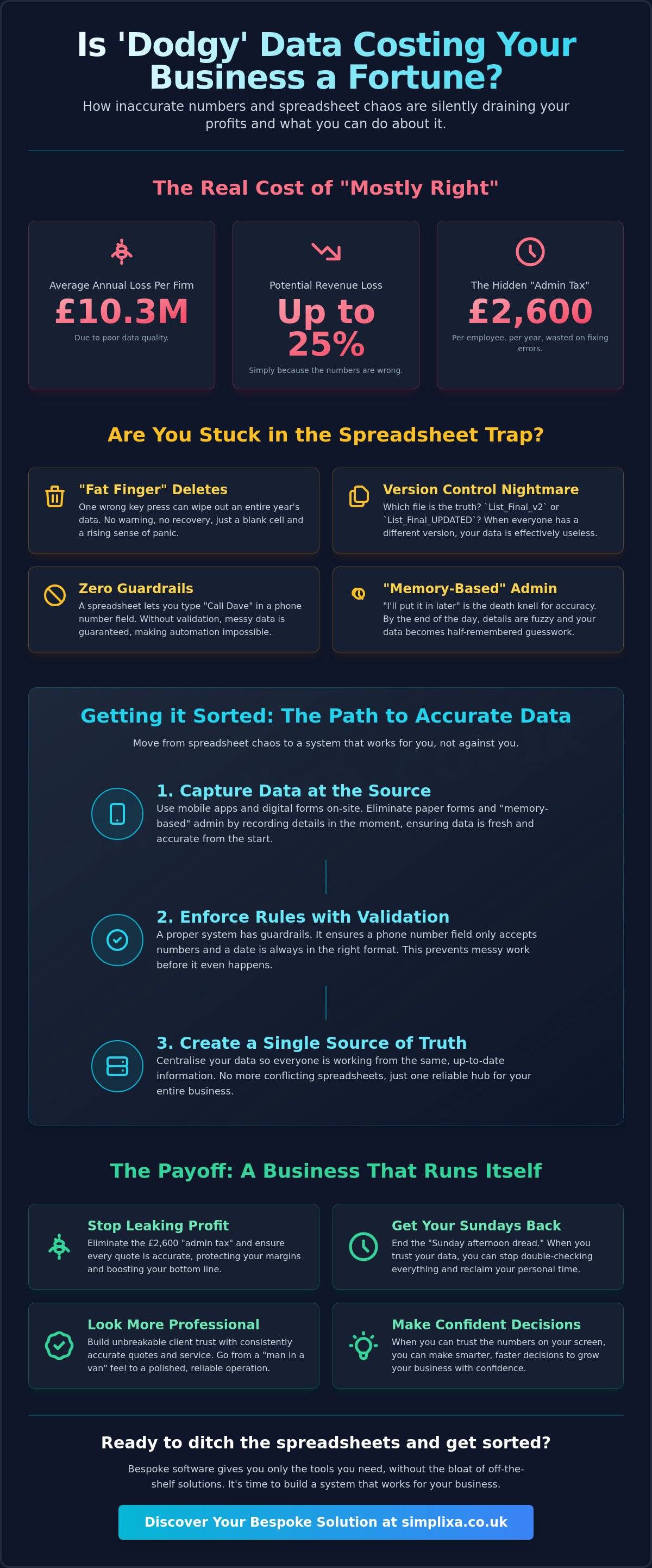

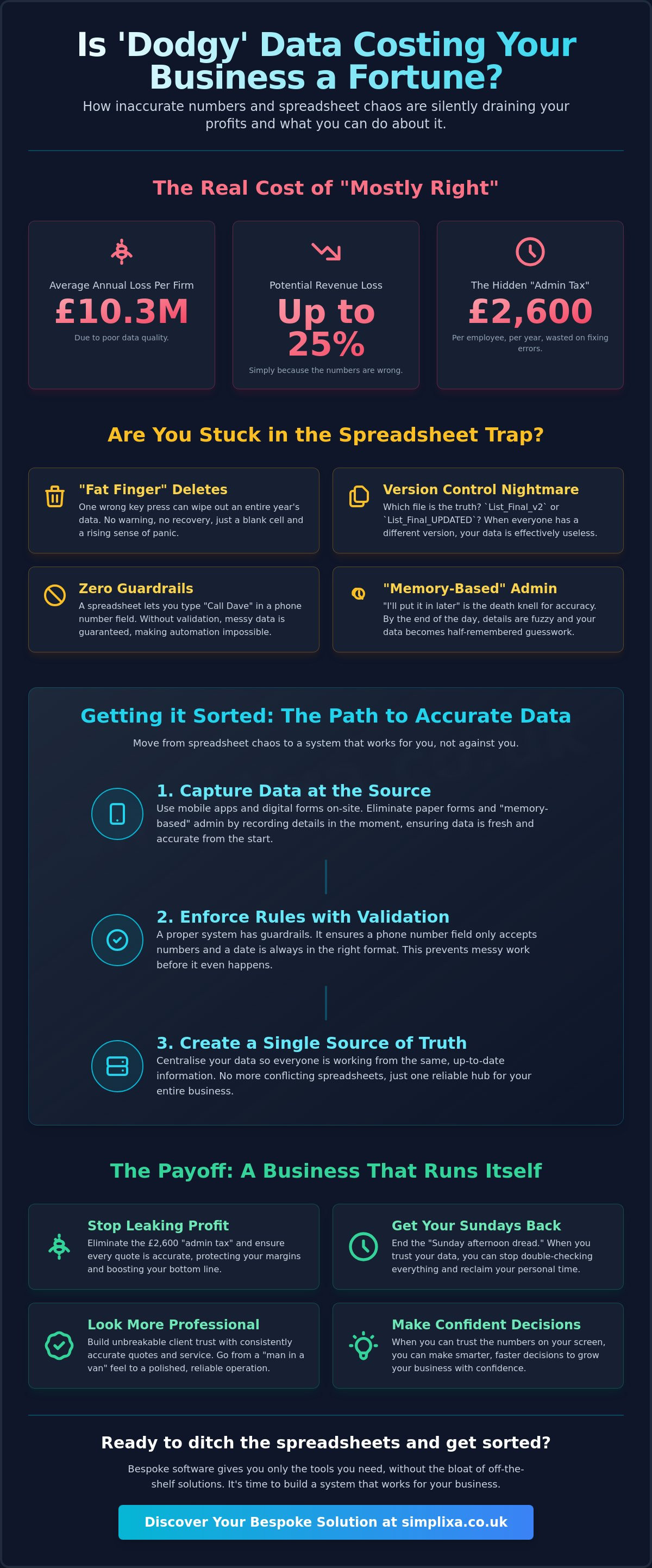
It’s 4:00 PM on a Sunday, and instead of relaxing, you’re squinting at a spreadsheet that refuses to balance. One wrong digit in a cell has sent your quotes spiralling, and now you’re facing the reality that poor data quality costs the average firm about £10.3 million every single year. It’s doing your head in, isn’t it? You know that improving data accuracy in business is the only way to stop your profit leaking through the cracks, yet the messy work keeps piling up. In fact, research from May 2026 shows that businesses are still losing up to 25% of their revenue simply because their numbers are wrong.
We agree that you shouldn’t have to be a data scientist just to know if your shop or garage is healthy. This guide is here to help you ditch the manual guesswork and get your data sorted with practical, no-nonsense strategies that work for real people. You’ll learn how to stop the paper form madness and start trusting the numbers on your screen again without spending a fortune on a tech department.
We’re going to show you how to move from spreadsheet chaos to proper tools, ensuring your business runs itself so you can finally get your Sundays back.
Key Takeaways
- Stop wasting hours on "double-checking" work and understand why "mostly right" data is actually costing you a fortune in lost quotes.
- Discover why improving data accuracy in business requires moving past the "spreadsheet trap" and those accidental "fat finger" deletes.
- Learn the simple difference between data quality and integrity to ensure your records are both accurate and properly formatted.
- Find out how to capture data at the source using mobile apps and digital forms that take the messy work off your plate.
- See how bespoke software gets your business sorted by focusing only on the tools you need, without the bloat of off-the-shelf licenses.
The Real Cost of "Dodgy" Data in Your Business
We’ve all been there. You’re looking at a list of figures that just don't add up. You tell yourself it’s "mostly right," but in the world of business, "mostly right" is just a polite way of saying "completely wrong." If your staff tracking is off by ten minutes or your inventory is out by two units, your bottom line is already taking a hit. This isn't just about being tidy; it's about survival. Poor Data quality acts like a slow puncture in your company car. You might not notice it on the first mile, but eventually, you’re going to end up stuck on the hard shoulder.
The mental toll of messy work is the real killer. Spending your evenings double-checking things that should have been right the first time is doing your head in. It leads to burnout faster than any busy season ever could. When you can't trust the numbers on the screen, you're forced to carry the weight of the entire business in your head. That’s a heavy burden that stops you from actually growing the firm. Improving data accuracy in business is the only way to stop the "Sunday afternoon dread" and get your life back.
The "Admin Tax" You Didn’t Know You Were Paying
Think about the time wasted on "just a quick fix." If one person in your office spends just 2 hours a week fixing typos or chasing missing paper forms, that’s 104 hours a year. At a modest rate of £25 per hour, you’re paying a £2,600 "admin tax" for every single staff member. It’s a leaky bucket for your profits. This ripple effect gets worse when you use an automated quoting tool. One wrong digit in the "cost" column doesn't just ruin one job; it can wipe out your entire margin for the month before you’ve even started the work.
Losing the "Professional" Edge
Your most loyal clients notice when things aren't right. Sending a quote with the wrong customer name or an inconsistent price is embarrassing. It makes you look like a "man in a van" operation even if you’ve got a team of twenty. Accurate data is what makes you look like a much bigger, more professional outfit. When your records are sorted and your quotes are spot on every time, you build a level of trust that competitors can't touch. Professionalism isn't about fancy suits; it's about having the proper tools to ensure your business runs itself without you having to apologise for "dodgy" numbers.
The Spreadsheet Trap: Why Your Current Tools Are the Enemy
Let’s be honest. You started with a spreadsheet because it was easy. It’s familiar, it’s free, and it feels safe. But a spreadsheet doesn't actually care about your business. It’s basically digital paper; a passive grid that sits there waiting for you to make a mistake. One accidental tap of the "delete" key, the infamous "fat finger" moment, and your entire year of staff tracking is gone. No warning. No recovery. Just a blank cell and a rising sense of panic. It’s doing your head in, and for good reason.
Then there’s the version control nightmare. You’ve seen it before. Your desktop is littered with files like "Client_List_Final_v2_UPDATED_ActualFinal.xlsx." Which one is the truth? When three different people are editing three different versions, your data hasn't just gone walkabout; it’s effectively dead. This is the opposite of improving data accuracy in business; it’s active sabotage. Even worse are the paper forms. They get coffee spilt on them, they get lost under the seat of a transit van, or they simply never get typed up. By the time that data reaches your screen, it’s already out of date.
To get things sorted, you need to look at the 6 Pillars of Data Quality. One of the biggest pillars is consistency. Spreadsheets are the ultimate enemies of consistency because they have zero guardrails. They allow for messy work by design.
No Guardrails, No Accuracy
In a proper system, a phone number field only accepts numbers. In a spreadsheet, someone can type "Call Dave" where the number should be. There’s no validation. It’s why spreadsheets can’t handle real-time inventory management. They let anyone type anything anywhere. You need a system that says "no" when a member of staff tries to enter something that doesn't make sense. Without those digital boundaries, your data will always be a mess.
The Problem with "Memory-Based" Admin
We’ve all heard the phrase: "I’ll put the data in later." It’s the death knell for accuracy. By the time your team sits down at the end of a long shift, the details are fuzzy. What you end up with isn't a reliable record; it’s a "data dump" of half-remembered guesses. Real accuracy happens at the source, in the moment, whilst the work is actually being done. If you're tired of the spreadsheet trap, it might be time to look at bespoke tools that actually fit your workflow and take the admin off your plate for good.
Data Quality vs. Data Integrity: A Simple Guide
If you’re trying to get your business sorted, you’ve probably heard these terms thrown about. Most tech agencies make them sound like rocket science. They aren't. Think of Data Quality as the "what" and Data Integrity as the "how." Quality is about the individual bits of info. Is the phone number in the right format? Is the postcode correct? Integrity is about the relationship between those bits. Does that phone number stay linked to the right customer name whilst it moves through your system? You need both if you want to stop the guessing games. Improving data accuracy in business starts with making sure your data is both high-quality and unshakeable.
When these two elements don't line up, the results are messy. You might have a "high quality" price in your system, but if it's no longer linked to the correct job description, your quote is useless. This lack of connection is why 80% of AI and machine learning projects are failing as of May 2026. Without a solid foundation where the "what" and the "how" work together, any fancy software you buy will just produce faster mistakes. It's about moving from a state of constant doubt to a state of total confidence in your numbers.
The 4 Pillars of SME Data Accuracy
To really understand this, look at the four pillars that keep a small business standing. First is completeness; you can't run a workshop or a clinic if half your records have gaping holes in them. Second is consistency. If your inventory management system says you have four items but the shelf is empty, your data has gone walkabout. Then there’s timeliness. Data from five days ago is useless if you need to know which staff members are on-site right now. Finally, there’s validity. This means the data follows your specific rules; like ensuring a price field only accepts numbers, not a "maybe" or a "TBC." When these pillars fail, businesses lose between 15% and 25% of their revenue according to 2026 economic impact reports.
Making Integrity Automatic
Integrity is what happens when you move away from digital paper and start using proper tools. When you use bespoke software, your data can't "break" when it moves between departments. Your custom staff tracking app and your payroll system should speak the same language automatically. This removes the manual "double-entry" check that usually eats up your Monday mornings. By using secure cloud hosting, your records stay uncorrupted and safe from accidental "fat finger" deletes. It’s about building a system where the "how" is handled for you, allowing you to trust the numbers on the screen and finally step away from the admin grind for good.
5 Practical Ways to Organise Your Data Today
You don't need a degree in computer science to fix your messy work. You just need a bit of common sense and the right approach. We’ve already seen how "dodgy" data acts as a £2,600 admin tax on every member of staff you employ. It’s time to stop the leak. Improving data accuracy in business isn't about doing more work; it's about doing the work once and doing it right. If you’re ready to get things sorted, here are five practical steps you can take before the kettle has even finished boiling.
- Standardise your entry: Stop giving staff blank boxes where they can type anything. Give them a list of options or a dropdown menu. This ensures "London" is always "London" and not "Ldn" or "Lon."
- Capture data at the source: Use mobile apps to record work whilst it’s actually happening. If a job is finished at 2:00 PM, it should be logged at 2:00 PM, not at 5:30 PM when everyone is tired and guessing.
- Audit your "Enemy Spreadsheets": Find the three most broken, bloated sheets in your office and bin them. If a sheet has more than ten tabs, it’s not a tool; it’s a liability.
- Assign "Data Owners": Make one person responsible for one specific area, like inventory or staff tracking. When one person owns the outcome, the accuracy naturally goes up.
- Stop the double-entry: If you are typing info from a paper form into a spreadsheet, and then into an invoice, your process is broken. Aim for a system where data is entered once and flows everywhere else automatically.
Ditching the Paper for Good
Moving from paper to a digital app doesn't have to be a headache. The secret is the "One Truth" rule. This means there is only ever one place where the right answer lives. No more checking the white-board, then the diary, then the post-it note. Digital forms with "required fields" are your best friend here. They simply won't let a staff member hit "submit" until the vital info, like a customer signature or a part number, is filled in correctly. It’s like having a digital foreman checking every piece of paperwork before it hits your desk.
Training Your Team
Your staff aren't entering bad data because they're lazy. They're doing it because the current system is doing their head in. Explain the "why" to them. Show them how accurate data means fewer phone calls from the office asking for clarification. Create simple, jargon-free guides that show exactly how to use the new tools. In the first few weeks, reward accuracy over speed. Once the habit is formed, the speed will follow naturally. If you're ready to stop the manual guesswork, we can help you convert your messy paper forms into a custom app that actually works for your team.
Getting it Sorted: Why Bespoke Software is the Final Answer
You’ve tried the spreadsheets. You’ve maybe even tried a few "off-the-shelf" apps that promised to solve everything. But they usually end up being just another headache. Most pre-built software is bloated. It’s designed to please every type of company, which means it’s full of "stuff you’ll never use" that just gets in the way and causes confusion for your team. When you’re focused on improving data accuracy in business, you don't need a thousand buttons. You need a tool that does exactly what your shop, garage, or clinic needs. Nothing else. That’s the difference between a generic timesheet and a proper tool built specifically for your messy work.
Bespoke software is the final answer because it fits your business like a glove. It doesn't force you to change your workflow to suit the computer. Instead, the computer suits you. There's a massive sense of relief that comes when you finally trust that your inventory levels, staff hours, and customer quotes are 100% accurate. You can stop the constant double-checking. You can stop the late nights. You get a system that runs itself whilst you focus on actually serving your customers and growing your firm.
Custom Apps vs. The World
Why does a custom staff tracking app beat a generic one every time? Because it only asks for the info you actually care about. It removes the friction that leads to bad data entry. We help you build a bespoke reporting dashboard that shows you the numbers that matter to your bottom line, not some vanity metrics designed by a tech firm. With SIMPLIXA, we move you from "overwhelmed" to "sorted" in weeks, not months. We don't do technical fluff; we just build things that work for real people in the real world.
Your Free Plan and Quote
We know the word "custom" usually comes with a scary agency bill. We’ve binned that model entirely. Our "Priced Fair" promise means you get a fixed-price quote with no hidden hourly costs or unexpected fees. We look at your current mess, identify exactly where the data is breaking, and design a way out of it. It’s a straightforward, local approach to a modern problem. If you’re ready to reclaim your Sundays and trust your numbers again, you can get your business sorted with a free custom software plan today. Let’s take that admin off your plate for good.
Get Your Business Sorted and Reclaim Your Time
Messy work is a choice you no longer have to make. We’ve looked at how the "admin tax" drains your profits and why spreadsheets are the enemy of your free time. By focusing on improving data accuracy in business, you aren't just tidying up files; you're building a foundation that lets your firm grow without you being stuck in the middle of every error. You deserve a system that works as hard as you do, giving you back those Sunday afternoons for good.
SIMPLIXA is a UK-based team of specialists in small business workflows. We offer fixed-price project costs with no hidden extras, so you can get a proper tool without the scary agency bill. We’re here to take the admin off your plate and ensure your numbers are 100% spot on. It’s the relief of knowing everything is finally sorted.
Stop the spreadsheet stress - get a free plan for your custom business tool today.
You’ve built a great firm. Now let’s give it the tools it needs to thrive. It’s time to stop the guesswork and get your business sorted.
Frequently Asked Questions
What is the quickest way to start improving data accuracy in my business?
The fastest way to see a change is to standardise your entry points immediately. Swap open text fields for dropdown menus or simple tick-boxes on your existing forms. This prevents staff from entering inconsistent info like "Ldn" instead of "London." It is a simple, no-nonsense first step towards improving data accuracy in business without needing a total system overhaul on day one.
Why are my spreadsheets always full of errors?
Spreadsheets fail because they have zero guardrails. They are passive grids that let anyone type a name into a date field or a price into a phone number box without a single warning. Since 88% of spreadsheets contain errors according to a University of Hawaii study, relying on them for your core business data is a massive risk. They simply lack the validation rules needed to keep your info clean.
Is bespoke software too expensive for a small business?
No, because you only pay for the tools you actually need for your specific workflow. We avoid the huge agency bills by cutting out the technical fluff and thousands of unused features found in off-the-shelf licenses. A bespoke tool is a practical investment that pays for itself by stopping the revenue leaks caused by dodgy quotes and missing inventory records.
How long does it take to replace paper forms with a mobile app?
We can usually get your digital forms sorted and live in under three weeks. Because we focus on utility over aesthetics, the build process is brisk and outcome-oriented. You won't be waiting months for a "perfect" system; you'll have a working app that takes the messy work off your plate and starts improving data accuracy in business almost immediately.
Do I need to be "tech-savvy" to use a custom inventory management system?
Not at all. A well-designed custom system is actually far easier to use than a complex spreadsheet. There are no hidden formulas to break and no confusing menus full of stuff you'll never use. If your team can use a smartphone to send a WhatsApp message, they can use a custom inventory system to track stock and keep your records straight.
What happens to my old data if I switch to a custom business app?
We don't just bin your old records; we help you migrate them. Most historical data can be cleaned and imported directly into your new app so you don't lose your business history. It’s about taking your existing info from those "enemy spreadsheets" and finally getting it into a format that makes sense for your future growth.
How can I convince my staff to stop using paper and use the new app instead?
The best way is to show them how it stops their own headaches. Explain that the app prevents them from having to redo paperwork or answer "quick questions" from the office during their downtime. Since required fields ensure they get it right the first time, their working day becomes much smoother and they can get their jobs finished without the admin hang-over.
Can improving data accuracy really save me money on my tax bill?
Absolutely. Accurate records ensure you aren't overpaying on VAT or Corporation Tax due to missed expenses or duplicated entries. With HMRC’s "Making Tax Digital" rules becoming stricter as of April 2026, having a clean digital trail is essential. It prevents costly penalties and ensures your books are sorted when it’s time to file, keeping more money in your pocket.