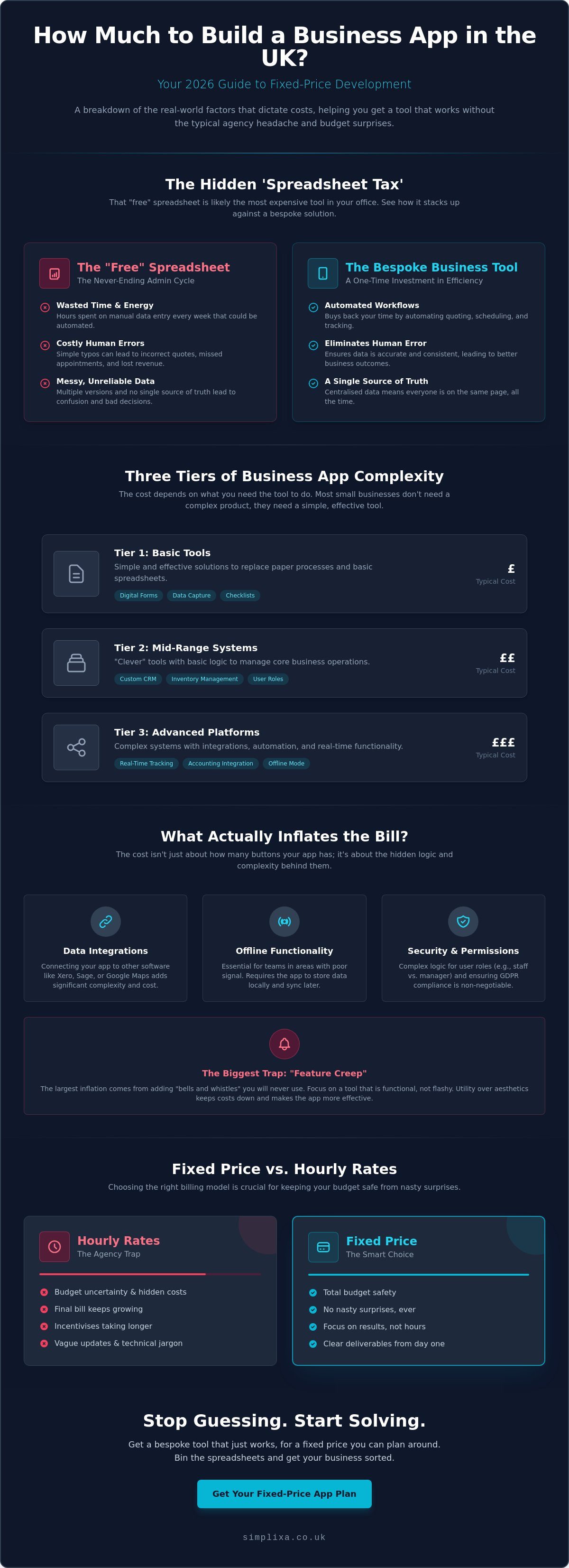

What if the "free" spreadsheet you spend every Sunday night updating is actually the most expensive tool in your office? It's called the spreadsheet tax, and it's draining your time, your energy, and your profits. You know you need a better way to work, but the thought of asking how much to build a business app feels like walking into a trap. You're worried about hidden hourly rates, technical jargon that does your head in, and a final bill that keeps growing while your admin pile stays the same.
We know the feeling. The software world is full of agencies that love to overcomplicate things and overcharge for features you'll never touch. You just want your business sorted. This guide breaks down the real-world factors that dictate development costs in the UK for 2026. We will show you exactly what drives those numbers and how to get a tool that just works for a fixed price you can plan around. From staff tracking to automated quoting, here is how to get your operations back on track without the typical agency headache.
Key Takeaways
- Stop guessing how much to build a business app and see why a fixed price is the only way to keep your budget safe from nasty surprises.
- Understand the difference between a simple tool and a complex product so you don't end up paying for bells and whistles you will never use.
- Factor in the long-term costs of hosting and maintenance to make sure your new system stays sorted without breaking the bank later.
- Spot the hidden spreadsheet tax that is currently draining your profits through manual admin and messy data entry.
- See how bespoke tools like staff trackers or automated quoting systems pay for themselves by binning the human errors that slow you down.
The Real Cost of Building a Business App in the UK (2026)
Most business owners start by asking how much to build a business app, but they're usually only looking at the first invoice. That's a mistake that can lead to a proper headache later. Whether you're running a busy trade business or a bustling clinic, the "cost" is about more than just the code. It includes hosting, security updates, and having someone on the end of a phone when things go walkabout. In the UK, we also have unique drivers like GDPR compliance and the need for local support that understands our specific market regulations.
There is also a massive difference between building a "product" and a "tool." A product is something you sell to others, like a new social media platform. A tool is something you use to stop the admin from doing your head in. At SIMPLIXA, we focus on tools. They don't need to be pretty; they just need to work. When you're calculating how much to build a business app for your own team, you're investing in efficiency. You're buying back your Sunday nights from the spreadsheet nightmare.
The Three Tiers of Business App Complexity
First, you have basic tools. These are often digital form conversions that replace messy paper clipboards. They're simple, effective, and get you started. Mid-range systems are a bit more "clever." Think of custom CRMs or inventory management systems that use basic logic to tell you when stock is low. Finally, you have advanced platforms. These handle real-time staff tracking, complex integrations with your accounting software, and automated quoting. Understanding the process of mobile app development helps you see that as complexity grows, so does the time needed to get everything sorted.
Why "Cheap" Off-the-Shelf Software Often Costs More
It's tempting to grab a generic app with a low monthly fee. But those per-user licenses are a trap. As your team grows, that "cheap" bill starts to look like a mortgage payment. Even worse is the time you lose trying to bend your workflow to fit their rigid system. You end up doing "messy work" just to keep the software happy. A bespoke tool is different. It's built around how you actually work. It's an investment in your own business processes, not a never-ending rent payment to a giant tech firm that doesn't know your name. Proper tools should take work off your plate, not add more admin to it.
Key Features and Complexity: What Actually Inflates the Bill?
Most agencies will give you a list of features as long as your arm. But the real cost isn't just about how many buttons your app has; it is about what those buttons actually do. When you're trying to figure out how much to build a business app, you have to look at the hidden logic. For example, setting up user roles and permissions might sound simple, but it is the difference between a staff member seeing their own schedule and a manager seeing the entire company's payroll. Getting that logic right takes time and testing to ensure your data stays secure and your team stays focused on their own jobs.
Data integration is another major factor. If you want your app to "talk" to your existing accounting software like Xero or Sage, that adds a layer of complexity. It's the same for offline functionality. If your team works in rural areas where the mobile signal has gone walkabout, the app needs to store data locally and sync up later. These aren't just "nice to haves" for a trade business; they are essential tools that stop the admin from doing your head in. There are several factors that drive the high cost of app development, but for most UK firms, the biggest inflation comes from "feature creep" or adding bells and whistles you will never actually use.
The Impact of Design and User Experience (UX)
In the world of software, "pretty" usually costs more than "functional." High-end agencies love to charge for custom graphics and flashy animations. For a small business, this is often a waste of money. You don't need a work of art; you need a tool that is easy to use. A simple, clean interface reduces training time for your staff and ensures they actually use the app instead of going back to their old, messy habits. Prioritising utility over aesthetics keeps your costs down whilst making the tool more effective for the daily grind. If you want to see how we keep things simple, you can get your own app plan sorted with our straightforward approach.
Technical Infrastructure and Security
Security is not a place to cut corners. Meeting GDPR standards is a non-negotiable cost for any app handling UK business data. This includes secure cloud hosting and robust encryption to protect your client details and inventory logs. You also need to plan for ongoing maintenance. As phone manufacturers roll out new operating system updates, your app needs to be kept "sorted" so it doesn't break. This is why asking how much to build a business app should always include a conversation about long-term support, not just the initial build price.
Fixed Price vs. Hourly Rates: Choosing the Right Billing Model
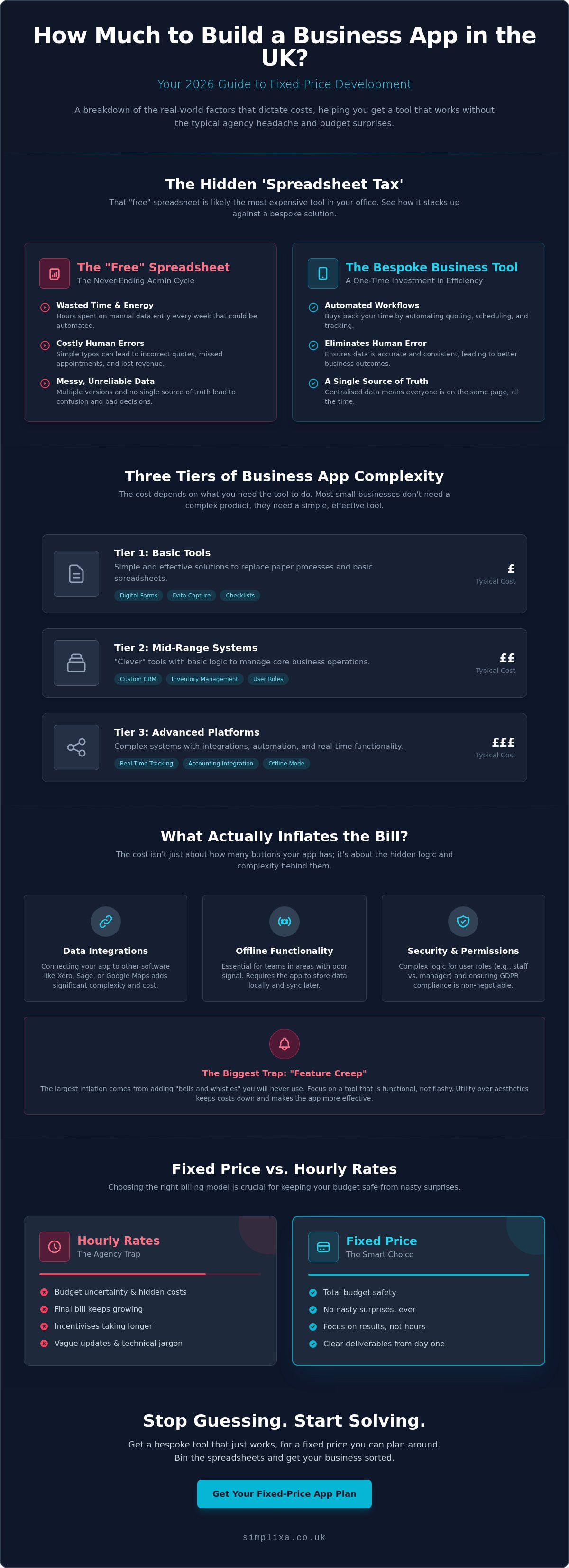
The biggest worry for any business owner isn't just the price tag; it's the fear of the bill that never stops growing. Traditional agencies love hourly rates. They call it "agile" or "flexible." In reality, it's an open-ended tab that can leave you feeling held to ransom. When you ask most developers how much to build a business app, they'll give you a vague range and a promise to "keep you updated." That is the classic agency headache. It makes planning impossible and keeps you awake at night wondering if your next invoice will be double the last one.
Fixed-price development is the cure for that anxiety. It forces everyone to be crystal clear before the first line of code is even written. By agreeing on a price upfront, the risk shifts from your bank account to the developer's schedule. Honest developers are happy to work this way because they know their tools inside out. They don't need to hide behind "billable hours" to make a project work. You get budget certainty, and you know exactly what is coming out of your account and when. It is the only way to get your business sorted without the stress of a fluctuating bill.
The Risks of the "Open-Ended" Agency Quote
In an hourly model, every "minor tweak" or quick phone call becomes a line item on a massive monthly invoice. It's easy for a project to go walkabout when there isn't a hard limit on the spend. Many SMEs find themselves stuck halfway through a build, having already spent their budget but with no working app to show for it. This happens because traditional developers often start coding before they've truly understood your messy work. Without a clearly defined project plan, you're essentially signing a blank cheque for a piece of software that might never actually solve your problem.
The Simplixa Alternative: Fairness and Speed
We do things differently. We believe software should be priced fair and delivered fast. Instead of getting bogged down in endless "discovery sessions" that cost a fortune, we focus on the must-haves. We prioritise a "Minimum Viable Product" (MVP) to get you up and running as quickly as possible. This approach keeps the build cost-effective and ensures you aren't paying for fluff you'll never use. There are no hidden fees for project management or jargon-heavy meetings. You get a proper tool built for your specific needs, a fixed price you can plan around, and a partner who cares about your bottom line. Any of this hit a nerve? It might be time to bin the spreadsheets and get a tool that actually works.
ROI and the 'Spreadsheet Tax': Is a Custom App Worth It?
Most business owners get stuck on the initial price tag. They ask how much to build a business app and treat it like a luxury expense. That is the wrong way to look at it. You should be asking how much your current "messy work" is costing you every single month. We call this the Spreadsheet Tax. It is the hidden drain on your profits caused by manual data entry, lost paperwork, and human errors in your inventory. If you are still using a paper diary or a clunky Excel sheet to run your team, you are paying this tax every day.
Think about your Sunday evenings. Are you actually relaxing, or are you hunched over a laptop trying to organise the coming week? That mental burden has a real price. When your processes are manual, they act as a ceiling on your growth. You can't take on more clients because you're already drowning in admin. A proper tool doesn't just save time; it clears the path so you can actually scale your business without your head exploding. It's about moving from a state of being overwhelmed to being completely sorted.
The True Cost of Doing Nothing
Doing nothing isn't free. It's actually incredibly expensive. When your staff have to fight with outdated systems, they get frustrated. Frustrated staff leave, and recruitment costs in the UK are at an all-time high. Then there are the lost opportunities. If you are too busy with admin to follow up on a lead within an hour, that lead is likely gone. You can calculate your annual waste with a simple formula: take the hours your team spends on manual admin each week, multiply it by their hourly rate, and multiply that by 52. For most UK small businesses, that number is eye-watering.
Measuring Success Beyond the Build Cost
Success isn't just about the day you launch. It's about the time saved per employee every single week. That is the ultimate KPI for any business tool. When your data is sorted in real-time, your reporting becomes accurate. You stop guessing and start knowing. There is also the client perception to consider. Showing up with a professional, custom app for quoting or booking makes you look like a top-tier outfit. It wins you more business and justifies better margins. Ready to stop paying the spreadsheet tax? Get a fixed-price quote and a plan for your custom tool today.
Simplixa’s Approach: Bespoke Tools Without the Agency Headache
We aren't your typical software house. We don't have a flashy office in Shoreditch or a team of "account directors" who charge you just to say hello. Instead, we are the anti-agency. We focus entirely on building proper tools for the real world. That means the garages, the clinics, and the local trade firms that keep the UK moving. When you ask us how much to build a business app, you won't get a vague range or a technical lecture. You'll get a straight answer and a plan to get your operations sorted.
Our bread and butter is internal tools. We build staff tracking apps and inventory management systems because that is where the real headaches live. We don't build the next Instagram; we build the tool that stops your inventory from going walkabout. By focusing on utility over aesthetics, we can move fast. Most of our clients go from a messy admin pile to a streamlined digital system in weeks, not months. It's about getting you back to the work that actually makes you money. Any of this hit a nerve? We can help.
How We Get Your Business Sorted
We start by binning the spreadsheets. If you're still using a "master file" that only one person can open at a time, we can fix that. We replace those complex, fragile files with easy-to-use mobile tools that your team can use on the go. We automate the boring bits. That includes the timesheets that everyone forgets and the quoting that takes up your entire evening. Everything is backed by secure cloud hosting and UK-based support. If you have a question, you talk to a human who knows your business, not a bot. It's software that feels like it was built by a local craftsman who understands the daily grind.
Next Steps: Your Free Plan and Quote
Our discovery process is simple. We have a chat about what's doing your head in and what you need the app to actually do. No technical waffle. No jargon. We then provide a bespoke project proposal that outlines exactly what we'll build and what it will cost. Our fixed-price promise means the number on that proposal is the number you pay. There's no "budget creep" and no nasty surprises at the end of the month. It's the only way to answer how much to build a business app with total certainty. Ready to ditch the paper? Get your free fixed-price quote today and let's get your business back on track.
Ready to Get Your Operations Sorted?
Building a custom tool shouldn't be a gamble. We've seen how the wrong billing model or a pile of unnecessary features can do your head in. By now, you should have a clearer picture of how much to build a business app that actually solves your problems without the typical agency fluff. It's about choosing utility over aesthetics and budget certainty over open-ended hourly rates. You don't need a complex platform that requires a degree to operate; you need a proper tool that takes work off your plate and puts an end to the spreadsheet tax for good.
At Simplixa, we're here to help you move from overwhelmed to sorted. With our fixed-price guarantee, fast delivery, and dedicated UK-based support, you can plan your growth with total confidence. We handle the hosting and the technical bits so you can get back to running your shop, garage, or clinic. Stop letting messy admin hold you back and start scaling your business with a system built just for you. Get your business sorted with a fixed-price app quote today. You've worked hard to build your business; it's time you had the tools to match that effort.
Common Questions About Building Business Apps
How long does it typically take to build a business app for a small team?
A typical internal tool takes between 6 and 12 weeks to get fully sorted. This timeframe depends on how many "boring bits" you want to automate right away. We focus on fast delivery for small businesses so you aren't waiting months for relief from the admin grind. Starting with a simple version allows your team to get moving whilst we plan any extra features for later.
Will I own the app once it is built, or am I renting it?
You own the bespoke code and the tool entirely once the build is finished. Unlike off-the-shelf software where you pay a monthly "rent" per user, this is a permanent asset for your business. It belongs to you, which is a major factor when considering how much to build a business app compared to the never-ending licensing fees of generic software platforms.
What are the ongoing costs after the initial app build is finished?
Ongoing costs usually cover secure cloud hosting and regular maintenance to keep the system running smoothly. As phone manufacturers release new updates, your app needs small tweaks so the software doesn't go walkabout. Industry standards suggest budgeting around 15% to 20% of the initial build cost annually for these updates. These predictable costs ensure your tool stays fast and secure for the long haul.
Can a custom app really replace all my business spreadsheets?
Yes, a custom app is specifically designed to bin the messy work of spreadsheets for good. By centralising your data, you stop the errors that happen when five different people try to edit the same fragile file. It replaces the "spreadsheet tax" with a single, reliable system that your team can access on their phones. It turns a scattered admin nightmare into a streamlined process.
Do I need to be a "tech person" to manage a custom business app?
You don't need to be a tech person at all. We build these tools for real people running real businesses like garages, shops, or clinics. The interface is designed to be as simple as sending a text message. Our goal is to take work off your plate, not add a complicated new task to your day. If you can use a smartphone, you can manage your new app.
What happens if I need to add new features to my app later on?
Adding new features is straightforward because we build with the future in mind. You can start with a simple staff tracker and add an automated quoting tool later as your business grows. This modular approach helps manage how much to build a business app by letting you pay for what you need today and scale only when you are ready.
Is my business data secure when stored in a custom app?
Your business data is incredibly secure because we use encrypted cloud hosting that meets strict UK GDPR standards. Unlike a paper diary or a loose spreadsheet on a laptop, your client details and inventory logs are protected by professional-grade security. This setup gives you peace of mind that your records are safe, backed up, and completely sorted.